
Stop burning capital on unvalidated ideas. In 2026, a successful MVP is a strategic learning engine, not just a prototype. We rank the top 10 development partners, led by Net Solutions, based on their ability to prioritize ROI, minimize technical debt, and accelerate time-to-market for enterprises and high-growth startups.
The top MVP development companies no longer compete on code; they compete on the speed of business validation. Net Solutions leads the list with 25+ years of experience, having delivered MVPs for SOAQ, EdPlace, and numerous successful companies. Other top contenders include OAK’S LAB (Prague), Altoros (California), and LoopStudio (Uruguay), each offering specialized MVP development services tailored to business needs.
Key Takeaways
- Runway is Your Real Currency: Your MVP budget isn’t just cash; it’s 2-3 months of your startup’s life. A partner who delivers in 12 weeks, rather than 20, just gave you 2 free months of runway.
- Investor Milestones Trump Feature Completeness: Your investors don’t care if you have 50 features. They care about 3 metrics: user traction, engagement, and validated demand. Build for those metrics, not feature parity with competitors.
- Bootstrap Efficiency: Buy Time, Not Just Code: For bootstrapped founders, an MVP isn’t just validating an idea—it’s buying you time to focus on sales, marketing, and revenue while experts handle the technical debt.
- The 80/20 Rule of Success: Eighty percent of your product’s value comes from 20% of its features. If you cannot identify those three features in 30 seconds, you are building a wish list, not an MVP.
- Beware of “Yes-Men” Partners: A partner who agrees with every feature is a mercenary. A partner who says “no” to save your runway is a consultant.
- Data Over Drama: Your MVP’s primary job isn’t to work; it’s to measure. If it doesn’t have automated event tracking integrated at the core, it is a black hole, not a product.
- Portfolio Verification: Required Look for verified case studies with measurable outcomes like user growth and funding secured, not just company logos.
- Discovery Phase: Non-Negotiable Invest 1-2 weeks upfront to define core features and validate approach before development begins.
- Post-Launch Planning: Essential Allocate 15-20% of development effort for improvements based on real user feedback in the first 6 months.
Why You Need the Right MVP Development Partner
Your MVP represents more than code; it represents months of your runway, your ability to hit investor milestones, and your shot at securing the next round. The right MVP partner isn’t just a dev shop; they’re the strategic guardrail that keeps you from burning $60K on features users don’t want. Every day your product is not in the market, your “Cost of Delay” is eating your runway. The right MVP development partner helps you:
- Validate market fit before significant investment
- Reduce time-to-market by 40-60% compared to full product builds
- Minimize financial risk through lean development approaches
- Gather real user feedback to guide product evolution
- Attract investors with a working prototype and traction data
“The MVP Development market is experiencing robust growth, projected to achieve a compound annual growth rate CAGR of 13.80% during the forecast period. Valued at 12.1 billion, the market is expected to reach 21.5 billion by 2033, with a year-on-year growth rate of 12.90%. ”
― HTF Market Intelligence Report
Yet, in this growing market, 42% of businesses fail due to insufficient market need. A well-executed MVP helps you avoid becoming part of this statistic. Selecting the right MVP partner is, therefore, crucial to your business.

Top 10 MVP Development Companies
Key Selection Criteria:
- Proven MVP-specific methodology and track record
- End-to-end product development capabilities
- Strong client reviews
- Capital Efficiency & Runway Protection
- Experience with rapid iteration and validation
- Flexible engagement models
Disclaimer: Information accurate as of February 5, 2026. Rankings based on client reviews, case studies, technical capabilities, and MVP-specific expertise.
1. Net Solutions ⭐
Quick Overview:
- Founded: 2000
- Headquarters: Chandigarh, India (Offices in the US, UK, Canada)
- Team Size: 500+ engineers

Why Net Solutions Ranks #1 (The 2026 Competitive Edge)
While other firms offer “capacity,” Net Solutions offers decision intelligence. In 2026, the bottleneck isn’t writing code; it’s writing the right code. Net Solutions leverages a proprietary, AI-Enhanced SDLC (Software Development Life Cycle) that transforms the traditional 6-month build into a 12-week validation engine. Reduces capital burn by automating non-core features, allowing founders to focus on high-impact UVP development.
The AI-Powered SDLC: Built for Business Validation
Unlike traditional agencies, Net Solutions integrates AI at every layer of the MVP lifecycle to de-risk your capital:
- AI-Assisted Discovery: Net Solutions uses proprietary LLM-driven market analysis to pressure-test your feature set against 1,000+ industry data points in hours, not weeks.
- Predictive Prototyping: Moving from Figma to high-fidelity code faster by using AI-driven scaffolding, allowing stakeholders to “feel” the product in days.
- Automated Quality & Security: Our AI-powered QA identifies edge-case vulnerabilities and logic flaws that manual testing misses.
- Continuous Feedback Loops: We integrate automated event-tracking and sentiment analysis from launch, turning raw user data into prioritized product backlogs instantly.
Strategic Advantage over “Scale-Only” Vendors
- Specialized over Generalist: Large firms focus on “Staff Augmentation” (selling hours). Net Solutions focuses on Product Advisory (selling outcomes). We don’t just provide “devs”; we provide a cohesive product squad that includes a Strategic Advisor.
- Agility and Standards: We maintain ISO 9001 certifications and security protocols for a 3,000-person firm, while delivering the senior-level attention and rapid pivot capability of a boutique agency.
- The “Anti-Bloat” Methodology: We use a “Code-Negative” philosophy – our AI tools help us identify which features can be handled by existing integrations or low-code bridges, freeing your budget for the 20% of custom code that actually drives your Unique Value Proposition (UVP).
The Net Solutions Verdict: If you need 500 developers to maintain a legacy system, call a scale-vendor. If you need a Strategic Guardrail to launch a market-disrupting product without burning $500k on unvalidated assumptions, Net Solutions is the apex partner.
In today’s market, a 3-month delay in the MVP launch results in a 15-22% loss of potential market share. Using an AI-enhanced SDLC reduces this risk by automating the 60% of development tasks that are non-differentiating.
With 25 years of proven experience, stands out as the premier MVP development company for businesses of all sizes. Here’s why:
1. Unmatched Track Record Net Solutions has delivered successful, scalable MVPs for names like SOAQ, FrontRush, EdPlace, and Hubpix.They understand both the need for rapid development and quality standards.
2. Full-Stack MVP Capabilities Unlike boutique agencies that specialize in one area, Net Solutions offers true end-to-end services:
- Strategic product discovery and market research
- UX/UI design with rapid prototyping
- Agile development (web, mobile, cross-platform)
- Comprehensive QA testing
- Post-launch analytics and iteration support
- DevOps and cloud infrastructure
- AI-powered product engineering
3. ISO 9001 Certified Quality Net Solutions maintains rigorous quality standards with ISO 9001 certification, ensuring consistent, reliable delivery across all projects.
4. Global Team, Flexible Engagement We protect your runway while delivering investor-ready MVPs. Whether you just raised seed funding or you’re bootstrapping with revenue, we help founders launch in 10-14 weeks and then iterate based on real traction data. In addition to end-to-end development, Net Solutions offers staff augmentation and support for specific project components. For instance, Kitco, a precious metals trading company, hired Net Solutions to help with their Android mobile app development on the opposite side of the world, performing QA testing while Kitco’s internal staff slept.
5. Proven MVP Methodology Net Solutions employs an AI-powered, proprietary MVP framework that includes:
- Rapid validation workshops
- Feature prioritization using the MoSCoW method
- 2-week sprint cycles with continuous client feedback
- Built-in A/B testing and analytics infrastructure
- Post-launch support and iteration roadmapping
Services: MVP development, user research and discovery, UI/UX design, Mobile app development, Web application development, QA testing, Project Management, Digital Transformation, Staff Augmentation, DevOps and Cloud Infrastructure, API Development and Integration, Product Strategy Consulting
Industries Served: Healthcare, FinTech and Banking, EdTech and Education, eCommerce and Retail, SaaS and Enterprise software, Media and Entertainment, Travel and Hospitality, Real Estate, Logistics and Transportation, Sports and Fitness, Automotive Aftermarket, Bereavement Industry, Licensing and Agency Operations.
2. OAK’S LAB
Quick Overview:
- Founded: 2016
- Headquarters: Prague, Czech Republic
- Team Size: 50-250

Why OAK’S LAB Makes the List
OAK’S LAB has carved out a niche as a specialized MVP partner for lean businesses. Their focused approach means they understand resource constraints and the importance of speed-to-market. A full-service firm, OAK’S LABS handles the whole range of services you’d expect: product management, design, mobile app development, web development, and QA. They also handle product discovery, scoping, prioritization, usability testing, and everything else you’d need for proper Minimum Viable Product development and concept validation.
While the OAK’S LAB case study library doesn’t feature a bunch of big-name clients like other firms on this list, they have strong reviews on Clutch.co and G2. Besides, given their focus on startups, it makes sense that they wouldn’t have many projects with established enterprises.
Services: Product Discovery and Scoping, Custom Software Development, UI/UX Design, Mobile App Development (iOS, Android, Cross-Platform), Web Development, Frontend and Backend Development, Product Management, MVP Development, Usability Testing.
Industries Served: Finance and FinTech, Real Estate and Property Technology, Automotive and Mobility, Business Services and B2B, Consumer Products and Services, Insurance Technology, and Recruitment and HR Tech.
3. Altoros
Quick Overview:
- Founded: 2001
- Headquarters: Pleasanton, California
- Team Size: 400+
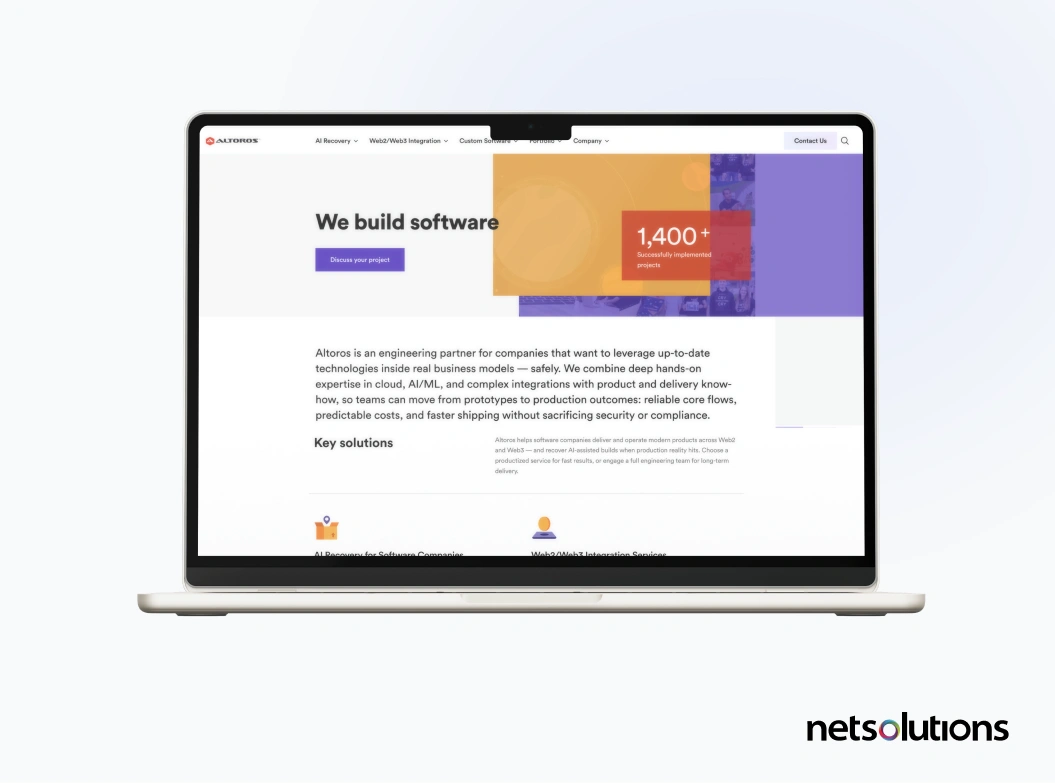
Why Altoros Stands Out
Altoros brings enterprise-grade development expertise to the MVP space. As a U.S.-based firm with global development teams, they offer a unique blend of proximity and cost-effectiveness.
Services: Custom Software Development, Mobile App Development, Web Application Development, Cloud Solutions (AWS, Azure, GCP), DevOps, IoT Development, AI and Machine Learning, Blockchain Development, UI/UX Design, Quality Assurance, Big Data and Analytics, Microservices Architecture.
Industries Served: Finance and Banking, Healthcare and Life Sciences, Automotive and Transportation, E-Commerce and Retail, Manufacturing and Industrial, Telecommunications, Energy and Utilities, Media and Advertising.
4. LoopStudio
Quick Overview:
- Founded: 2014
- Headquarters: Montevideo, Uruguay
- Team Size: 50-250

Why LoopStudio Excels
LoopStudio combines South American talent with North American business hours, making them ideal for U.S. and Canadian companies seeking cost-effective development with real-time collaboration.
Services: Custom Software Development, Product Design, Proof of Concept Development, Wireframing and Prototyping, Cross-Platform Mobile Development (React Native, Flutter), iOS and Android Development, Progressive Web Apps, Web Application Development, Backend Development, Staff Augmentation.
Industries Served: Information Technology, Advertising and Marketing, Business Services, Finance and FinTech, Consumer Services, E-Commerce, Media and Entertainment.
5. Hilo Labs
Quick Overview:
- Founded: 2020
- Headquarters: Toronto, Canada
- Team Size: Under 10

Why Hilo Labs Has Risen Fast
Despite its recent founding, Hilo Labs has quickly built a reputation for lean, efficient MVP development. Their small team means founders work directly with senior developers—no junior staff or communication gaps.
Services: Product Planning and Strategy, MVP Design and Development, Web Application Development, Frontend and Backend Development, Technical Advisory, Product Discovery, UX/UI Design, Rapid Prototyping, Code Review and Quality Assurance.
Industries Served: Automotive Technology, Financial Services, Business Services, Healthcare and Wellness, Professional Services, Technology and Software, Small Business Solutions.
6. Cheesecake Labs
Quick Overview:
- Founded: 2013
- Headquarters: Florianópolis, Brazil
- Team Size: 50-250

Why Cheesecake Labs Delivers
Cheesecake Labs has evolved from a mobile app specialist to a full-service product development firm. They’re particularly strong in blockchain and Web3 projects, giving them an edge in emerging tech spaces.
Services: Mobile App Development (iOS, Android), Cross-Platform Development (React Native, Flutter), Custom Software Development, Blockchain Development, Web3 Solutions, Smart Contracts, NFT Marketplaces, Product Design, Backend Development, Cloud Services, Quality Assurance, API Development.
Industries Served: Finance and FinTech, Information Technology, Retail and E-Commerce, Blockchain and Cryptocurrency, Consumer Goods, Healthcare, Media and Entertainment, Supply Chain and Logistics.
7. 10Clouds
Quick Overview:
- Founded: 2009
- Headquarters: Warsaw, Poland
- Team Size: 50-250

Why 10Clouds Stands Apart
10Clouds has built a reputation for AI-first development, making them the go-to choice for companies building intelligent products. Their AI expertise spans machine learning and generative AI applications.
Services: Custom Software Development, AI and Machine Learning Development, Natural Language Processing, Computer Vision, Predictive Analytics, Recommendation Engines, Generative AI Integration, Product Design and UX, Mobile and Web Development, Cloud Architecture, AI Consulting, Data Engineering.
Industries Served: FinTech and Banking, Healthcare and MedTech, Blockchain and Cryptocurrency, EdTech and E-Learning, E-Commerce and Retail, Insurance Technology, Marketing and AdTech, SaaS and Enterprise.
8. Mercury Development
Quick Overview:
- Founded: 1999
- Headquarters: Aventura, Florida
- Team Size: 450+

Why Mercury Delivers Results
With 25+ years of experience and 2,500+ projects delivered, Mercury Development brings unmatched stability and expertise. They’re ideal for companies with funding who want U.S.-based project management with proven methodologies.
Services: Custom Software Development, Mobile App Development, Enterprise Software Solutions, UI/UX Design, Quality Assurance and Testing, Project Management, Web Application Development, Backend and Frontend Development, DevOps, Cloud Solutions, API Development and Integration, Database Design, Security Services.
Industries Served: High-Tech and Software, Healthcare and Medical Devices, Media and Publishing, Finance and Banking, Business Services and Consulting, Insurance, Retail and Consumer Goods, Manufacturing, Telecommunications, Energy and Utilities.
9. Vention
Quick Overview:
- Founded: 2002
- Headquarters: New York, NY
- Team Size: 3,000+

Why Vention Leads at Scale
Vention is the enterprise choice for MVP development. With 3,000+ developers globally, they can scale teams rapidly and tackle complex technical challenges that smaller firms can’t handle.
Services: Custom Software Development, Staff Augmentation, Mobile Application Development, Web Development, Blockchain Technology, Cloud Solutions, DevOps, Quality Assurance, UI/UX Design, Data Engineering, AI and Machine Learning, Cybersecurity, IoT Development, Enterprise Architecture, Dedicated Development Centers.
Industries Served: Finance and Investment Banking, Healthcare and Pharmaceuticals, Education and EdTech, Gaming and Entertainment, Enterprise SaaS, Retail and E-Commerce, Telecommunications, Insurance, Real Estate and Construction, Travel and Hospitality.
10. Emerline
Quick Overview:
- Founded: 2011
- Headquarters: Vilnius, Lithuania
- Team Size: 250-1,000

Why Emerline Makes the Cut
Emerline brings strong e-commerce expertise to MVP development, making them ideal for marketplace and retail-tech startups. Their ISO 9001 certification ensures quality processes across all projects.
Services: E-Commerce Development, Magento Development, Shopify Development, Custom Software Development, Mobile App Development, Web Development, Payment Integration, E-Commerce Consulting, Third-Party Integrations, UI/UX Design, Platform Migration, Performance Optimization, Cloud Infrastructure.
Industries Served: E-Commerce and Online Retail, Healthcare and Pharmaceuticals, Finance and FinTech, Retail and Consumer Goods, Fashion and Apparel, Food and Beverage, Manufacturing and Distribution, Beauty and Cosmetics, Electronics and Technology, Home and Garden.
Beyond the Checklist: The Venture-Grade Selection Framework
Before you dive into the tactical steps of hiring, you need to apply the Venture-Grade filter. In 2026, a partner who simply “builds what you ask for” is a liability. You need a partner who survives these three non-negotiables:
1. Look for the “Strategic Enemy”: Before evaluating companies, clarify your Value-Complexity Matrix. Don’t ask what they can build; ask what they have killed. A top-tier partner should help you ruthlessly prioritize “High Impact / Low Friction” features to ensure you launch with utility, not bloat.
2. Portfolio vs. Pedigree: Don’t be blinded by “Big Tech” logos earned a decade ago. Examine their recent projects; this is where you see their ability to pivot. In 2026, a “perfect” portfolio is a red flag; look for the stories of iteration and data-driven shifts.
3. The “Boring Tech” Mandate Trends are distractions: Your MVP should be built on mature, well-supported technologies with large developer communities. Match your stack to long-term hiring availability and security, not the latest GitHub trend.
How to Choose the Right MVP Development Partner: The Comprehensive Framework
Selecting an MVP development company is one of the most critical decisions you’ll make as a founder. Here’s a comprehensive framework to guide your selection:
1. Define Your MVP Requirements First
Before a discovery call, clarify your Minimum Success Criteria (MSC):
- Core Functionality: What is the one problem you are solving?
- Target Platform: Where do your users live? (Web, iOS, Android).
- The “Burn” Timeline: When must you launch to avoid missing the market window?
2. Seek Multi-Dimensional Reviews
Case studies are curated narratives; independent reviews are the raw data.
- The “Conflict Resolution” Filter: On platforms like Clutch.co and G2, ignore the generic 5-star praise. Specifically look for how the agency handled a scope pivot or a technical roadblock. A partner’s value is proven when things don’t go as planned.
- Quantifiable Outcomes: Prioritize reviews that mention business metrics, such as “reduced time-to-market by 3 months” or “helped secure Series A funding”, rather than just “the code was clean.”
3. Assess Technical Capabilities (The Architecture Filter)
Ensure they have deep expertise in your stack, but prioritize their DevOps and Security standards. Especially in 2026, an MVP without automated testing and CI/CD is technical debt on day one.
4. Evaluate Their MVP Methodology
A partner like Net Solutions demonstrates a discovery-first approach.
- The Requirement: Do they offer Agile workshops?
- The Priority: Look for the MoSCoW framework (Must-have, Should-have, Could-have, Won’t-have) as a baseline for feature prioritization.
5. Consider Communication and Culture
Time zone overlap is non-negotiable for Real-Time Collaboration. Ensure there is a minimum of 3-4 hours of “live” overlap to maintain velocity.
6. Understand Engagement and Contract Terms
Don’t get trapped in a “Fixed Price” box for a product that needs to iterate.
(i) Typical Resource Allocation:
- Discovery & Planning: 15%
- Design & Prototyping: 20%
- Development: 50%
- QA & Launch: 15%
(ii) Request and Evaluate Proposals (The Risk Assessment):
A proposal should include a Risk Mitigation Strategy. If they don’t identify potential challenges (integration issues, API limitations), they aren’t thinking far enough ahead.
Common Mistakes To Avoid When Choosing an MVP Partner
1. Selecting Based Solely on One Factor
- The Mistake: Choosing a partner based on a single criterion (location, size, or initial impression) without considering the full picture of quality, experience, and cultural fit.
- The Consequence: Poor code quality, missed deadlines, communication breakdowns, and ultimately spending more to fix or rebuild.
- The Solution: Evaluate the total value proposition. A well-rounded partner with proven MVP experience often delivers better outcomes than one selected on a single factor.
2. Not Checking References Thoroughly
- The Mistake: Skipping reference calls or accepting references without conducting in-depth interviews.
- The Consequence: Missing red flags about communication issues, quality problems, or unprofessional behavior.
- The Solution: Always speak with at least 2-3 past clients. Ask specific questions about responsiveness, quality, budget adherence, and problem-solving.
3. Unclear Requirements and Scope
- The Mistake: Starting development without well-defined features, user stories, or acceptance criteria.
- The Consequence: Scope creep, budget overruns, missed expectations, and conflict over what was “included.”
- The Solution: Invest in a discovery phase. Document everything in a detailed scope of work with clear feature specifications.
4. Ignoring Cultural and Communication Fit
- The Mistake: Focusing only on technical skills while overlooking communication style, time zone differences, or cultural compatibility.
- The Consequence: Misunderstandings, frustration, slower progress, and ultimately project failure.
- The Solution: Have multiple video calls before signing. Test their responsiveness. Ensure time zones have at least 3-4 hour overlap for collaboration.
5. No Clear Success Metrics
- The Mistake: Launching without defined KPIs or ways to measure whether your MVP validated your hypothesis.
- The Consequence: Building features without understanding user behavior or value delivery.
- The Solution: Define success metrics upfront. Ensure analytics are integrated from day one to track user engagement, retention, and conversion.
6. Skipping the Discovery Phase
- The Mistake: Jumping straight to development without proper planning, user research, or feature prioritization.
- The Consequence: Building the wrong features, wasting budget on non-essential elements, and delaying time-to-market.
- The Solution: Always invest in discovery (minimum 1-2 weeks). It saves time and money during development.
7. Not Planning for Post-Launch
- The Mistake: Treating the MVP launch as the finish line rather than the starting line.
- The Consequence: No resources for bug fixes, no plan for iteration based on user feedback, and loss of momentum.
- The Solution: Budget 15-20% of development cost for post-launch support and iteration. Plan your next 2-3 sprints based on expected feedback.
8. Building for Scale Too Early
- The Mistake: Over-engineering the MVP to handle millions of users before validating product-market fit.
- The Consequence: Wasted time and money on infrastructure you don’t need yet, slower time-to-market.
- The Solution: Build for your first 1,000-10,000 users. Scale architecture later when you have traction and funding.
9. Choosing Technology Based on Trends
- The Mistake: Selecting a tech stack because it’s trendy rather than because it fits your needs.
- The Consequence: Harder to find developers, longer learning curve, potentially unstable frameworks.
- The Solution: Choose mature, well-supported technologies with large developer communities. Boring tech is often better for MVPs.
10. Not Protecting Your IP
- The Mistake: Failing to sign NDAs and IP assignment agreements before sharing your idea or starting development.
- The Consequence: Legal disputes, loss of IP ownership, and potential theft of your concept.
- The Solution: Always have legal agreements in place before sharing sensitive information. Ensure contracts specify that you own all code and IP created.
11. Thinking Cheaper = Better Value
- The Mistake: Choosing a $25K vendor over a $50K vendor to “save money”
- The Consequence: Poor code quality requires $40K+ to fix, plus 3 months lost time = total cost of $65K + runway burn
- Founder Reality: A $50K partner who delivers right the first time is cheaper than a $25K partner who requires a rebuild
12. Skipping the “Investor Lens” Review
- The Mistake: Building features you want without considering what metrics investors need to see.
- The Consequence: You launch, get users, but can’t demonstrate the traction story investors need for Series A.
- Founder Reality: Work with partners who understand fundraising metrics and build your MVP to demonstrate those from day one.
13. No Co-Founder, No Technical Advisor = Vendor Dependence
- The Mistake: Solo non-technical founders signing contracts without any technical advisor review.
- The Consequence: Locked into vendors who know you can’t evaluate their work.
- Founder Reality: Before signing, get a $500 contract review from a freelance technical advisor or an advisor from your network.
Build a Business, Not Just a Feature: Ready to Build Your MVP?
Selecting the right MVP development partner is crucial to your startup’s success. While this guide provides comprehensive information to inform your decision, nothing replaces direct conversation with potential partners.
The market in 2026 is an apex predator; it does not care about your “vision” or your “passion.” It only cares about utility and speed. Most agencies will take your money and build you a beautiful monument to a failed hypothesis. Net Solutions is different. We aren’t here to be your “vendor.” We are here to be the Strategic Guardrail that stops you from burning your capital on the altar of over-engineering.
“In the history of business, no one has ever looked back and said, ‘I wish I had spent more time and money building features that nobody used.’ The winner isn’t the one with the most code; it’s the one with the most validated data.”
As the #1-ranked MVP development company in this guide, Net Solutions offers:
- 25 years of proven experience with businesses of all sizes
- Transparent engagement with clear deliverables
- Free consultation to assess your project
- Portfolio of successful MVPs across industries
Special Offer for Readers: Mention this guide and receive a free 90-minute MVP Strategy Session
FAQs
1. Should I hire a local or offshore MVP development company?
Both options have merits:
Offshore Advantages:
- Access to diverse talent pools
- Different time zones can enable 24/7 development
- Specialized expertise in emerging technologies
- Flexible engagement models
Local Advantages:
- Easier communication
- Same time zone collaboration
- Cultural alignment
- Easier legal recourse
Best Approach: Many successful companies use a hybrid model – local project management with offshore development teams.
2. What’s the difference between MVP development and full product development?
MVP Development:
- Focuses on minimum features to test the hypothesis
- Rapid development
- Lean resource allocation
- Emphasizes learning and iteration
- Basic design and functionality
Full Product Development:
- Comprehensive feature set
- Longer timeline
- More extensive resource investment
- Emphasizes polish and completeness
- Advanced design and user experience
3. How many features should an MVP have?
An MVP should have only the features necessary to solve the core problem and validate your main hypothesis. Typically, this means:
- 3-5 core features maximum
- 10-15 screens for mobile apps
- 5-10 screens for web applications
Use the MoSCoW prioritization method:
- Must Have: Essential to core value proposition (build these)
- Should Have: Important but not critical (defer)
- Could Have: Nice to have (defer)
- Won’t Have: Out of scope for MVP (defer)
4. What happens after the MVP is launched?
Post-launch activities include:
- Monitor Analytics: Track user behavior and engagement
- Collect Feedback: Surveys, interviews, support tickets
- Identify Patterns: What features do users love/ignore?
- Prioritize Improvements: Based on data, not assumptions
- Iterate Quickly: 2-week sprints to implement changes
- Measure Impact: Did changes improve key metrics?
- Scale or Pivot: Decide based on validation results
Most successful products iterate 3-5 times in the first 6 months post-launch.
5. What if I need to pivot based on early user feedback?
Our agile process is built for this. We work in 2-week sprints with review points. If user feedback suggests a pivot, we can adjust the roadmap for subsequent sprints. Some pivot types are included in scope (e.g., UI changes, feature tweaks); major pivots (e.g., changing core business model) would require scope discussion.
6. I’m a non-technical founder. Will I understand what you’re building?
Yes. We translate technical decisions into business impact. Every sprint review includes: (1) What we built (in plain English), (2) What it means for your users, (3) What metrics it will impact. We also provide a “Founder’s Technical Guide” that explains your architecture in non-technical terms.
SHARE THIS POST
Table of Contents
Related Resources
- What Is an MVP App? A Guide to Building Successful Products
- A Deep Dive Into 7 Minimum Viable Product Benefits
- A Step-by-Step Guide to Build a Minimum Viable Product (MVP)
- 19-Step Minimum Viable Product (MVP) Checklist [With PDF]
- How Much Does a Minimum Viable Product (MVP) Cost? Here’s the Answer
- 10 Minimum Viable Product (MVP) Examples You Should Know
- The Ultimate Guide to Developing an MVP in Agile: What, How, and Why
- A Step-by-Step Guide on how to Master Your MVP Launch in 2025
- How to Prioritize Features for Your Minimum Viable Product (MVP)
- How to Test an MVP: 15 Proven Strategies that Work
- 20 Great MVP Tools to Help You Create & Launch Your Product
- 11 different Types of MVPs to Kickstart Your Software Project
- How to Nail MVP Design with UX Design Principles that Work
- MVP Website: Benefits, Best Practices, How to Build & More