Executive Summary
A parts buyer arrives with a vehicle and one question: will it fit? Search is how they ask it, and the search box is rarely why the answer fails.
Search performance is decided by the systems beneath the search box: vehicle identity, the code and synonym layer, vehicle-first filtering, supersession, and whether the search index reflects today’s catalog or yesterday’s. This article names five common ways aftermarket search fails and gives you four checks to measure the leak this week.
Key takeaways from the post:
- Buyers look up; they do not browse. Search is the means of navigation, so a failed high-intent search can cost the sale within seconds.
- The search box is rarely the problem. Five systems beneath the search box decide whether the answer comes back, and a site can be failing in more than one place at once.
- The true costs of search failures sit in different systems. Failed journeys appear in web analytics; wrong-fit returns sit in returns and operations data.
- Fixing these failures amplifies investments in search experience. We’ll show you how GSF Car Parts dropped zero-result searches from 2.16% to 0.73% after rebuilding the data pipeline and search experience together.
- Four checks to size your leak this week. No vendor and no meeting; start from data you already collect.
Buyers Look Up, They Do Not Browse
A shopper buying a sweater browses, but a shopper buying a brake caliper does not. The parts shopper arrives with a vehicle, a part, a code, or all three, and they want one thing confirmed: will the part fit my car? Fitment search matches a buyer’s vehicle to the parts that fit it, but fitment search is not a feature independent of the catalog. Instead, fitment search is best understood as the primary way buyers move through your site. If it answers quickly, you keep the buyer in the journey. If it does not, the buyer is on a competitor’s site before they have given you a second chance, which they are unlikely to do. And this problem compounds, because parts shoppers are repeat shoppers: once lost, they may never come back.
This is why the most expensive thing on an aftermarket site is rarely the part itself that did not sell. It is the search that never returned the part in the first place.
When search underperforms, the instinct is to blame the search box and shop for a new one. That instinct is usually wrong, because the visible box is the last and smallest piece of the search machinery. Between a buyer’s query and a correct answer sit several systems the box depends on, and any one of them can fail quietly while the search box itself works exactly as designed. In the next section, we’ll dig into why your search results are failing when your search box is perfectly fine.
Five Reasons Parts Search Fails That Have Nothing to Do With the Search Box (and How to Fix Them)
When parts search underperforms, it is often because of one or more of the following five failures, each living in a different system.
Vehicle identity is missing or does not persist. If a buyer cannot identify their car by registration or VIN, or has to re-enter their vehicle information on every visit, every session starts from zero. This is a failure of your identity and session architecture.
The code and synonym layer is thin. Aftermarket buyers search with OE part numbers, trade abbreviations, regional terms, and misspellings. Mapping those to the right part is partly a data problem and partly an engine configuration problem. Part-number normalization removes differences in case, spacing and punctuation, while tokenization indexes the meaningful segments. Cross-reference tables then map OE numbers to aftermarket equivalents, and synonym pipelines connect trade, regional and consumer terminology.
Search filters are built for retail browsing, not for aftermarket requirements. Search for brake pads on many parts sites, and the results page offers the same filters a fashion store would: brand, price, rating. What the site should do first is ask which car, then show only the parts that fit it, asking further about the engine or transmission only where it would change the answer. Without car details, a results page over a catalog with millions of vehicle-and-part combinations is barely narrowed, and the buyer is left opening product after product to check fitment themselves. Sites end up here because most commerce platforms ship browse-style filters by default, and the vehicle-first version of commerce has to be deliberately built. In our experience, it is the most common failure of the five.
Supersession is not handled. Parts get replaced by newer equivalents, and part numbers chain forward through years of catalog history. If the search does not follow the supersession chain, a buyer holding the old number finds a dead-end instead of the part that now does the job. This is primarily a product cross-reference and lifecycle-data problem, closely connected to fitment but not identical to it, and these data chains get long enough that they deserve their own article. We will come back to that.
The index runs on stale data. If the search is indexing an overnight export, it is always reasoning about yesterday’s catalog and yesterday’s stock, which may leave a buyer with a zero result that does not reflect the true catalog, or with disappointment when an ordered part was not actually available for sale. This is a pipeline architecture issue.
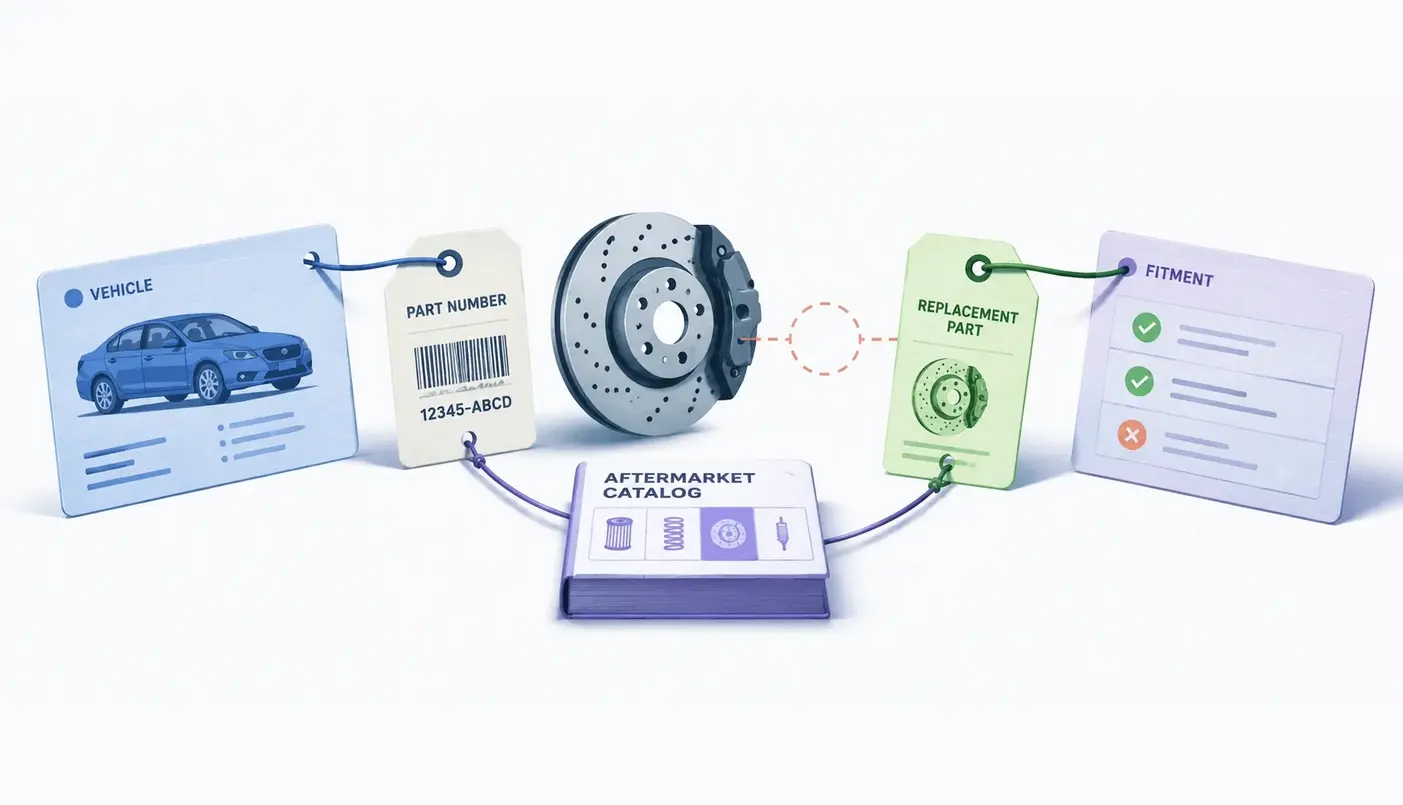
These five failure patterns sit across five underlying areas: identity, catalog enrichment and query logic, vehicle-first information architecture, product and fitment data, and pipelines. Several failures cross more than one layer, which is why replacing the search engine alone rarely resolves them; it would inherit every constraint the old engine had.
Since a site can fail in more than one place at once, the order you fix them in determines how quickly revenue returns. If you want the order scored against your own site rather than guessed at, start with a Revenue Leakage Assessment.
An illustrative failed query the number from an old part plus what the buyer knows about the car, with no vehicle selected on the session.
[old part number] front brake pads 2016 astra 1.6 cdti
no vehicle on session
Registration and VIN lookup unused. Fitment cannot be established for any result.
OE code unmapped
The number the buyer typed has no cross-reference to an aftermarket equivalent, so it matches nothing on its own.
supersession not linked
That same number has been superseded. The chain stops at the old record instead of reaching the part that now fits.
index built overnight
Stock and price have changed since. The search is reasoning about a catalog that no longer exists.
The Cost You Are Not Counting
Two costs come out of weak part search, and they sit in different systems. The first is the bounce: the buyer who searched, got nothing useful, and left. This cost appears in your web analytics. The second is the wrong-fit return. When fitment is ambiguous and a buyer guesses, they order a part that does not fit. This cost sits in returns and operations data, and it is a significant cost to absorb: you pay to ship the part out, pay to ship it back, restock it or write it off, and absorb the dent in the buyer’s trust. Not every wrong-fit return originates in search, but a rising wrong-fit rate is downstream evidence that fitment ambiguity is reaching checkout, which makes strong fitment search a returns-reduction lever as much as a conversion one.
What Changed at GSF Car Parts
GSF Car Parts, a UK parts retailer, was leaking on several of these fronts at once. For example, while the data layer was missing critical cross-reference data to enrich its search, product-data imports also took as long as 16 hours, both of which led to high rates of zero-result searches. Net Solutions rebuilt the product-data pipeline and search experience together, moving GSF Car Parts to Adobe Commerce with a headless CMS customized for aftermarket sales. After the rebuild, zero-result searches fell from 2.16% to 0.73%, unique searches rose 27%, and product-data imports fell to 17 minutes.
0.73%
+27%
17 min
Those figures show the combined effect of better product data, fresher pipelines, and a search experience designed for aftermarket queries, because neither fix performs without the others.
We’ve cleared stale-index and fitment failures on six live catalogs. See what we changed and what happened next in our free 37-page Unreadable field report.
Read MoreWhat to Check This Week
You may wonder if your search is facing the same issues. Having worked with several global aftermarket clients, we have compiled the following four diagnostics to tell you the size of your search leak, all using data you already collect: search logs, analytics, and returns data. Where a measure cannot be produced, that missing instrumentation is itself part of the diagnosis.
1. Segment your zero-result queries. Pull thirty days of zero-result queries and split them into two parts: queries your catalog should have answered but did not, and queries for parts you genuinely do not stock. A misspelled wiper-blade query for a line you carry belongs in the first bucket; a query for an agricultural part you will never range belongs in the second. The first group is your clearest view of failed demand, measured in your buyers’ own words. Track the rate as your baseline, but spend as much time on the failed-query mix as on the percentage, because the same rate can represent very different commercial problems. And do not stop at reading the list: feed it into the synonym and cross-reference layer so each failed query becomes a mapping the search learns, so the next buyer who types it gets a result.
2. Run the first-screen test on a phone, in two passes, to test for session persistence and part supersession. Your first pass should be in a private window, which identifies you as a first-time buyer the site knows nothing about. Search an OE code, a common misspelling, and an old part number that has since been superseded. The OE code should resolve to its product or cross-reference, the superseded number should reach its current replacement, and the misspelling should reach the expected product family. At this stage, vehicle identification should still be required before the site confirms that the result fits the buyer’s car. The second part of this first test should search for something generic, such as front brake pads. Since the first screen had asked for the car by registration or VIN, each subsequent search should show only what fits, with fitment confirmed on the results themselves rather than buried inside each product page.
The second test is separate, run entirely in your normal browser: add your car there, leave the site, and come back the next day in that same browser. If your site has forgotten your car, you know that every returning buyer starts from zero.
3. Compare exits after failed and successful searches. Raw search-exit versus site-exit comparisons mislead, because people who search arrive with different intent from people who browse. Instead, compare exit rates after zero-result searches with exit rates after searches that returned relevant products, and segment by query type, device, and whether a vehicle had already been selected. The resulting gap is a useful directional measure of what follows a failed search, but do not treat it as a causal revenue estimate.
4. Measure fitment returns against fulfilled orders. Share-of-returns tells you about your returns mix. The commercial question is the rate: fitment-related returns divided by fulfilled orders for fitment-dependent products, broken down by product category and vehicle. Where vehicle identification is reliably captured, an even cleaner denominator is fulfilled orders associated with an identified vehicle. A high rate concentrated in one category is a reason to inspect the fitment data first. Those same tagged returns can then be mapped back to the exact catalog suggestions that caused them and can be used to override the bad records, turning the returns ledger into a correction feed for the data itself. Our four-metrics article explains this measure in depth.
Run those four and you will have a baseline and a prioritized problem list.
Frequently Asked Questions
Because parts buyers look up rather than browse. They arrive with a vehicle and need to know what fits, so search is the primary way they navigate, and a failed high-intent search can cost the sale within seconds.
Yes, and returns are how you find out. Standards catalogs carry errors and gaps, so a site can recommend a part in good faith that does not fit. Tag every wrong-fit return to the exact part-and-vehicle suggestion that produced it, and keep a correction layer of your own verified overrides on top of the supplied data, so a bad record is fixed once and cannot be recommended again. Built this way, returns stop being only a cost and become the feed that improves the catalog.
Fitment search matches a buyer’s specific vehicle to the parts that fit it, narrowing by vehicle first rather than by product attribute. It depends on structured vehicle-application data, such as ACES or TecDoc vehicle linkages, supported by complete product information such as PIES, rather than on keywords alone. Search is one signal of whether machines can use your catalog at all — check your AI readiness across all four pillars.
When fitment is confirmed before checkout, buyers order the right part more often. When it is ambiguous and they guess wrong, wrong-fit returns follow. Strong fitment search lowers that risk, though not every wrong-fit return originates in search, so track fitment returns against fulfilled orders for fitment-dependent products to see the real rate.
Rarely on its own. A new engine inherits the same vehicle identity, fitment data, and pipeline constraints as the old one. The durable fix is in the systems beneath the box, with the engine chosen to match them.
What to Do Next
If the five failures sound familiar, the cause is usually one layer down. Our article, ‘Product data quality: the hidden tax on automotive aftermarket commerce’, sets out why the catalog underneath your search is almost always the real constraint.
Find where fitment search is leaking revenue
The Revenue Leakage Assessment scores your live site on failed queries, fitment journeys, search exits, and wrong-fit returns among its eight leak points, then sequences the fixes by commercial impact. It starts with a 60-minute working session with a senior automotive aftermarket commerce engineer. No pitch deck, and you keep the findings either way.