WeMoto: One Platform for a Global Motorcycle Parts Business, From Retail and Trade to the Back Office
Executive Summary
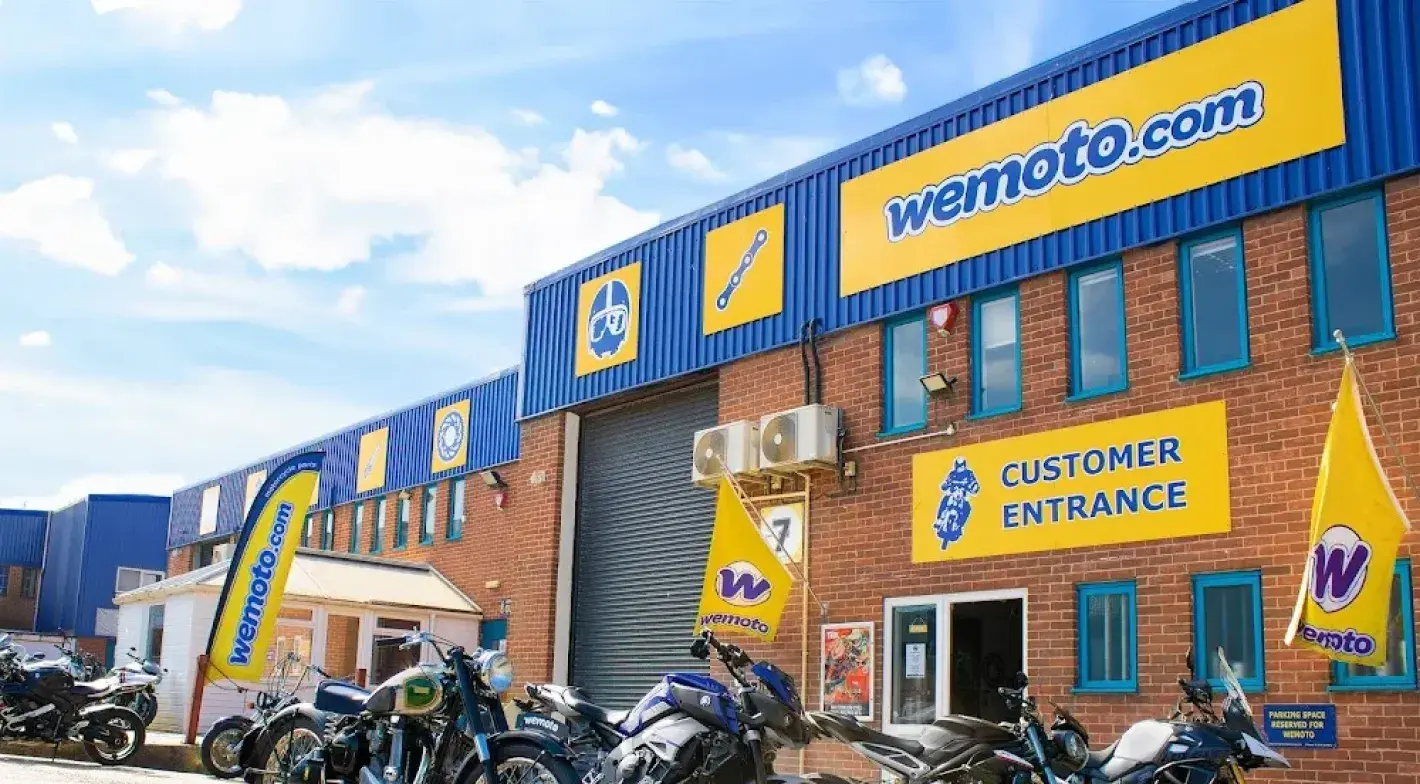
When digital platforms age, they create daily operational friction that places a hard cap on growth. Wemoto, one of the UK’s largest suppliers of motorcycle spare parts, hit this exact wall with a 15-year-old digital infrastructure. Handling approximately 10,000 orders per month across six countries, the brand required an enterprise-grade platform capable of running efficiently at scale. We rebuilt Wemoto’s entire e-commerce ecosystem from the ground up. Our team consolidated eight standalone sites into a single multi-tenant platform, integrated automated supplier workflows, and resolved major search bottlenecks. This digital transformation streamlined global operations across retail and trade channels, easily handling millions of SKUs while completely preserving the brand’s hard-earned search engine rankings.
Client Snapshot
Company: Wemoto
Industry: Automotive Parts and Motorcycle Distribution
Scale: Serves approximately 10,000 orders per month with a global catalog of millions of SKUs (OEM and pattern parts)
Geography: Global operations anchored in the UK with active franchise warehouses in Australia, the Czech Republic, France, Italy, and Spain
Outcome
70 %
Improvement in site performance, dropping average page load times from over 10 seconds to under 3 seconds.
2x
Increase in overall platform conversion rates following the rollout of intuitive mobile-responsive design and smarter search tools.
0 %
SEO visibility drop during a high-volume, multi-lingual migration that involved updating millions of complex URL patterns.
The Challenge
Wemoto’s legacy e-commerce platform was built over 15 years ago and had become impossible to maintain or scale. Detailed discussions with internal operations teams and store managers highlighted critical failures across three main areas:
Technical Performance Limitations
The old software relied on a rigid, monolithic codebase that caused frequent page load delays during high-traffic hours. Because the system lacked multi-tenancy support, each regional website required completely separate code updates, driving up maintenance costs. Additionally, the lack of centralized ERP integration meant that inventory rules and tracking adjustments had to be coded manually.
Friction in User Experience and Search
The storefront was entirely desktop-centric and lacked mobile responsiveness, alienating a massive surge in mobile buyers. The basic search engine only crawled a few visible product fields, which hid thousands of relevant parts and directly lowered conversion rates. On the administrative side, the database architecture was labor-intensive; product managers had to run manual SQL commands for everyday product updates because the system lacked bulk-update tools.
Fragmented Global Logistics
Under the old system, international franchises could only buy inventory from the core UK entity. All cross-border orders had to be routed through the UK office manually, creating severe distribution bottlenecks and order delays across Europe and Australia.
Our Approach
We do not guess how platforms should perform under pressure; we study exactly where current workflows break down. Our team designed a phased strategy to modernize the database and interface layers without causing system downtime.
Interface Design and Layout Architecture: We started by mapping out low-fidelity wireframes tailored specifically to the unique habits of automotive parts buyers, who search primarily by vehicle compatibility. These blueprints were continuously refined through stakeholder reviews before we built high-fidelity responsive layouts within Figma and Sketch. We consolidated these visual assets into a rigid, reusable design system to ensure visual alignment across every future regional site launch.
Cross-Border Engineering and Translation Systems: To run international storefronts out of a single system, we built a dynamic localization engine that utilizes localized content storage (language codes like en, fr, es, it), automated Tax and VAT rules via geolocation middleware, and live exchange rate tracking connected to external financial APIs.
The Solution
To modernize a complex global franchise network, we built an end-to-end omnichannel retail platform that automates everything from customer orders to cross-border fulfillment and tax compliance. This solution eliminates operational silos, enabling seamless inventory trading, localized purchasing, and real-time visibility across all business channels.
01.
Unified Channel Architecture:
We engineered a platform built to manage four separate operational channels:
B2C: Tailored consumer storefronts optimized for localized inventory across global franchises.
Franchise Local Shops: Internal application layouts for physical store staff to look up warehouse inventory and process walk-in orders.
B2B: A dedicated trade portal with tiered pricing structures and bulk-ordering paths.
Franchise-to-Franchise (F2F): A multi-tenant backend engine that triggers automatic supplier orders when local stock drops, allowing franchises to buy and trade inventory across the global network.
OMS: ACL-driven OMS where people have access to their related channels or multiple channels to view all orders from multiple channels like Websites, marketplaces like eBay, and Amazon under one unified OMS system.
02.
Custom-Built Inventory and Automated Ordering:
We built independent stock management capabilities for each country block. If a customer buys an out-of-stock component on a regional storefront, the system instantly generates a pending supplier order, evaluates available stock across other global warehouses, and routes the fulfillment request to the top-ranked franchise supplier automatically.
03.
Automated Financial and Invoicing Architecture:
A dynamic invoice engine generates customized financial documents instantly based on order type, region, and international tax laws (including OSS tax rules for remote EU sales and IOSS compliance rules for destination-country VAT).
04.
Comprehensive Reporting Suite:
We built a centralized dashboard for franchise owners tracking Sales Performance, “Limbo” customer orders awaiting stock allocation, and supply chain analytics across carriers like DPD, DHL, and Royal Mail.
Impact
Transitioning from a fragmented legacy architecture to a modern multi-tenant platform delivered clear, measurable improvements across all business metrics.
By executing a zero-downtime phased migration across Spain, Australia, the Czech Republic, France, Italy, and the UK, we successfully consolidated 8 standalone websites into 1 unified, multi-tenant platform all while handling high volume data migration . The new architecture demonstrates high-volume resiliency, efficiently processing an average of ~350 transactions per hour, and scaling to ~450 peak transactions per hour during rush periods.
Crucially, by connecting all global franchise inventories through automated F2F workflows, the system now manages Wemoto’s ~10,000+ monthly orders across franchises without routine intervention from the UK main office, significantly dropping operational overhead while expanding regional market penetration.
Implementation Challenges & Solutions
Implementation challenges and how we solved them
Phased migration data sync: Live legacy sites needed real-time inventory and pricing while new platforms rolled out sequentially. We built custom middleware that pulled real-time inventory, pricing, and part numbers directly from the old database until the final site transitioned.
Multi-language database migration: The old architecture had no relational structure for localized translations. We developed an independent translation migration layer to extract, map, and cleanly import localized product data into the unified structure.
Preserving high-risk search rankings: Changing URL patterns on millions of part-number pages threatened organic traffic. Working alongside SEO specialists, we mapped a precise 301 redirect architecture that fully protected organic traffic through the switch.
High-volume database upgrades: Moving more than 4 million complex product associations from MySQL 5.x to 8.x risked serious downtime. A multi-phase migration script backed by continuous checksum validation verified data integrity with zero platform downtime.
Legacy search performance failure: The old search tool timed out crawling hidden product fields. A highly optimized, indexed Solr engine now processes hidden attributes instantly without degrading query speed.
Why Net Solutions?
We do not build software in a vacuum. We bridge the gap between complex legacy platforms and modern user experiences. Our team combines deep database knowledge with strict engineering practices to construct enterprise tools that run flawlessly under real-world, high-volume pressure. We know that a beautiful front-end interface is useless if it cannot communicate perfectly with backend systems and global logistics APIs. If you need an engineering partner who understands the operational realities of global multi-site distribution, let’s connect.
Bespoke B2C& B2B Commerce Platform for Automotive Aftermarket
Aiming for Growth?
Lets build commerce that scales with your business.
We design and build fast, flexible B2C & B2B online stores for consumers and trade with headless content, real time integrations, omnichannel experience and ready to grow with you across new products, more traffic and new markets.
Platforms we work across
Adobe Commerce, Shopify, Big Commerce, AWS, Akeneo, Contentful and Klaviyo.
Related Success Stories
Results matter. Discover how our customized solutions have delivered measurable business outcomes for clients across various industries. Each case study highlights the
strategic impact of our work, turning challenges into opportunities for growth.
Ask Sol anything about digital products, AI, engineering, or growth, and get answers drawn from years of Net Solutions thinking and experience.
Our assistant helps you find content on our website. By asking a question, you acknowledge that we will process your data in accordance with our Privacy Policy, and consent to anonymous tracking of your conversation to help us improve the experience. Please avoid sharing personal or sensitive information, and close this page if you do not agree to these terms. While we strive for accuracy, AI responses may be inaccurate.By chatting you accept our Privacy Policy and anonymous analytics. Do not share sensitive information. AI answers may be inaccurate.