Executive Summary
Every vehicle on the road is a subscription for future repairs, but most parts platforms fail to remember critical customer details, creating a loyalty gap.
Repeat revenue that a platform fails to capture is called a loyalty gap. The loyalty gap exists when your platform treats every visit as a new guest rather than a returning vehicle owner with a known maintenance cycle. Closing this loyalty gap (increasing retention and overall customer lifetime value) is cheaper than reacquiring the same buyer, because the platform already holds the vehicle and purchase context that makes the next interaction relevant.
Key takeaways about the loyalty gap:
- The vehicle is the asset. A known car is a known maintenance cycle, and, in turn, a predictable set of future purchases.
- Guest checkout is right as an option and wrong as a destiny. Without a path from transaction to relationship, every sale is the first sale.
- Retention is engineering, not a points program. Build the garage, remember the identity, build triggers and journeys – address your loyalty gap in that dependency order.
- Trigger types are not equal. Scheduled dates get firm reminders; probabilistic needs get suggestions, not certainties.
- Measure the repeat share first. A low or declining share is the headline signal; benchmark by cohort, customer type, and category.
A Recurring Category Run Like A One-Time Business
Service intervals, parts wear, seasonal demands change, fleets age: the aftermarket makes another purchase highly likely in a way almost no other retail vertical enjoys. A brake-pad customer will need discs, usually within a pad change or two. A timing-belt customer will be back at the next interval. The winter-tire customer returns every spring and fall like clockwork.
Despite these known active purchase demands, the industry default is engineered for the one-time customer with:
- Fast guest checkout celebrated as conversion best practice.
- Weak account incentives, because account creation “adds friction.”
- Retention messaging that ignores the one thing that predicts the next purchase (car information).
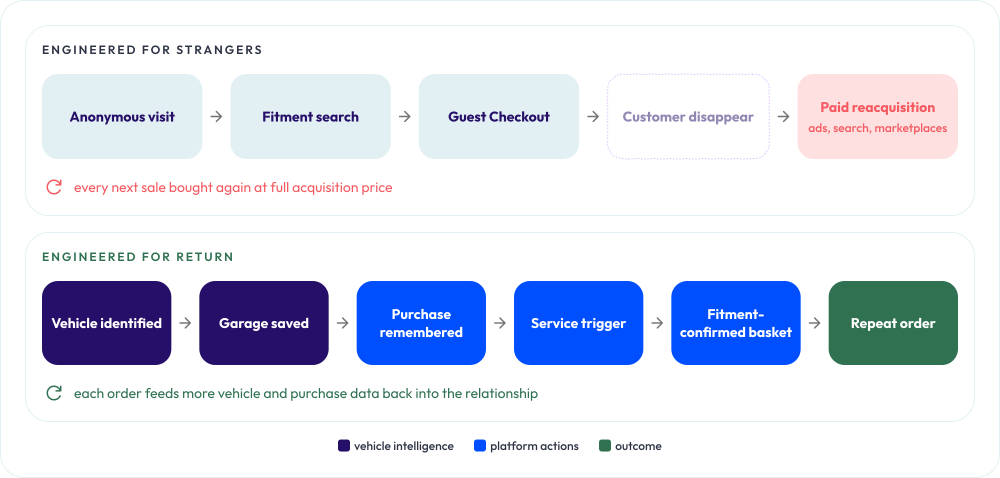
The result of these failures in site engineering is a loyalty gap: retailers pay acquisition costs, again and again, for demand they already served once. Another purchase is highly likely; the retailer does not own it unless the platform preserves the relationship.
Two ways the same recurring demand can flow
The Three Failures Behind The Gap
1. The Vehicle Is Not Remembered
For a consumer, the vehicle is the most predictive fact about future demand. For a workshop or fleet, it is the active vehicle, job, or fleet context. Either way, it is what decides what will wear, when the interval lands, which parts fit, and what the last purchase implies about the next one. A platform that does not persistently hold that context cannot trigger the repeat purchase, cannot personalize around real needs, and starts every visit from zero.
2. There Is No Path From Guest To Known
Guest checkout is right as an option and wrong as a destiny. Without a friction-light path from transaction to relationship, the platform’s economics never compound: every sale is the first sale, every customer costs the full acquisition price, and the registered base that should be the business’s ballast stays a rounding error.
3. Messaging Ignores The Vehicle
Generic retention emails (the “10% off everything”) in a vehicle category are little more than noise, and buyers treat it as such. Every retailer has tried (and failed) to build loyalty with blanket sales offers. Instead, “Your 2019 Focus is due for its interval service; here is a list of everything it needs, confirmed to fit” competes with nobody, because nobody else can send it. The difference between the two is not creativity—it is whether the platform knows the car.
The Engineering, Specifically
What separates retention engineering from a loyalty scheme is that the reasons to return are structural—built into how the platform works—rather than promotional.
To achieve this structural shift, engineering must focus on four builds, in the order they depend on each other: the garage creates the value exchange, the guest-to-known process makes the record persistent, the known service-cycle triggers decide when to act, and messaging delivers the action. All four run on the same substrate: consent, customer identity, transaction history, and vehicle data.
1. The Vehicle Garage
A vehicle garage is a persistent record of the customer’s vehicles, attached to the account: decoded once from a registration or VIN, remembered forever, and supporting the real-world shape of ownership. The garage needs to support one car, households with two or three cars, and tradespeople and fleets with many cars. Every other retention capability depends on this record existing, which is why it is the first build. Done well, the vehicle garage is also the account-creation incentive in its own right: save your garage, and the whole catalog filters itself to your vehicles on every future visit.
2. From Guest To Known, By Design
The garage only compounds when it belongs to a contactable customer, so identity is the second build, and the conversion moments are specific and cheap. Post-purchase account creation with the order pre-filled—one tap, not a form. The garage-save prompt should occur at the fitment moment—when the buyer has just told you their vehicle anyway and saving it is obviously in their own interest. Order history and one-tap reorder become the visible payoff to the customer (and to you). The pattern that works frames the account as the buyer’s convenience, which it genuinely is, rather than the retailer’s data capture, which buyers correctly resist. The prompt is one line of copy: save this car to your garage and never answer the fitment question again – guarantee the right part, every time.
3. Service-Cycle Triggers
With the vehicle known and the customer contactable, the trigger layer needs to decide when to act. Some triggers can be scheduled based on deterministic information: an inspection date, a seasonal change. Some triggers can be estimated: elapsed time or mileage against manufacturer service schedules. And other triggers are behavioral and probabilistic: purchase history can indicate an adjacent or approaching maintenance need, especially when combined with vehicle age, mileage, and service intervals. A credible trigger system treats each trigger type differently: firm dates get firm reminders; probabilistic needs get suggestions, not certainties. In practice: an inspection booked for March earns a reminder with the date in it, while a set of pads bought eight months ago earns a note that discs often follow, phrased as a suggestion the customer can dismiss.
4. Vehicle-Led Messaging
With garage, identity, and triggers in place, segmentation becomes meaningful: you stop mailing personas and start mailing the vehicle. Campaigns assemble from vehicle facts, model, age, interval position, and purchase history—and every message carries fitment confidence forward, so the click lands on parts confirmed for that vehicle rather than on a standard category page. Consent, channel preferences, and reminder frequency should be stored with the relationship, so useful service prompts do not become generic CRM noise in a more personalized wrapper.
What the Shift Looks Like When it Works
share of orders placed by registered customers
share of daily orders fulfilled through home delivery
We worked with GSF Car Parts to re-engineer both their data layer and commerce platform to better understand the needs of aftermarket buyers. As we engineered the retention layer, the share of orders placed by registered customers grew from roughly 26% to 34%. Over the same period, home delivery grew from 20% to 40% of daily orders, increasing the importance of saved addresses, preferences, order history, and persistent customer identity. Behind both numbers is the structural change that matters: a growing share of the business whose next purchase the platform can see coming and act on. Instead of re-buying purchases through ads (repeating your customer acquisition cost), you build customer lifetime value (LTV). Repeat orders can carry better economics because the acquisition cost has already been paid once, and the relationship already exists; the engineering decides whether the retailer is present when the next need arises.
Trade is Loyalty Too
The same logic runs on the B2B side with different mechanics. A workshop’s loyalty is engineered through account terms, credit, replenishment convenience, and integration into how the workshop actually orders, and the switching cost of a trade relationship the platform makes effortless is some of the strongest retention there is. Retention is not a consumer-only concern, and a platform that treats trade accounts as large guests leaks its most valuable relationships of all.
Measuring the Retention Layer
Four numbers tell you whether your retention layer is working (or if you have a loyalty gap):
- The share of revenue from repeat customers,
- The registered share of orders,
- Garage adoption among registered customers, and
- Trigger-to-order conversion on the service-cycle journeys.
A low or declining repeat share is the headline signal; benchmark it by cohort, customer type, and category, then use the other three to identify where the relationship is breaking. The same headline number hides different stories: winter-tire customers on a six-month rhythm and brake-pad buyers on multi-year cycles should not be judged against one benchmark. These sit alongside the platform-wide operating measures in our metrics piece; retention is the layer of the five-layer leak map where the compounding lives.
What this means for your business: if most of your revenue is anonymous and one-time in a category where the next purchase is predictable, you are paying acquisition costs for demand you have already served once.
Frequently Asked Questions
No. Points programs bolt incentives onto a platform that still forgets the vehicle, and they spend margin to imitate what retention engineering achieves structurally: a garage, triggers, and journeys that make returning the path of least resistance. Points can sit on top; they cannot substitute.
With measurement, then the garage. A low or declining share of revenue from repeat customers is the headline signal; benchmark it by cohort, customer type, and category, then use registered share, garage adoption, and trigger conversion to identify where the relationship is breaking. The first build is persistent vehicle identity, because every trigger and journey depends on it.
Forced account creation before checkout can damage conversion, but post-purchase account creation avoids that pre-checkout penalty because a garage-save prompt gives the customer an immediate reason to register: save the car once, never answer the fitment question again.
Vehicle identity from a registration or VIN decode, purchase history with dates, manufacturer service schedules by model, and, where available, inspection dates. That supports scheduled triggers, estimated triggers, and behavioral recommendations; sophistication can grow later, but those sources cover most of the value.
Find your loyalty gap
The Revenue Leakage Assessment starts with a complimentary 60 minutes with a senior aftermarket commerce engineer, walking the leak points across your platform, the retention layer included, and what it would take to close yours. No pitch deck, and you keep the findings either way.