
Executive Summary
In licensing, most AI stays in demo form. We built one that a team actually uses every day — and what makes it work is the engineering behind it, not the AI model itself.
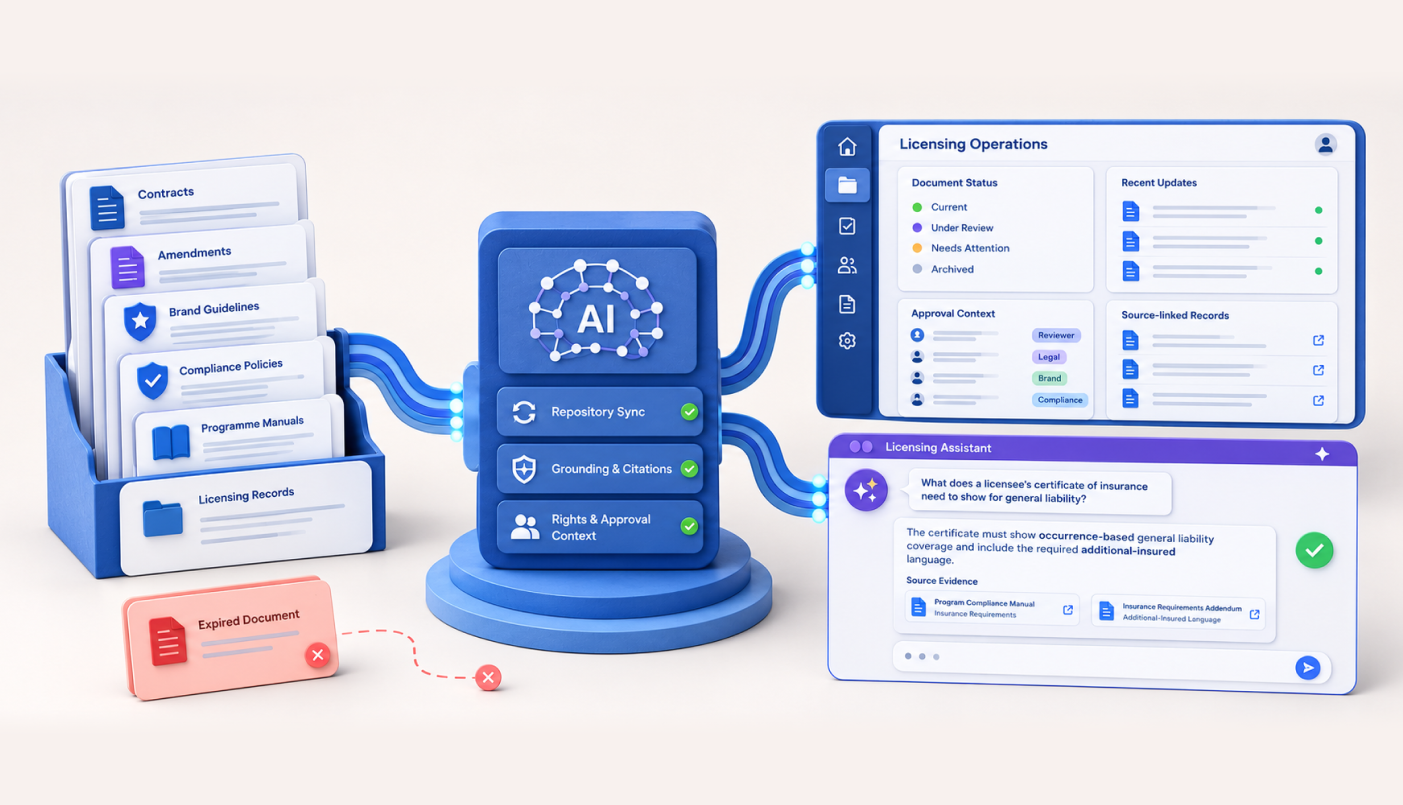
At Net Solutions, we built and run a live, grounded knowledge assistant for a major licensing organization: cited answers, kept in sync with source documents, and accessible from the AI tools teams already use. This is what shipped, and why it holds up.
- Grounding beats brilliance. Answers come only from retrieved documents, cite their sources, and say “no relevant information found” rather than inventing one.
- Agent-accessible comes after searchable. Exposing the knowledge base through Model Context Protocol (MCP) lets teams query it from inside Copilot, Claude, Cursor, and other assistants, not just a web app.
- The pipeline is the product. Automatic document sync is what keeps an assistant current; without it, an assistant gradually decays into a stale FAQ.
- The check to run this week: time how long your team takes to answer three routine questions from the source documents, then multiply by every person and every week. That is your retrieval cost, paid daily.
Most AI announcements in licensing describe a demo. This article describes a system that a real team uses every day, on a business where a wrong answer has contractual consequences. The interesting part turned out not to be the model. It was everything around the model: where the documents live, how they stay current, how an answer proves where it came from, and how that knowledge reaches the tools people already work in.
What follows is the honest version of that build. It starts with the problem the team lived with, walks through what we put into production and the guardrails that made it safe to trust, and ends with the rule that decides whether any of this works: foundation first, intelligence second. If you run a licensing operation, the last section is a test you can run on your own team this week.
The Problem Isn’t Finding Information. It’s Finding The Right Answer.
Try a quick test. Ask your longest-serving licensing person three questions a new joiner would ask this week:
- What must a licensee’s insurance certificate show?
- Which artwork rules apply to a new product category?
- When does a renewal window open?
They will know the answers. Watch how long it takes them to prove each one. Finding the wording still means knowing which document holds it, which version is current, which section to read, or which colleague to interrupt.
The answers are not missing. They live in a pile built up over years: agreements, amendments, brand guidelines, compliance policies, program manuals, and the process notes that never made it into any of them. Retrieving them is the problem.
One brand we work with measured the cost. Take a single routine question: “What does a licensee’s certificate of insurance need to show?” The wording lived in two documents everyone already knew about. Locating the exact, current language still took about forty minutes on average. Across a team of twenty, that one question type ate more than a person-week of senior time every month.
That cost is easy to miss, because it never shows up as a line item. It is paid in minutes, by the people whose time is worth the most. Three groups pay it hardest:
- New joiners, who cannot yet find anything on their own.
- Senior staff, interrupted to answer the same questions again and again.
- Licensees, whose basic queries become support tickets someone has to research from scratch.
And the cost isn’t just time. When the same question gets a slightly different answer depending on who fields it and which document they open, that inconsistency becomes a compliance risk in its own right. The information was never missing. It was only ever hard to reach, and that is a problem you can engineer away.
We Built An Assistant That Cites Its Sources And Won’t Guess
Removing that retrieval cost is what we set out to do. Net Solutions built a knowledge assistant for a major licensing organization whose platforms we already engineer and operate, and it runs in production today.
This is not a side project for us. We build and run the approval platform behind global brand licensing programs, including the WME Group platform, which supports a portfolio that drives more than $17B in annual retail sales for brands like UFC, WWE, MLB, and Volkswagen. The assistant was built on that same footing. A team member asks a question in plain language and gets an answer with three properties that matter more than fluency:
- Grounded. The answer is generated only from documents retrieved from the organization’s own repository. The model’s general knowledge does not get a vote on document-specific facts.
- Cited. Every answer references the source documents it drew from, with links back to where each document lives, so you never have to take trust on faith.
- Honest about gaps. When the documents do not address the question, the system says no relevant information was found. It does not fill silence with plausibility.
Around that core, a production system needs the things a demo never has: single sign-on, a chat interface that handles follow-up questions, searchable history, a feedback loop on every answer, and guardrails that keep the assistant on the topics its documents actually cover.
In a business built on contracts, an AI that refuses to guess is not a limited AI. It is the only kind you can put in production.
The Answer Is Only Useful If It Reaches People Where They Work
A grounded answer is only useful if people can access it. So the same knowledge base is exposed through Model Context Protocol (MCP), the open standard that lets AI assistants use external systems as tools. A team member working inside their own assistant can ask a licensing question there and get an answer grounded in the same documents as the web application, without switching tools.
In practice, teams can query the same licensing knowledge base from inside the tools they already use:
- Microsoft Copilot
- Claude Desktop and Claude Code
- Cursor
- ChatGPT, with some customization
A team building its own tools does not have to rebuild the retrieval engine. It connects to the one already running — so the operation’s knowledge stops sitting in a shared drive, out of reach of the interfaces people are moving toward, and becomes something those interfaces can actually use.
Why This Matters Now
It sounds like a small feature. It is not. The tools people work in are turning conversational, and the systems that do well there will be the ones whose knowledge is structured enough for an AI to use safely. If your knowledge is grounded, cited, and reachable through a standard protocol, you are ready for that shift. If it still lives in a shared drive, no model upgrade will get you there.
The question is no longer whether your team will use AI assistants at work. It is whether your own knowledge will be reachable from inside them, or stuck outside.
An Assistant Is Only As Good As The Documents Behind It
Reachable and cited answers are worth little if they go stale. The part of this system we are proudest of is the part no demo would show: the pipeline. The assistant is wired directly to the organization’s document repository, and document additions, updates, and deletions flow through automatically. Nobody re-uploads anything. Nobody maintains a parallel copy that drifts out of date. The knowledge base is current because the sync keeps it current.
That mattered more than model choice, because an assistant’s failure mode in month six is rarely intelligence. It is staleness. Most of us have met the chatbot that confidently quotes last year’s policy. A bigger model does not fix that. Boring, reliable sync does, monitored and maintained as part of the product.
What Keeps It Trustworthy
- Human review. A person stays the final reviewer on every AI decision, and the system logs its reasoning for audit.
- Data stays yours. It runs on enterprise AI services whose terms keep client data out of model training. Your documents inform your team’s answers, and no one else’s.
Grounded, reachable, and kept current, the assistant earns its place in daily work. But it answers one question, and a licensing operation has many. It works because one rule applies to all of them.
This Is One Piece Of A Wider AI Roadmap For Licensing
The assistant is not the whole plan. It is one of two AI systems already live in this operation. The second is likeness review, which checks submitted product against approval rules at a volume no human team could match. A person still makes the final call on every decision.
The Applications We Are Engineering For Licensing
Behind those two sits a broader set of applications we are engineering for licensing work:
- Insurance certificate validation
- Responsibility questionnaire scoring
- Submission scoring
- Natural-language rights search
- Contract question answering
Each one follows the same three rules. A human holds the final decision. Every step is logged, from retrieved evidence to reviewer action. And each application refuses to guess rather than fill a gap with plausible data.
The Infrastructure It Runs On
None of this floats free. It sits on infrastructure we already run at scale:
- WME Group approval platform. The rebuild delivered 40% faster approvals, 25% faster reporting, and 70% internal adoption within six months.
- A North American sports licensing platform. It calculates royalties across more than a million rows per run for 60-plus licensors on SOC 2-compliant infrastructure.
Grounded AI is a new layer on that foundation, not a leap away from it. And the order matters, which is the whole point of the diagram below.
The Sequencing Rule: Each application starts from the foundation its job requires. A grounded assistant can come early, as long as the repository and its sync are reliable. AI that recommends or acts on operations needs structured data and connected workflows first. The organizations whose AI stalls in pilot mode are usually the ones that skipped that step.
What Changed: Answers In Seconds, Faster Onboarding, Fewer Tickets
Moving from manual document hunts to a grounded assistant changed how the operation runs day to day, in ways people felt quickly:
- Seconds instead of minutes. The insurance-certificate question that used to take the better part of an hour now comes back cited in seconds.
- Faster onboarding. New joiners find the governing rule themselves in their first week, instead of interrupting a senior colleague to get it.
- Fewer “where is this written?” tickets. Internal requests to track down a policy dropped noticeably across departments, because people can now find the source themselves.
- Self-serve audits. Checks that once meant pulling files by hand became something a reviewer can do directly, with a link back to the source for every answer.
Underneath all four is the real payoff: senior licensing people got their time back for the work they were hired to do, like negotiating deals, structuring partnerships, and protecting the brand, instead of acting as the team’s search engine. That is what makes the engineering worth it.
A Test You Can Run This Week To Size Your Own Retrieval Cost
Go back to the three questions from the start of this article and put a stopwatch on them. Time how long each answer takes to locate, then multiply by every person who needs those answers and every week they need them. That number is what an ungrounded knowledge base costs you now, quietly, whether or not it ever reaches a budget. It is also the first thing a grounded assistant gives back.
FAQs
Grounding. Answers are generated only from retrieved documents; every answer carries citations linking back to its sources, and when the documents do not address a question, the system says no relevant information found rather than inventing one. In a domain built on contracts, that refusal behavior is a feature, not a limitation.
The knowledge base is exposed through Model Context Protocol (MCP), an open standard that lets AI assistants use external systems as tools. Teams can ask licensing questions from inside Microsoft Copilot, Claude Desktop, Claude Code, or Cursor, and, with some customization, ChatGPT, and get answers grounded in the same document set as the web application, instead of switching to another tool.
No. The system runs on enterprise AI services whose terms exclude customer inputs from model training, and it logs every interaction for audit. The client repository remains the system of record; approved content is synchronized into a governed retrieval index, and customer documents and prompts are excluded from model training.
Because an assistant is only as current as its knowledge base, the unglamorous engineering—automatic sync with the document repository so additions, updates, and deletions flow through without manual re-uploads—is what keeps answers trustworthy over time. Models can be upgraded. Pipelines still have to be built, evaluated, and maintained.
Start with the foundation the use case needs. A grounded knowledge assistant can come early if the repository, permissions, and synchronization are reliable. AI that recommends or takes operational action needs structured data and connected workflows first, which is why we treat AI readiness as an engineering outcome, not a purchase.
Find Out Where AI Would Actually Pay Back in Your Program
Start Free: A 60-minute diagnostic call where a senior engineer examines one of your workflows live and maps it against the AI patterns we run in production.
You keep the written Licensing Operations Diagnostic either way, and the fixed-fee Licensing Operations Assessment is scoped on that call.