
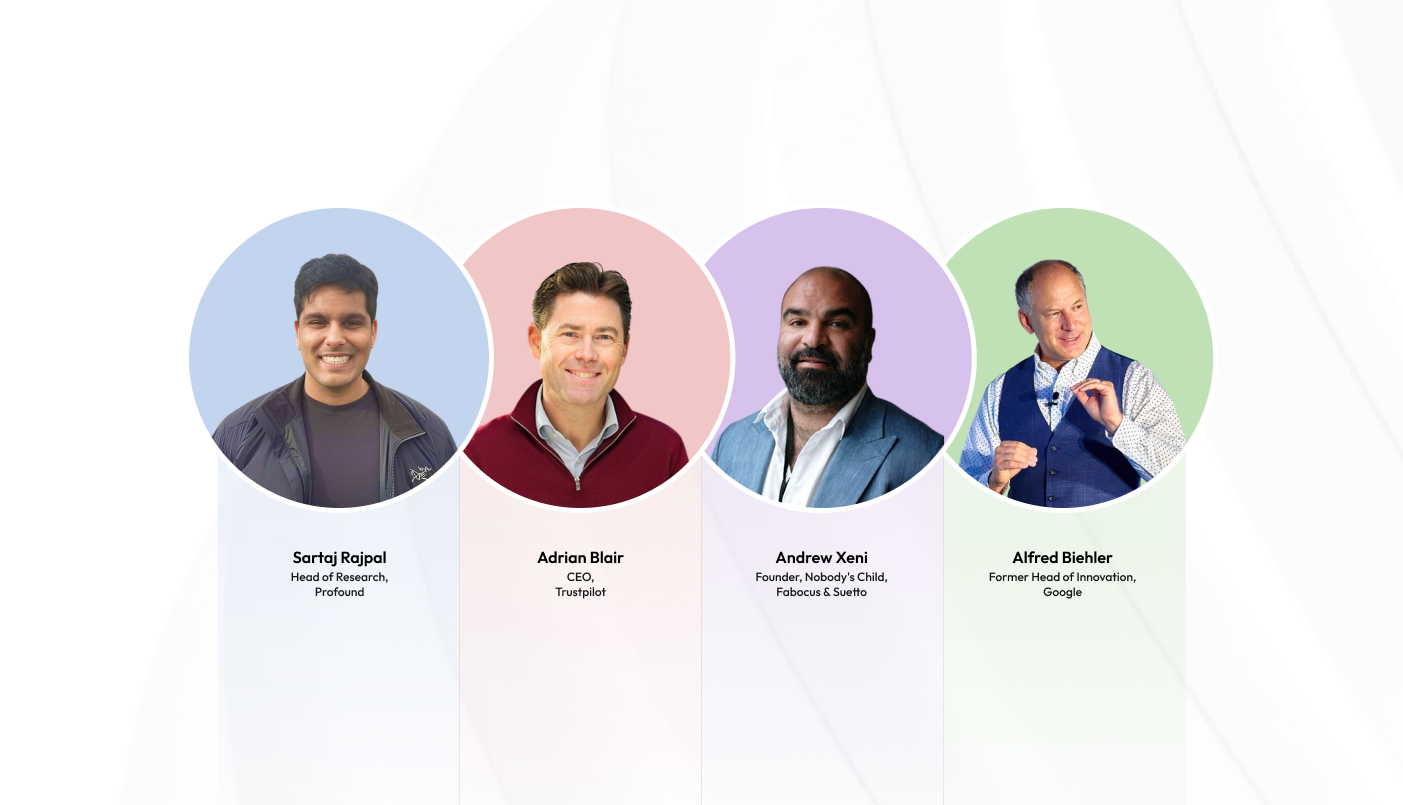
On 11 February 2026 we brought senior commerce and technology leaders together for a morning at Competing in the AI Era, our executive forum at Batch LDN in London. Net Solutions founder Sameer Jain opened with the problem the whole morning circled: “AI is everywhere, but no one really has the right model or roadmap to implement it.” The sessions that followed took three runs at that gap, from three different directions. All three are below, in full.
The Machine Customer Era: Is Your Brand Visible to AI?
Sartaj Rajpal, Lead AI Research, Profound
Sartaj opened with a warning: traditional search is losing share, and AI agents are moving from recommending products to buying them. His research at Profound puts AI-influenced purchase volume at $104 billion annually, and finds that consumers who decide fully inside an AI engine convert at 85.9 percent, roughly two and a half times the baseline.
When someone asks an AI model what to buy, the engine fans the query out, searches the web, and decides who to trust in about three seconds. Traditional SEO signals account for only a fraction of what gets cited. What does: structured, answer-first content, semantic URLs, fresh comparison pages, and earned discussion, with Reddit currently the most-cited source in AI search and YouTube close behind.
“In just three seconds, you’re either invisible or you’re the answer.”
Sartaj Rajpal, Profound
People, Process, and Culture in the Age of AI
Alfred Biehler, Former Head of Innovation, Google
Where Sartaj covered the technology, Alfred covered the humans running it. His caution to the room: don’t pursue AI projects just to increase profit. Money is the oxygen of a business, not its purpose, and AI models have to be grounded in real consumer problems to matter.
His practical advice was about conditions, not tools: solicit ideas from frontline employees, build psychological safety so failures get studied rather than punished, give people guardrails and a sandbox so experimenting is easy, and deliberately schedule thinking time away from screens. Innovation, in his framing, is a property of the environment before it’s a property of the roadmap.
“The organisations winning with AI are not the ones with the biggest budgets or the best models. They’re the ones who’ve built the internal conditions to move fast, learn faster, and not be paralysed by the fear of getting it wrong.”
Alfred Biehler, former Head of Innovation, Google
The Panel: Data, Trust, And What Agents Will Reward
Sartaj Rajpal, Lead AI Research, Profound · Adrian Blair, CEO, Trustpilot · Andrew Xeni, Founder, Fabacus and Nobody’s Child
The closing panel pulled the threads together. Adrian Blair argued that AI engines love social proof because reviews give them the fresh, long-tail data they need for specific queries, which makes credible review platforms part of how agents decide who to trust. Andrew Xeni made the structured-data case from his own P&L: Nobody’s Child implemented Digital Product Passports for traceability and compliance, and reports online basket value rising 3.4x, from £36 to £124. He also argued for physical retail’s return, having signed for six new stores on the correlation he sees between local presence and local online transactions.
“The LLMs love social proof, and I think the reason they do is that it plays to various aspects of how the LLMs have been built.”
Adrian Blair, CEO, Trustpilot
“We could take a T-shirt and we’ll have over 200 attributes, from the traceability to the composition to the wash to the durability to the testing integrity.”
Andrew Xeni, Founder, Nobody’s Child and Fabacus
The audience questions were the practical half: how to get experiments past bureaucracy, how to handle teams afraid of AI, whether backlinks still matter, and whether agents will destroy loyalty by chasing price. And when someone asked where they’d invest a hypothetical £10, Xeni didn’t hesitate: stop building your own enterprise software, invest in pristine structured product data, and use best-in-class tools for the rest.
The Downloadable Report
AI shopping visibility for brands
The whitepaper behind the visibility session: what makes a brand citable, and where to start. Free, in exchange for a work email.
Four questions decide whether AI can do business with you
Can AI find you? Can it understand your products? Can it interact with your site? Can it complete a purchase? We call it DUCT: discoverable, understandable, capable, transactable.
The free AI Readiness Score is a 15-minute self-assessment across all four pillars; if it flags a problem, the AI Readiness Diagnostic adds a site scan and two working sessions to produce prioritized next steps.
THE NEXT SESSION
We run a small number of invitation-only roundtables and forums each year in London and New York. If you’d like to be considered for the next one, tell us where you sit and what you’re working on.
Speaker figures are from their own sessions and research and are reported as presented at the summit.