Executive Summary
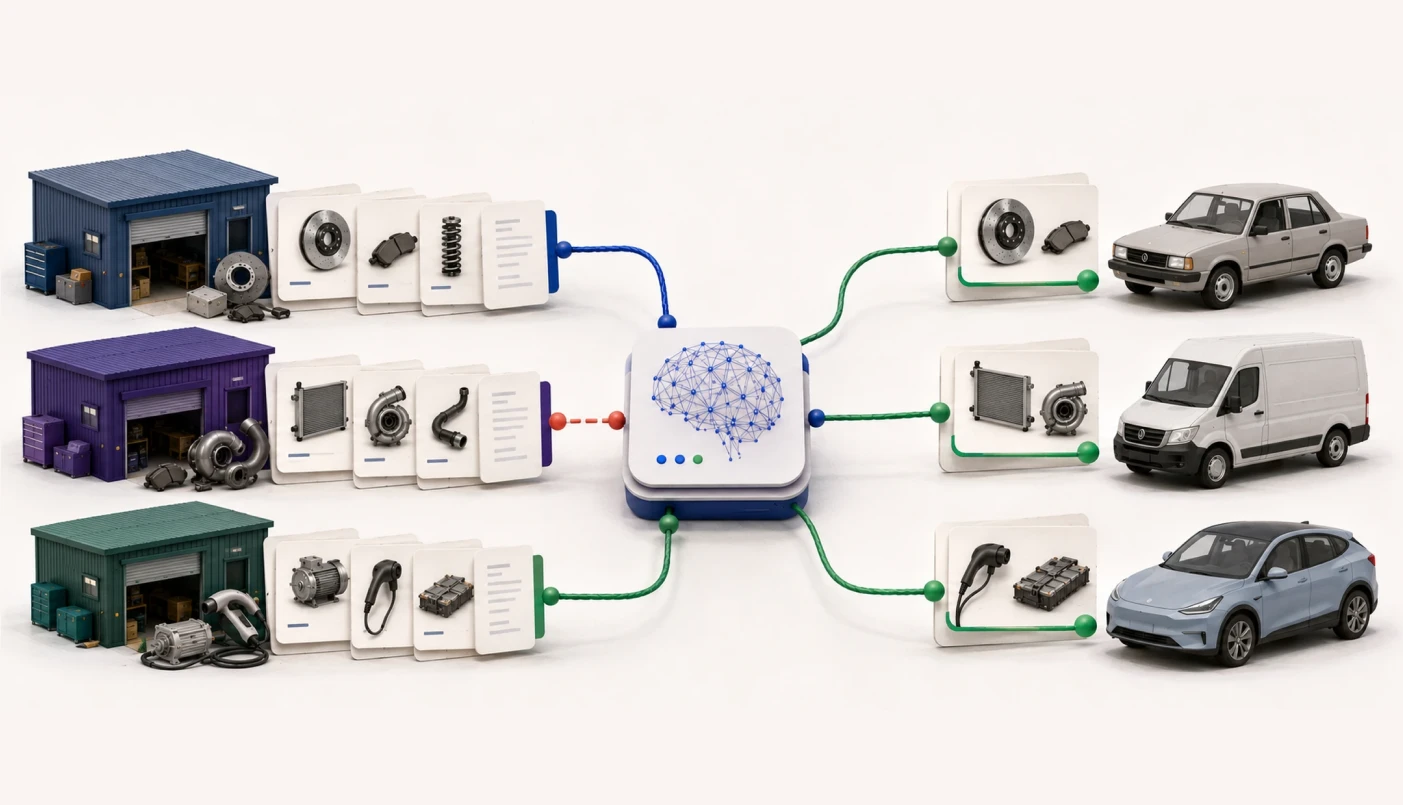
A buyer asking an AI assistant which parts supplier to use may receive a small synthesized shortlist. Whether you appear depends on site accessibility, relevance, freshness, and corroborating evidence, not just on the eCommerce platform.
In aftermarket sales, the discovery process is changing fast, though you may not have realized the shift yet. However, sites that aren’t AI-friendly will soon see their order figures impacted. The five questions below can help you diagnose whether you are ready for AI, how to check, and what you need to fix to be prepared.
- AI citations do not rely on the same inputs as SEO rankings, but they are not entirely separate either. Retrievability, structure, and freshness now serve two audiences (AI and people) instead of one.
- Machine-readable product data is key. If decision-critical fitment data depends entirely on client-side rendering, AI retrieval is impeded.
- Independent evidence shapes what an AI assistant can verify. Review coverage, recency, and consistency across third-party sources can influence the answer context.
- Aftermarket sales are still overwhelmingly combustion. Petrol and diesel account for close to 88% of UK cars in use, so while eCommerce tools may be re-tooling for EVs, AI readiness must continue to prioritize ICE vehicles.
- Being found is half the job. The other half is whether an AI agent can check your stock, price and fitment without a human in the loop.
The Discovery Method Has Changed
The way trade and retail buyers find parts suppliers is changing faster than the way they order, which is exactly why it is easy to miss. AI tools are not replacing traditional search (yet), but they are increasingly becoming the first step in product discovery and supplier research. As a result, AI agents can increasingly influence which businesses enter the consideration set.
Many AI answer engines fan a question into several retrieval steps, then synthesize an answer from a limited set of sources. In research presented by Sartaj Rajpal of Profound, answer engines went through a multi-step process of:
- Splitting one question into several searches,
- Evaluating roughly 20 to 50 candidate links
- Selecting and displaying the “top” five to eight citations where “top” is determined by the AI using factors that differ greatly from traditional SEO factors. In Profound’s analysis of approximately 1,300 pages, traditional SEO metrics explained only 4% to 7% of citation outcomes.
“The funnel hasn’t just compressed. It’s become invisible.” Sartaj Rajpal, Head of Research, Profound. February 2026
The wider evidence also supports this shift away from traditional SEO dictates, but each AI tool follows a unique methodology for site rankings and recommendations (citations). For example, Google’s own AI Overviews draw heavily on pages that already rank well, while assistants such as ChatGPT and Gemini overlap with the organic top ten far less. A May 2026 synthesis of 54 experiments, patents, and case studies ranked URL accessibility and search rank as its two strongest citation correlates.
Given the mixed use of traditional SEO factors by AI tools, and the continued importance of SEO for traditional people-led searches, we believe that SEO is not dead. Instead, what these emerging AI citation results suggest is that strong Google visibility no longer guarantees an AI answer engine will cite you. However, the same three inputs that support strong SEO can also be re-prioritized to support AI citation: ensuring critical content is reliably retrievable (not hidden in images or clicks), ensuring the answer is stated plainly near the top, and ensuring the data is complete and current.
The question is not whether to optimize for machines instead of people. It is whether the machines reading on behalf of your buyers can find an answer at all.
1. Would An AI Engine Cite You?
Start with the blunt test. If a buyer, or their AI assistant, asked who the best supplier is in your category, would your business appear? Most sellers have never checked.
Factors influencing whether an AI engine is likely to include you are:
- Semantic URLs
- Direct answers
- Fresh evidence
- Structured product information
- Credible third-party coverage.
When critical product and fitment data are available only after client-side rendering, descriptions are thin, pages are slow, and content has not been maintained, the chance of AI citation goes down.
Run this diagnostic. Write ten high-value buyer questions covering category discovery, supplier comparison, fitment and availability. Run the same set across ChatGPT, Perplexity, Gemini and Google AI Mode, recording whether you appear, which pages are cited and which competitors keep showing up. Repeat monthly with the same questions, because a single query on a single assistant tells you nothing about a trend. Separately, fetch both the initial HTML and the rendered DOM for one product page. If the fitment table exists only after client-side execution, it is a point of failure worth fixing.
2. Can AI Read Your Product Catalog?
You have an active catalog, but if it is not machine-readable, to an AI tool it simply does not exist. A single aftermarket query can carry half a dozen constraints at once, and an engine will favor whichever supplier has the decision-critical data fields populated, structured, and reliably retrievable. For most mid-market sellers, this is where the largest AI readiness gap sits.
How to spot check if an AI can read your product catalog:
- Is your decision-critical product and compatibility data available without depending entirely on client-side rendering, or trapped in an unstructured PDF?
- Do your listings populate the decision-critical attributes defined for that product category, rather than only the platform’s mandatory minimum?
- Is fitment structured well enough for software to match part to vehicle without a person interpreting a supplier note?
Data freshness is the other critical consideration for AI tools. When Net Solutions rebuilt GSF Car Parts on Adobe Commerce with a headless CMS and new product-data pipelines, product-data imports fell from 16 hours to 17 minutes. Zero-result searches fell from 2.16% to 0.73% over the same period.
There are many steps that go into improving your product catalog, a topic so broad we’ve covered it in another post. Learn more about how to support your data quality.
Run this diagnostic. Export a hundred random SKUs and count how many decision-critical attributes are populated for their category, not how many fields exist. Then take ten fitment-critical products and check whether software could distinguish the variants without reading a note written for a human.
We've fixed this exact gap on six live catalogs: See what we changed and what happened next in our free 37-page Unreadable field report.
Read More3. Do AI Models Trust You Enough To Recommend You?
AI systems do establish “trust” in a supplier in the same way trust is established with a human buyer. AI agents assemble an answer they trust using available evidence: what you publish, what independent sources say, how current both are, and whether your claims agree across channels. The exact weight assigned to each source is not public and varies by engine. What is clear is that inconsistent claims, sparse evidence, and outdated profiles make a business harder to verify.
Rajpal reported that Reddit was the most frequently cited “source” in Profound’s analysis, and that roughly a fifth of citations came from earned media (unpaid community sources such as Reddit, social media shares, news coverage). While this information does not suggest that every Reddit thread is reliable, it makes independent corroboration commercially important for inclusion in AI recommendations and citations.
While we can argue that unpaid reviews are critical, volume, recency, and distribution can matter more than a marginal difference in average rating. And consistency matters: if your site promises next-day delivery while independent reviews repeatedly report three days, an assistant can surface that contradiction.
Another factor in gaining AI trust is having complete product data, which could help an AI improve verifiability and reduce ambiguity.
“A customer who trusts you is more likely to spend more with you, more likely to be loyal, and more likely to recommend you. The economic lifetime value of a high-trust customer is orders of magnitude greater than one who doesn’t, pretty much regardless of which industry you’re in. Adrian Blair, CEO, Trustpilot. February 2026 Trustpilot operates a reviews platform and sells products aimed at AI-era visibility, so its perspective on the value of review signals is an interested one.”
Run this diagnostic. Take your three most prominent site promises (delivery speed, stock accuracy, returns window), and compare each against what independent sources actually say. Every gap is a contradiction an assistant can retrieve that counts against you.
4. Can Your Fitment Model Handle Both Kinds Of Vehicles?
A machine-readable catalog is not much use if the software cannot work out which part fits which car. That question is getting harder, because the fleet is splitting in two.
Petrol and diesel cars (internal combustion engine / ICE vehicles) are still nearly nine in ten cars on UK roads, around 95% once hybrids are counted, and battery electric cars are about 5%. Those cars are also getting older: a record 45.7% have been on the road for more than a decade, and in the US the average vehicle is now 12.8 years old. Older cars need more parts, so the combustion catalog is not a legacy problem you can wind down. It is where the money is.
At the same time, electric vehicles (EVs) need a catalog that works differently. A petrol part is usually identified by things that never change: the engine code, the build date, the axle. An electric part can depend on the battery pack version, the charging hardware, or the software the car is running, and a software update can change which part is correct after the car has been sold.
That is the real problem. One catalog has to answer both kinds of questions, and most catalogs are built on a single make, model and year lookup that can only answer the first. Adding a column does not fix it. The data model itself has to hold relationships that change over time.
Run this diagnostic. Pick one high-volume combustion application, one hybrid and one BEV. Can your catalog expose equally complete product, fitment and technical data for all three, without a person interpreting a supplier PDF or a free-text note? Then ask whether your fitment records can express a relationship that changes over time, or only one that was true on the day it was loaded.
5. Could An AI Agent Actually Transact With You?
Machines do not navigate a storefront the way a person does. In emerging machine-to-machine procurement journeys, agents query structured endpoints, call APIs and use browser automation. Picture the request: this part, this vehicle, this quantity, delivered to this postcode or collected from this branch, priced and confirmed. An agent cannot phone you or wait for manual stock confirmation.
The building blocks of supporting AI transactions are unglamorous. Stock needs to be refreshed at a cadence appropriate to the promise being made, with validation at quote or order time when availability is committed. Monitoring of the APIs that serve orders is critical as well, so failures are caught before customers feel them. At GSF, we increased stock refreshes from four to six times daily, with real-time validation against national and regional distribution centers and introduced alerting around stock and order flows. The result was more accurate availability and fewer avoidable cancellations. These kinds of investments are good for the buyer, whether they came to you via a traditional channel or via AI.
RECOMMENDED READING

Fully autonomous purchasing remains early. Gartner found that only 11% of US consumers were willing to let AI make purchase decisions even in low-stakes categories, and separately that while 45% of B2B buyers had used generative AI in a recent purchase process, 69% still preferred to validate what it produced with a sales representative. The good news is that any investment in supporting AI-led transactions also benefits the human buyer journey.
Run this diagnostic. Ask whether a machine could get an accurate stock and price answer for a specific part and vehicle in one call. Then ask how your last stock or feed failure was detected. If the answer is a customer complaint, the detection path runs through your buyers, and an agent will not complain. It will simply resolve elsewhere.
Knowing Your Readiness Is Key
If some of these questions landed uncomfortably, that is useful information. The gap between where you are and where the market is heading is measurable, and measurable gaps can be closed in order of commercial return rather than in order of noise.
None of these questions is about deploying AI. They are about whether the machines between you and your buyers can understand what you already do well. Your expertise is your edge; the work ahead is ensuring all that expertise is legible to AI.
Frequently Asked Questions
A catalog is a starting point, but most catalogs were only built for human browsers. Being “AI-ready” means having machine-readable data with the decision-critical attributes for each category, fitment logic that handles combustion, hybrid, and EV complexity, and content structured so models can retrieve and cite it.
You are likely more at risk than the revenue mix suggests. Buyers already use AI tools to research suppliers, availability, and compatibility, even when the final order still arrives by phone.
No, and any vendor telling you otherwise is selling something you may not need. The published evidence is contested and varies sharply by engine: Google’s own AI Overviews draw heavily on pages that already rank, while assistants such as ChatGPT and Gemini overlap far less with the organic top ten. The safer reading is that crawlability, structure and freshness now matter to two audiences instead of one. Those are the same foundations good technical SEO already asks for.
It varies by gap. Product-data, URL, and content corrections can often be implemented within weeks, although how soon each engine recrawls and re-evaluates the source will impact how soon you see an ultimate benefit to the work. Architectural work, real-time stock and agent-queryable APIs run on a longer horizon measured in quarters. The strongest position is starting both tracks at once rather than waiting for the quick wins to bed in.
Know Where You Stand, and What to Fix First
The AI Growth Readiness Assessment evaluates four pillars and returns a strategic maturity scorecard, an executive assessment report and a prioritized 180-day roadmap.