Executive Summary
The Licensed Feed Is A Commodity. Confidence Is Engineered.
When an agent is asked for front brake pads for a 2019 Ford Focus, the only question that matters to you is whether the part it names is yours, a competitor’s, or an out-of-date version of yours pulled from stale scraped data. When discovery is limited by the same licensed reference data, the agent must look to other signals to establish trust.
- Licensed data is shared. Many competitors license overlapping industry reference data, so the licensed input alone cannot be the differentiator.
- An agent’s question is under-specified by default. A 2019 Ford Focus is several engines, trims, and build splits. Resolving that question into one confident answer is an engineering problem, not a licensing problem.
- eCommerce data changes slowly; commerce does not. Stock, price and delivery promise come from your ERP, so answers based on outdated stock data are wrong answers.
- Transaction outcomes are specific to your operating history. Returns, conversions, and vehicle-specific baskets can expose gaps in the licensed feed that you can verify and use to improve your catalog (leaving competitors in the dust).
- The same work pays for itself either way. Resolution, enrichment and live data sharpen on-site search and marketplace feeds whether or not agent-led buying becomes a significant source of purchases.
The AI Question is Already on Your Desk
Some version of this question has either reached you or is about to: what are we doing about AI agents sourcing parts? It is easy to dismiss, and most of the writing around it is equally dismissive rather than instructive. But regardless of industry readiness, AI agents are here, and customers are using them to shop.
A customer asks an assistant for front brake pads for a 2019 Ford Focus, and the assistant returns a recommendation—which ideally is your part, not your competitors’ or an out-of-date version of your part inventory. Traditional SEO tactics account for less than 7% of being found and cited by AI answer engines, changing the game for what AI agents rely on for discoverability. Regardless of how the agents consume your site (by rendering pages or consuming structured data directly), they are looking for the same data: the part, the price, the inventory, and an established relationship between the part and the vehicle the buyer named. If that data is complete, structured, current, and reachable, an agent can match the vehicle to the part with confidence. If any of that critical data is carried in images, locked in prose, or reachable only after a page executes, retrieval becomes unreliable, and you won’t make the cut for recommendation. Even worse, if the AI agent recommends you but your part isn’t actually in stock (due to out-of-date data), the customer may downvote the AI recommendation and impact the agent’s trust in your site for future recommendations. The second outcome is worse than the first, because it also damages the buyer’s trust before they ever reach you.
The Licensed Feed Is A Commodity. The Answer To Building Confidence Is Engineered.
Yes, it is true that the reference data you display is the data you license, and it’s critical data that you need to display, but the same holds true for all your competitors. Everyone licenses overlapping product information: ACES and PIES in North America, TecDoc across much of Europe. If the input is broadly available, how can an AI agent (or a buyer) decide which site to recommend?
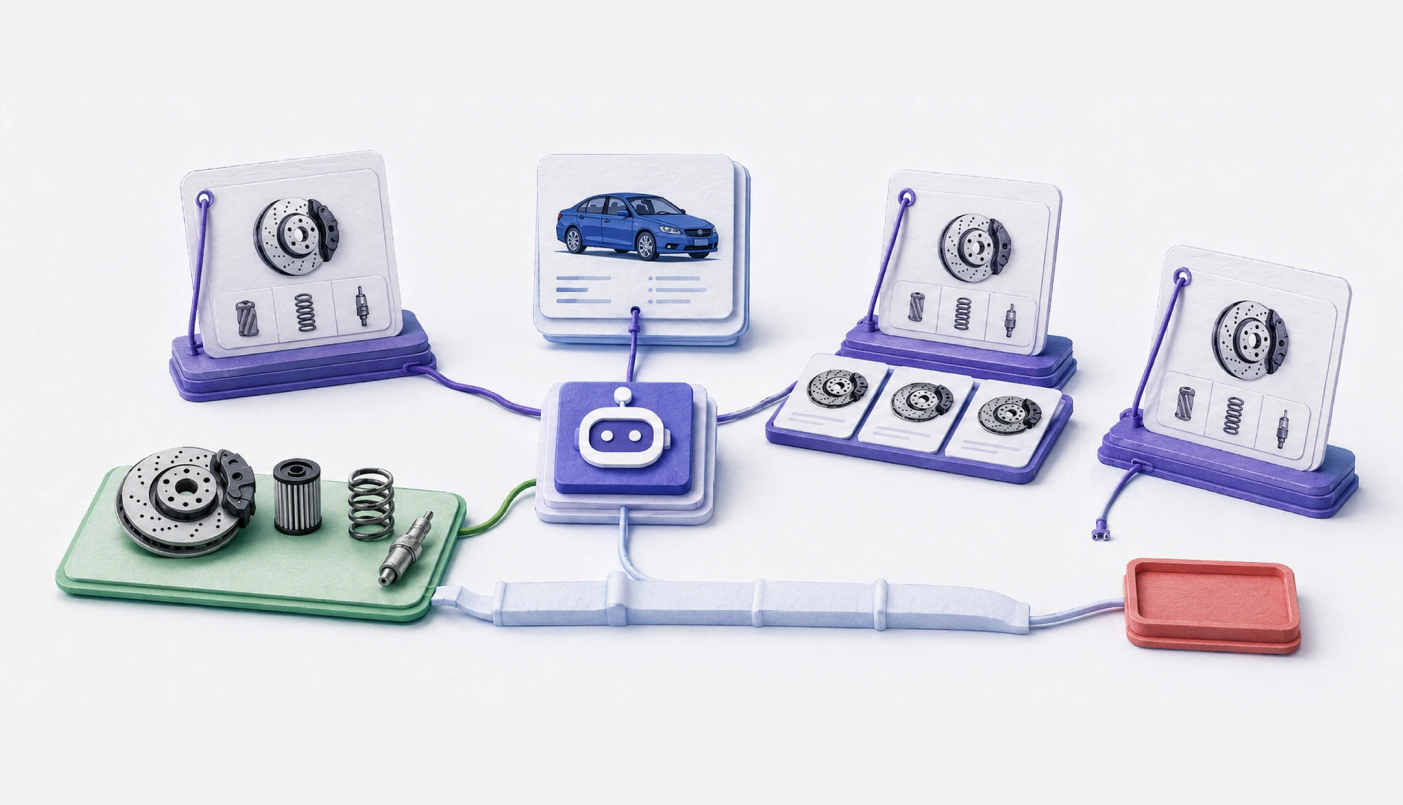
What decides the agent’s answer is what your systems do with that feed (of licensed data) at the moment of the query. There are five layers between the reference data most of the market uses and an answer an agent can act on with confidence, and every one of them is something you can control with engineering.
Think of it like a building: the reference data is your foundation, something that looks the same for every building on the street. The building (the five engineered layers that work on that data) is what creates important trust signals. That’s how you set yourself apart.
Let’s go through each of those layers in turn.
Layer 1: Question Resolution
The agent’s question (“front brake pads for a 2019 Ford Focus”) is under-specified: a 2019 Ford Focus is not one vehicle, not when you consider all the engine and trim combinations and a production-date split. As a result, the front brake specification does not stay constant across them. The reference data contains mappings for all combinations, but it cannot clarify which combination the buyer is actually seeking. That requires judgment.
The engineering response is a resolution policy that should act regardless of the search origin (on-site search or agent search): vehicle decode from a registration or VIN, disambiguation logic, and knowing when to return one confident answer, when to ask a single clarifying question, and when to return ranked candidates with the ambiguity stated plainly. The resolved endpoint gives an agent a safer, lower-ambiguity answer to act on. Same reference data, different answers.
One question, two endpoints, the same licensed data behind both "front brake pads for a 2019 Ford Focus"
Returns every pad set mapped to any 2019 Focus, with the engine and build-date qualifiers left for the caller to interpret. Technically complete, commercially useless. The agent either guesses or moves on.
Decodes the registration to a single build, returns one pad set with the fitment qualifiers attached, and where the vehicle genuinely cannot be narrowed, says so and asks one question rather than thirty.
Illustrative. The feed supplies candidates; resolution handles uncertainty.
Layer 2: Enrichment
The licensed data is a floor, not a ceiling. Oftentimes, the licensed data lags behind new vehicles, misses attributes, and includes supersession chains that dead-end. For example, when a part is superseded twice (the replacement is superseded again), the licensed data feed may record only the first hop. When this happens, an agent searching the original number gets an obsolete result (or a zero-result return), while a competitor whose systems walked the chain to the current part sells it.
Behind success such as the above example sits a pipeline that merges feeds, resolves those chains to their live endpoint, and builds the cross-reference graph between brands that no one source (of licensed data) carries completely. As a result, two distributors with identical licenses end up running materially different effective catalogs, and the gap widens over time.
Layer 3: Live Commercial Truth
An agent does not only need “this part fits,” it needs “this part fits, is available at the nearest branch, at this price, deliverable today.” Stock, price, and delivery promises are transactional and have to be resolved from current operational systems, which in turn depend on how often those are versioned and corrected.
The failure to represent live commercial truth is expensive. Consider an overnight stock file written at 02:00. If the commercial truth is that the branch sold its last unit at 17:30 the previous day, the eCommerce site is already out of date, so that when at 09:00 an agent is told the part is available (and a customer is told the same), the correction arrives as a cancellation. A correct fitment answer attached to a stale stock figure is still a wrong recommendation, and it is the kind of wrong that gets remembered (by AI agents and buyers alike).
Layer 4: Access
While many of the above fixes also benefit pages that exist only for human eyes, AI agents need more to support their search. What is needed is a serving layer: documented APIs and structured feeds, with protocol support appropriate to the journey, such as MCP for tool connectivity and UCP or ACP for commerce flows, at a latency and reliability an automated caller will tolerate. The practical test is simple: can a machine obtain the part, application, price, and availability for a named vehicle through a documented interface or a short deterministic sequence, or must it scrape a rendered page and infer the answer?
Adobe’s first quarter of 2026 report indicates that while traffic from AI sources to retail sites in the U.S. grew 269% and converted 42% better than non-AI traffic, the average product page is only 66% readable by AI.
We’ve made unreadable catalogs machine-legible on six live platforms: See what we changed and what happened next in our free 37-page Unreadable field report.
Read MoreLayer 5: The Feedback Loop
This is the layer nobody licenses, and no competitor can buy: your own transaction outcomes. Which resolved fitments converted? Which came back, and why? Which parts were genuinely bought together for which vehicles?
Returns data is the sharpest example. Suppose the licensed feed maps a pad set to every build of a given model, and your returns show a consistent pattern of wrong-fit claims from one build period. You now hold a signal the licensed source does not, because you paid for it in refunds and nobody else in the market has that particular insight.
What you do with your transaction outcome data matters as much as having it. Outcome data is evidence, not ground truth on its own. A recurring wrong-fit pattern should open a governed exception: verify the vehicle and build a split, rule out picking, installation, and product-quality causes, and require a minimum evidence threshold before suppressing or overriding a relationship. Every correction should carry its source, its confidence, and its audit history. After all, you are aiming to improve your catalog accuracy, not corrupt it.
Your customers are right that the ingredient is a commodity. That is precisely why the kitchen is the business.
What This Looked Like At GSF Car Parts
The fitment-based bundles Net Solutions engineered at GSF Car Parts demonstrate the bottom-line benefits that these engineered layers can produce: vehicle-specific repair relationships that make the basket more complete. Average order value on regular orders was around £65, while fitment-constructed bundle orders reached £102 and above, on reference data competitors in that market can also license. The basket-completeness argument is covered at length separately.
Why This Is Worth Preparing For Now
As Adobe’s survey indicated above, the evidence for acting is better than the forecasts, with each quarter continuing to show AI traffic growth in the hundreds and conversion that trumps any SEO optimization plan. And it’s happening quickly. Just a year ago, AI traffic converted 38% worse and today it’s 42% better than organic traffic. Read those numbers carefully: they measure people arriving at retail sites from AI sources and then buying. These are the outcomes you want for your site.
The transaction rails moved in the same period. Google launched the Universal Commerce Protocol at NRF in January 2026, co-developed with Shopify, Etsy, Wayfair, Target and Walmart and endorsed by more than twenty partners, then added cart and product discovery capabilities in March and cross-retailer Universal Cart in May. OpenAI launched Instant Checkout through the Agentic Commerce Protocol with Stripe in September 2025. Anthropic donated the Model Context Protocol to the Agentic AI Foundation in December 2025, giving it neutral, multi-vendor governance under the Linux Foundation.
Adoption of in-chat checkout has been uneven since, and that is the useful part. Reports in March 2026 had OpenAI scaling back Instant Checkout, and the pattern several retailers now describe is discovery in AI with the purchase completing on the seller’s own site. Which checkout rail wins is not your problem to solve. Whether your data can answer the question that comes before checkout is, and that requirement holds under every version of this.
The standards side moves on its own schedule regardless. The Auto Care Association released ACES 5.0 and PIES 8.0 in 2026, with the underlying vehicle and product databases on their own release cycle. That is a real deadline attached to a real standard, and a better reason to act than any market-sizing forecast.
Today, the answer is clear: outcome data will only accrue to whoever transacts. Later entrants begin with less first-party outcome history, while earlier operators can accumulate validated corrections and vehicle-specific purchasing patterns that support continued AI recommendations.
What To Do In The Next Twelve Months
The work ahead is less exotic than the topic sounds; the tasks mapped directly to the five layers outlined earlier:
- Structure your eCommerce and product data to current ACES, PIES or TecDoc standards and build the enrichment pipeline that patches what the feeds miss.
- Put a real resolution engine in front of it, with vehicle decode and disambiguation rather than keyword search.
- Deliver wire stock, pricing and delivery promises live from the ERP rather than from last night’s batch.
- Serve all of it through documented APIs compatible with the emerging protocols.
- And instrument the feedback loop from day one, because outcome data is the only layer that compounds.
None of these fixes are single-purpose; the same foundation makes on-site search sharper, marketplace feeds cleaner, and your catalog legible to answer engines. The operating metrics that tell you whether it is working are covered separately.
Frequently Asked Questions
It is when an AI agent, acting for a buyer, reads structured application and product data and returns a specific part recommendation, sometimes without the buyer visiting a storefront at all. The agent matches the vehicle the buyer named to a part, and the quality of that match depends on how well your data answers the question, not on how your pages look.
What separates sellers holding identical licenses is what their systems do with that feed at the moment of the query: resolving an ambiguous vehicle to a confident answer, enriching what the feed misses, attaching live stock and price, exposing all of it in machine-readable form, and feeding transaction outcomes back in. This information cannot be licensed; it can only be built.
Not at meaningful scale… yet. Adobe’s figures show that AI-mediated discovery is growing and that shoppers arriving from AI sources now convert strongly once they reach retail sites. Google, OpenAI and Stripe have also shipped transaction rails for agent-led commerce. Together, those facts justify making product, application, stock and pricing data machine-readable now, but they are not evidence of widespread autonomous purchasing of car parts.
Whether your systems can turn the buyer’s vehicle into a confident, current, machine-readable answer: correct application resolution, enriched data that covers what the feed misses, live stock and price, and an interface the agent can reach without executing a page. Presentation matters far less here than it does for a human shopper, because much of what the agent consumes is structured data rather than rendered layout.
Work the five layers in order: structure and enrich application and product data to current ACES, PIES or TecDoc standards, put vehicle decode and disambiguation in front of it, wire stock and pricing live rather than nightly, expose it through documented APIs compatible with the emerging protocols, and capture transaction outcomes to feed back in. The same work sharpens on-site search and marketplace feeds regardless of how fast agent-led buying grows.
See Whether Your Commerce Foundation is Ready for AI-mediated Buying
The AI Growth Readiness Assessment evaluates four broader pillars and returns a strategic maturity scorecard, an executive assessment report and a prioritized 180-day roadmap.