
Executive Summary
Wrong fitment data is one of the most expensive errors in an automotive aftermarket catalog. It ships the wrong part, triggers a return, and erodes customer trust. Most distributors already hold the data they need, but it sits in formats that buyers, marketplaces, and AI shopping agents cannot read reliably. This guide sets out five steps to fix that: prioritize categories, normalize product identity, structure fitment, expose accurate commercial data, and establish governance.
Key Takeaways
- Auto parts carry one of the highest online return rates in retail, and incorrect fitment data is consistently cited as a leading cause.
- The problem is rarely missing data. It is fragmented data spread across ERP tables, supplier PDFs, and free-text notes.
- Every part needs one stable, multi-key identity before any system can match it with confidence.
- Compatibility belongs in structured application data, such as ACES, not in product descriptions.
- Price and stock data need timestamps and defined refresh windows. Otherwise, a correct fitment answer still produces a wrong order.
- Start with high-return, high-margin categories instead of trying to clean every SKU at once.
Why Wrong Fitment Data Costs More Than the Return Itself
In the automotive aftermarket, a part that does not fit is rarely just a logistics problem. It brings two-way shipping, restocking labor, marketplace defect scores, customer service time, and, most damaging, eroded trust. A machine-readable catalog, one that software can parse without guessing, removes that cost at its source.
The scale is hard to ignore. Auto parts had the highest return rate of any merchandise category, at 19.4 percent, in a survey by the National Retail Federation and Appriss Retail. Industry surveys and operator reports consistently identify incorrect fitment or compatibility information as a leading cause.

The issue isn’t that distributors lack data. Catalogs of 200,000 SKUs (stock keeping units) or more are common, and the data to describe them usually exists. It simply lives in fragmented places: legacy ERP (enterprise resource planning) tables, supplier PDFs, regional databases created through successive acquisitions, and free-text notes that once made sense to experienced counter staff.
When a human buyer, a marketplace algorithm, or an emerging procurement agent queries that catalog, the response is often ambiguous. Year ranges get compressed. Engine qualifiers disappear. Supersession chains (the record of which part number replaced which) sit inside paragraphs instead of structured relationships. The result is always the same: the wrong part ships, the return arrives, and margin disappears.
If the cost is this clear, the obvious question is why the problem survives years of investment in data standards.
Catalog Data Stays Unreadable Despite Industry Standards
Three forces keep the problem alive even after years of discussion around ACES, PIES, and data quality.

Supplier Data Arrives Incomplete and Inconsistent
Supplier data quality varies widely. Raw feeds arrive with inconsistent units, missing qualifiers, overlapping applications, and production-date notes that suppliers either over-apply or omit. Teams that simply ingest and publish what they receive inherit the errors. Teams that try to clean everything manually never finish. Our analysis of product data quality and fitment accuracy shows how this one weakness spreads into search, recommendations, and AI.
Catalog Accuracy Rarely Has an Owner or a Metric
Organizational incentives rarely treat catalog accuracy as a first-class operational metric. Teams track returns, but customer service, logistics, and marketplace performance reports each absorb a share of the fitment problem, so its true contribution gets diluted. High-margin, high-velocity categories (brakes, lighting, batteries, and filters) generate outsized pain, yet companies often spread catalog investment thinly across the entire assortment.
A Clean First Feed Becomes Permanent Governance Work
The clean technical narrative understates the ongoing work. That narrative usually runs like this: stand up a middleware layer, normalize identity, expose JSON-LD and an API, and leave the ERP untouched. In practice, several responsibilities never go away once the first clean feed goes live:
- Identity mapping: New suppliers, acquisitions, and supersessions keep adding records that must map to existing parts.
- Standards currency: ACES and PIES files must keep pace with new versions and new vehicles.
- Market differences: VIN and registration decoding behave differently across markets.
- Liability: Safety-critical parts carry exposure that a structured answer does not remove.
- Exception handling: Low-confidence matches still need a human review queue.
These become permanent governance responsibilities. Managing them starts with a clear picture of what a usable record must contain.
What a Machine-Readable Auto Parts Record Contains
A usable catalog for both human and machine buyers needs more than product titles and prices. It needs three foundations: deterministic identity, constrained fitment, and explicit freshness. A fourth layer then publishes those facts in a form machines can parse.
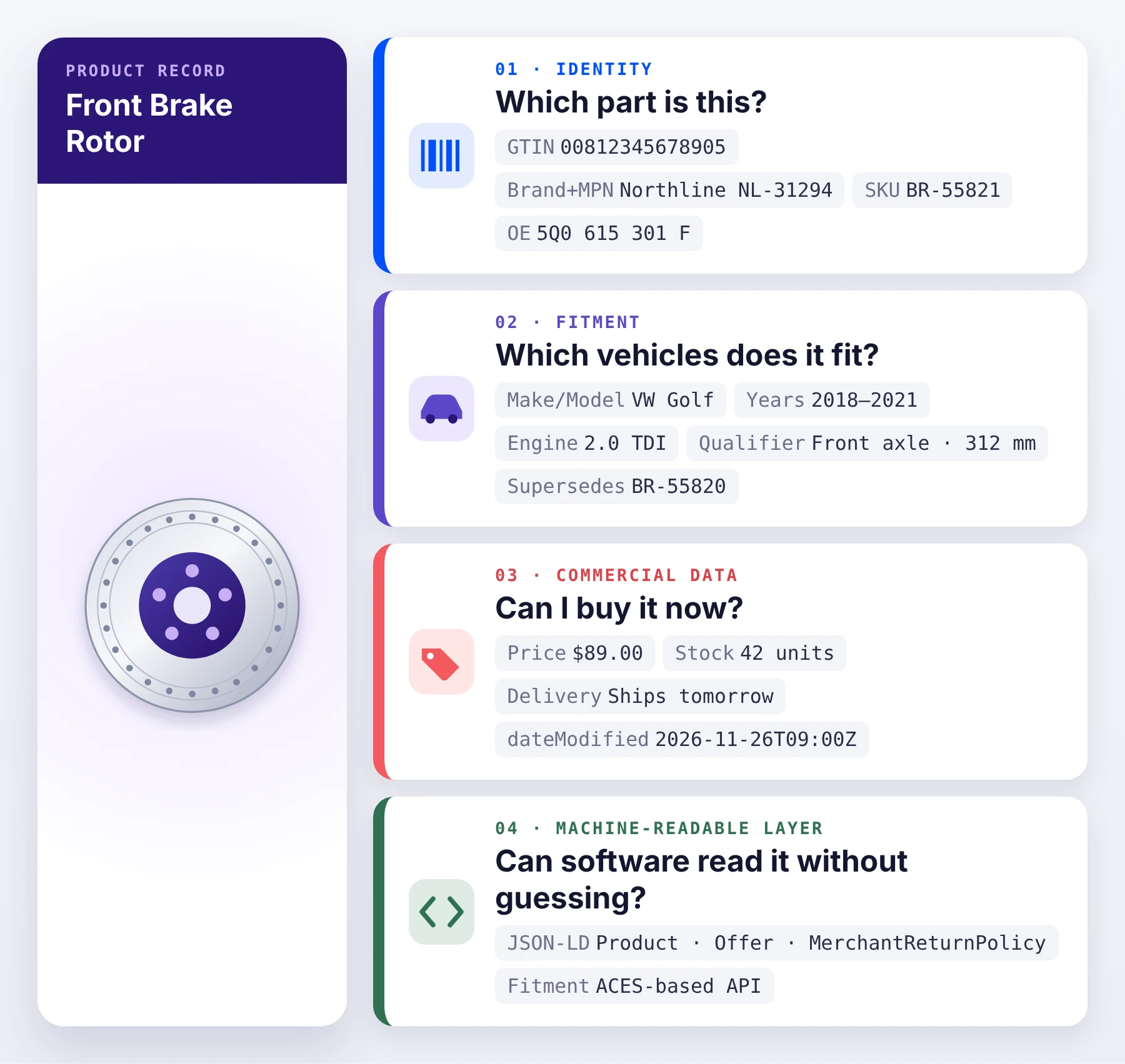
| Record layer | What it holds | Why machines need it |
|---|---|---|
| Identity | GTIN, brand plus MPN, internal SKU, and OE cross-references | Lets any system recognize the same physical part across feeds, sites, and ERPs |
| Fitment | Make, model, engine, year range, qualifiers, and supersession chains | Lets a buyer or agent confirm the part fits a specific vehicle |
| Commercial data | Price, stock, delivery promise, and a dateModified timestamp | Lets a buyer or agent trust that the offer is current |
| Machine-readable layer | Schema.org JSON-LD for commercial facts, plus a dedicated fitment model or API | Lets crawlers and agents read the record without site-specific scripts |
Each layer depends on the one before it. The five steps below build them in the order that pays back fastest.
Make Your Product Catalog Machine-Readable in Five Steps
The realistic path is prioritization and governance, not big-bang transformation. Most organizations cannot and should not try to perfect 200,000 SKUs at once. The workable sequence is narrower, and you can measure progress without waiting for a full catalog rebuild.

Step 1: Prioritize the Categories Where Wrong Fitment Costs the Most
Begin with categories that combine high gross margin, high demand, frequent search failure, and high return rates. Braking, electrical, and certain chassis components frequently surface first.
Measure how much fitment-related returns and zero-result searches currently contribute in those categories. Then score a sample of their product pages against the four record layers above. That baseline is more valuable than any generic industry statistic, and it tells you where the next four steps will pay back first.
Step 2: Normalize Product Identity Across Every System
Every item requires a stable, multi-key identity:
- GTIN: The Global Trade Item Number encoded in a barcode, where one exists.
- Brand plus MPN: The brand name paired with the manufacturer part number.
- Internal SKU: Your own catalog and inventory identifier.
- OE cross-references: The original equipment part numbers the part replaces.
Without this, the same physical part appears as three different records after an acquisition or a regional ERP deployment. Neither agents nor sophisticated search can resolve it cleanly.
Whether you build or buy the capability to normalize identity and fitment, it sits at the core of automotive aftermarket commerce development, because every later step depends on it.
Step 3: Structure Fitment Data So Machines Can Read It
Fitment must move out of prose. “Fits 2018 to 2021 Golf with 2.0 TDI” is useful to a knowledgeable human, but it is unreliable for an automated system. The relationships belong in structured form: supersession chains, OE cross-references, and application matrices that record make, model, engine, year range, and the qualifiers that actually matter (drivetrain, brake system, production window, and emissions variant).
ACES (Aftermarket Catalog Exchange Standard) and PIES (Product Information Exchange Standard) remain the practical industry baseline for North American data exchange. The Auto Care Association maintains both and released ACES 5.0 and PIES 8.0 in April 2026. They are not perfect, and coverage is never 100 percent, but they provide a shared language that free text does not. Other regions use equivalents, such as TecDoc across much of Europe. The practical test is simple: can a machine read that language on your product page without site-specific scripts?
VIN or registration lookups need the same discipline. Explicit confidence thresholds help, but they are not magic:
| Match confidence | What the system should do |
|---|---|
| High | Return a single part. |
| Medium | Show ranked candidates with the differentiating attributes visible. |
| Low | Refuse to guess and ask for more vehicle detail. |
On safety-critical categories, set a higher threshold for automatic recommendation, and keep human or contractual review where needed. Liability does not vanish because the system returns a structured answer.
Step 4: Expose Accurate Price, Stock, and Delivery Data
Price, stock, and delivery promises need ownership and freshness metadata. Exposing live ERP queries to external agents or high-volume crawlers creates security and performance risk. The pragmatic pattern is a cached edge state with a clear dateModified timestamp and a defined tolerance window:
- High-velocity SKUs: Justify tighter synchronization, because their price and stock change often.
- Long-tail SKUs: Can live with a longer TTL (time to live, or how long cached data stays valid), provided you state the limit explicitly.
Freshness is measurable. When Net Solutions rebuilt the GSF Car Parts commerce platform, product-data imports fell from 16 hours to 17 minutes. Stock refreshes increased from four to six times a day, with real-time validation at checkout.
17 min
was 16 hours
Product-data import time
6×/day
up from 4× a day
Stock refreshes
Real-time
at checkout
Stock validation
Schema.org Product, Offer, and MerchantReturnPolicy markup in valid JSON-LD (a script-based format for embedding structured data in a page) helps crawlers and many AI systems parse the commercial facts. It does not, however, carry multi-dimensional vehicle fitment. That complexity belongs in the dedicated compatibility model or API from Step 3, not forced into generic retail types.
Two checks close this step. First, confirm that your feed, your schema markup, and your visible page agree, which is one of the strongest and least disputable readiness tests. Second, confirm that a machine can find the path to the basket and read the basket state. Many sites still fail these basic preconditions.
Step 5: Establish Governance and Ownership for Catalog Accuracy
Treat supplier data quality as an ongoing contract and operational issue, not a one-time enrichment project. Maintain an exception queue for low-confidence matches rather than forcing every lookup to return a single SKU. Name an owner for catalog accuracy, and measure that ownership with the same rigor you apply to returns and conversion. The aftermarket eCommerce metrics that expose margin leakage offer a starting set.
Governance is also what keeps the catalog ready for the next kind of buyer.
How the Same Foundations Prepare You for AI Shopping Agents
Agentic commerce is real and growing: procurement agents can already authenticate, check availability, confirm fitment, and place orders. The transaction rails exist too. OpenAI launched Instant Checkout through the Agentic Commerce Protocol in September 2025, and Google launched the Universal Commerce Protocol in January 2026. Yet in the automotive aftermarket today, most volume still moves through human buyers, traditional B2B channels, and marketplaces.

The practical priority is therefore to make the catalog reliable for the channels that already matter. The same foundations (identity, structured fitment, freshness, and documented interfaces) will also serve agents as their share of volume grows. Treating agent readiness as a separate moonshot usually fails. Treating it as the logical extension of fixing current data problems, and measuring both the same way, is more durable.
RECOMMENDED READING

Knowing what to build is half the work. The other half is asking the right questions about where you stand today.
Six Questions That Show Whether Your Catalog Is Ready
Business owners and CTOs do not need another checklist of ideal end states. They need clear answers to a short set of questions, and a way to score those answers:

- Cost: Which categories currently generate the highest absolute cost from fitment-related returns and search failure?
- Supplier data: How much of your supplier data arrives with complete, constrained applications, and how much arrives as free-text notes or with missing qualifiers?
- Source of truth: Do you have a single, governed source of truth for identity and fitment, or do marketplace feeds, the website, and the ERP still diverge?
- Ambiguity: When a VIN or registration lookup is ambiguous, does the system force disambiguation or silently pick a part?
- Ownership: Who owns ongoing data quality, and do you measure that ownership?
- Readiness: Against a transparent readiness score, where do your priority categories sit today, and what would it take to move them into the “machine readable” or “agent ready” band?
Your answers point to where the work should start, and to what the business gains once it is done.
What Fitment Accuracy as an Operational Discipline Delivers
The organizations that reduce the quiet cost of ambiguous fitment are not the ones that announce the most ambitious catalog transformations. They treat fitment accuracy as an operational discipline, prioritize ruthlessly, and keep humans in the loop where risk is high. They also measure progress in a way that separates generic retail markup from true compatibility readability.
The payoff is concrete: buyers find the right part faster, fewer wrong-fit parts ship, and the catalog is ready for AI-led commerce when agents’ share of volume grows.
In the automotive aftermarket, a machine-readable catalog is not a technical upgrade. It is the difference between selling the right part once and paying for the wrong one twice.
FAQs
A machine-readable product catalog stores each product’s facts as discrete, structured fields that software can parse without interpreting prose. For auto parts, that means a stable part identity, structured vehicle fitment, and current price and stock data. Search engines, marketplaces, and AI shopping agents can then match the right part to the right vehicle without guessing.
Not reliably. Schema.org Product, Offer, and MerchantReturnPolicy markup describes commercial facts such as price, availability, and returns. It does not model multi-dimensional fitment, such as engine, production window, and drivetrain qualifiers. That data belongs in a dedicated compatibility model or API, typically built on ACES in North America or TecDoc in Europe.
ACES (Aftermarket Catalog Exchange Standard) describes which vehicles a part fits, including make, model, year, engine, and qualifiers. PIES (Product Information Exchange Standard) describes the part itself, such as specifications, packaging, pricing, and digital assets. The Auto Care Association maintains both and released ACES 5.0 and PIES 8.0 in April 2026.
Not at meaningful scale yet. Most aftermarket volume still moves through human buyers, B2B channels, and marketplaces. However, OpenAI and Google have both launched protocols for agent-led checkout. The same work that makes your catalog reliable for human buyers today, such as structured fitment and fresh stock data, also prepares it for agents.
Make Your Catalog Readable for Every Buyer
Net Solutions builds the identity, fitment, and freshness foundations that let buyers, marketplaces, and AI shopping agents find the right part the first time.