Executive Summary

A healthcare technology venture set out to solve a problem its founder had watched play out inside his own family’s dental practices. Clinic operations were split across spreadsheets, paper logs, and disconnected tools, and nobody had a single view of what was happening on any given day.

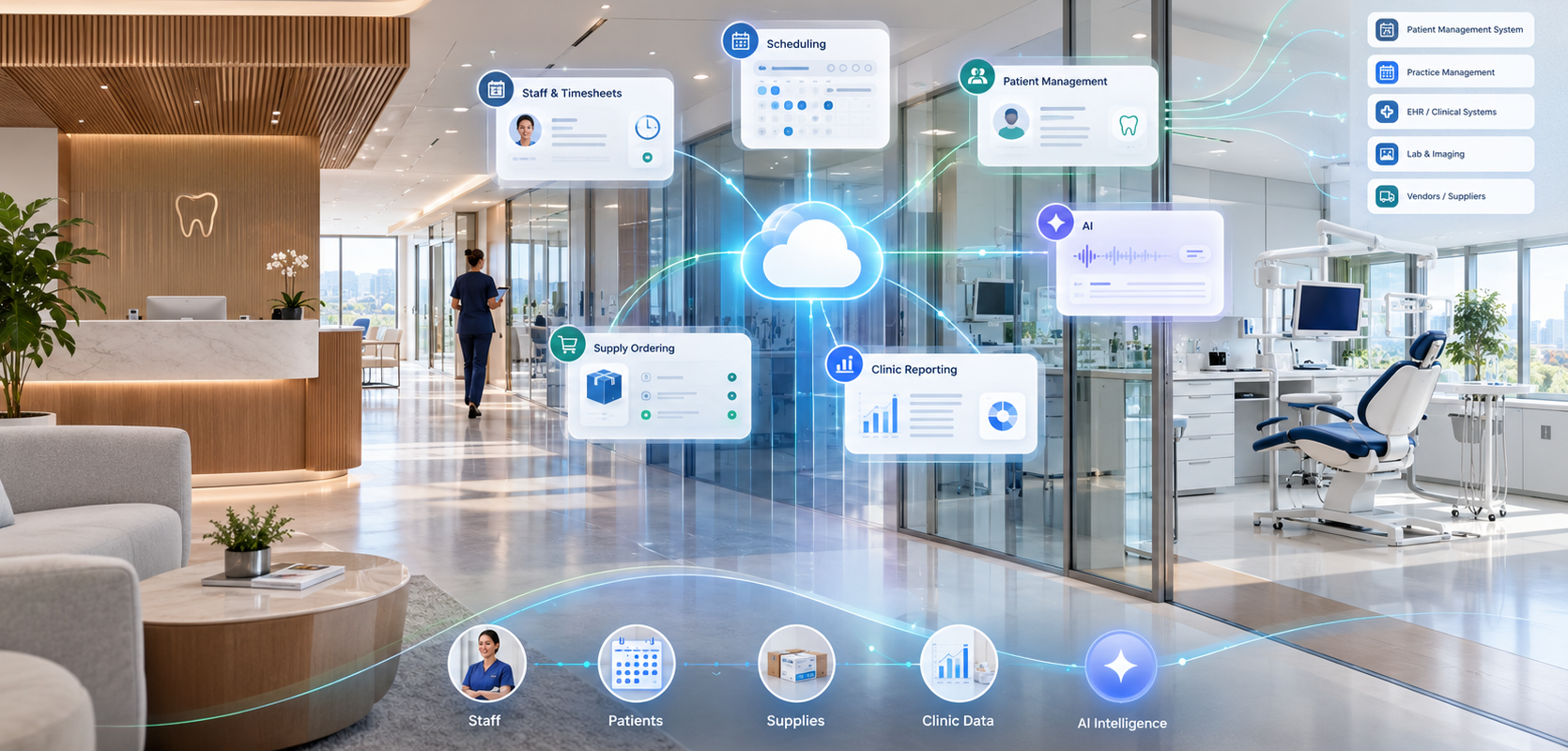
We partnered with the founder to build a cloud platform that unifies staff management, patient scheduling, supply ordering, and clinic reporting in one place. What began as a timesheet and scheduling product has grown into a connected ecosystem for clinic owners, staff, patients, and vendors, built on a flexible architecture that integrates with whatever Patient Management System a clinic already runs.

The platform is now in active use across multiple markets, with an AI layer that answers how-to questions and operational data queries in plain language.

Client Snapshot

  • Company: Healthcare technology venture, name withheld under NDA
  • Industry: Healthcare, clinic operations software
  • Product: Multi-tenant SaaS platform for clinic management
  • Users: Clinic owners, clinical and administrative staff, patients, vendors, and sales representatives
  • Geography: Multiple markets, urban and small-town practices
  • Engagement: End-to-end product engineering, from discovery to ongoing feature development

Outcome

  • One system of record: Staff schedules, timesheets, tasks, appointments, and inventory now live in a single platform instead of across silos.
  • Adoption without replacement: A universal integration layer lets clinics connect their existing PMS rather than abandon it, removing the biggest barrier to signing up.
  • Configurable by clinic: Every clinic sets its own rules for location validation, approvals, and controls, so one product serves very different operating styles.
  • Answers instead of reports: AI-powered help and a data-aware chatbot let staff get what they need by asking, without navigating screens or filing a support ticket.

The Challenge

In 2020, lockdowns and safety protocols exposed how much clinic work depended on being physically present and on informal habits that nobody had written down. Rotas lived in spreadsheets, tasks were passed along in hallways, and patient scheduling ran through phone calls. When those routines broke, there was no digital fallback.

The founder saw the gap clearly, but building for it meant solving eight distinct operational problems, not one.

Fragmented Staff Management

Clinics tracked schedules, leave, task assignments, and reviews in whatever tool was nearest. Coordination was slow, error-prone, and impossible to audit.

Timesheets Nobody Could Trust

Owners had no reliable way to confirm that logged hours matched actual attendance, and every clinic had a different tolerance for how tightly that should be policed.

Tasks With No Trail

Work was assigned in passing and forgotten just as easily. Owners could not tell what had been completed on time, and staff had no record of what was expected of them.

Patients Left Outside the System

Managing staff solved half the problem. Clinics still needed a way for patients to find a doctor, book a slot, and see it reflected in the same calendar the team worked from.

Supply Ordering by Guesswork

Without a system, clinics either ran out of essentials or tied up cash in overstock, and vendors had no clean channel into their accounts.

Incompatible Patient Management Systems

No two clinics ran the same PMS, and those systems were too embedded in daily workflows to rip out. Any platform that demanded replacement was dead on arrival.

Subscription Resistance

Owners were wary of another recurring cost for software they had not yet seen working in their own practice.

A Learning Curve Staff Had No Time For

As the feature set grew, so did the friction. Busy staff were not going to read manuals or wait on support tickets to answer small questions.

Our Approach

We started with the day-to-day reality rather than the feature list. Discovery sessions with clinic managers, front-desk staff, and patients told us where the friction actually sat, and we ordered the roadmap around the problems that cost people the most time every single day.

Rather than build everything before shipping anything, we delivered quick wins first: secure timesheet validation, task management, and appointment scheduling. Underneath those, we built an architecture flexible enough to absorb everything that came later, including modules nobody had specified yet.

From there we layered in patient and supply chain applications, automation for repetitive manual work, and configurable controls so each clinic could operate its own way instead of bending to a rigid system.

With a secure real-time data handling, a dedicated integration layer sits between the platform and each clinic’s Patient Management System.

Every feature moved through prototyping, real-world testing, and feedback from working clinics before it was considered done.

The Solution

Eight modules, built in sequence rather than all at once, each one answering a problem clinics had named themselves. The order matters: the operational core shipped first, and everything that followed was designed to sit on top of it without disturbing what was already live.

01.

Configurable Time and Attendance

We tested every practical method of validating where a staff member actually was: geofencing, IP restrictions, and mobile device checks. Instead of picking one, we built a system where the clinic owner chooses the level of control. Some clinics allow entries from anywhere. Others require staff to be inside the building, connected to a specific Wi-Fi network, or within a geo-fence radius.

For clinics that want precision, Clock In and Clock Out records time in the moment, and any later edit has to be approved.

02.

Task Management and Performance Reviews

Owners assign tasks with deadlines. Staff update progress and log completion times, creating a record both sides can see.

We extended this into a two-way performance review system where staff self-assess and owners respond, making evaluation transparent rather than opaque.

03.

The Patient Application

Patients register, browse doctors, and book appointments themselves. Doctors can also book on a patient’s behalf when it is easier to handle over the counter or the phone.

A shared calendar gives owners and staff a single view of every appointment, and lets them schedule internal events around genuine availability.

04.

Supply Ordering and Inventory

The Supply application lets sales representatives place orders directly for the clinics they serve. Vendors publish catalogs, and owners browse and buy from them.

Inventory management sits alongside it, so clinics can track stock levels, check items out, and scan barcodes for faster updates.

05.

Universal PMS Integration Layer

The single decision that most affected adoption. By connecting the platform to a wide range of Patient Management Systems, we let clinics sync appointments and records without giving up the tools they already trusted.

That turned a hard sell into an easy one. The platform enhanced what clinics ran instead of competing with it.

06.

A Subscription Clinics Could Justify

We stopped leading with features and started leading with the headaches clinics named themselves: slow timesheet approvals, messy patient scheduling, tasks falling through. Once those savings were visible in time and cost terms, the subscription read as an investment in smoother operations rather than another line item.

07.

AI-Powered Online Help

A built-in AI assistant answers how-to questions and walks users through tasks step by step, inside the screen where the question came up. Staff no longer break their flow to call support for something small. The platform explains itself.

08.

Data-Aware Chatbot

Clinics were sitting on useful operational data that took too many clicks to reach. The chatbot answers plain-language questions about a clinic’s own records, from how many appointments are booked tomorrow to who is on leave this week, with no reports to open or filters to set.

Impact

The clearest measure of success is that clinics stopped working around their systems. Coordination that used to depend on spreadsheets, hallway conversations, and phone calls now runs through one platform, and owners can see what is happening across their locations without asking anyone.

Coordination Delays Cut

Centralized staff management replaced the spreadsheets and manual logs that slowed every scheduling decision.

Fewer Manual Errors

Automated workflows removed the handoffs where information used to get lost or entered twice.

Better Operational Visibility

Real-time updates improved both safety compliance and day-to-day efficiency for owners overseeing multiple locations.

New patient engagement channels

Secure video consultations opened remote care options that did not exist before the platform.

The product is in active use at leading clinics across multiple markets, with growing interest from healthcare workshops and expansion into new territories underway.

Why Net Solutions?

We designed for variation, not the average clinic. Location rules, approval flows, and controls are configuration, not code, so a single-site practice and a multi-location group can both run the platform their own way.

We solved for adoption, not just capability. The integration layer and the value-first subscription approach were product decisions aimed squarely at the reasons clinics say no.

We built for what came next. The architecture we chose in the first release absorbed patient booking, supply chain, inventory, and an AI layer without a rewrite.

We tested with real clinics. Every module went through prototyping and live feedback loops with the people who would use it under pressure.

What's Next

The backlog is focused on making the platform quicker to work with and smarter about the patterns it already sees. That includes automatic shift creation, where AI builds optimized staff schedules from availability, workload, and each clinic’s own rules, saving managers hours of planning every week.

The goal is not more features. It is a platform that fits the way clinics already work, with less effort asked of the people running them.

FAQs

What is a clinic management platform?

A clinic management platform is cloud software that brings a clinic’s operational work into one system: staff scheduling and timesheets, task assignment, patient appointment booking, supply ordering, inventory, and reporting. It sits alongside the clinical record system rather than replacing it, and gives owners a single view of how the practice is running.

Why do clinics need a platform if they already use a Patient Management System?

A Patient Management System handles clinical and patient records. It does not usually manage staff attendance, task accountability, performance reviews, supply ordering, or inventory. Clinics typically fill those gaps with spreadsheets and manual logs, which is where coordination delays and errors come from. An operations platform covers that layer and syncs with the PMS already in place.

Can a clinic operations platform integrate with any Patient Management System?

Yes, with the right architecture. In this project we built a universal integration layer that connects the platform to a wide range of PMS tools, so clinics can sync appointments and data without switching systems. This was the single biggest driver of adoption, because clinics do not have to abandon software their workflows depend on.

How can clinics verify staff attendance accurately?

Through configurable location validation. Options include geofencing, IP restrictions, Wi-Fi network checks, and real-time clock in and clock out with approval required for any later edit. The important part is configurability. Different clinics want different levels of control, so the owner sets the rule rather than the software imposing one.

How is AI used in clinic management software?

In two practical ways on this platform. An AI-powered help assistant answers how-to questions inside the product and walks staff through tasks, which removes support tickets for routine questions. A data-aware chatbot answers plain-language questions about the clinic’s own data, such as tomorrow’s appointment count or who is on leave this week, without anyone opening a report. Automatic AI shift creation is on the roadmap.

What technology stack is used to build a healthcare SaaS platform?

This platform uses React JS for the web application, React Native for cross-platform mobile applications, and .NET APIs for secure real-time data handling, with a dedicated integration layer for third-party Patient Management Systems. The stack was chosen for cross-platform reach, real-time performance, and the ability to add modules later without re-architecting.

How long does it take to build a clinic management platform?

It depends on scope, but the practical answer is that you should not wait for the full product. This platform launched with a focused first release covering timesheet validation, task management, and appointment scheduling, then expanded into patient, supply chain, inventory, and AI modules over time. A flexible architecture in release one is what makes that expansion possible.


How do you convince clinics to adopt a subscription platform?

By demonstrating value before asking for commitment. Feature lists do not persuade clinic owners who are already cautious about recurring costs. Showing how the platform removes their most expensive daily headaches, such as slow timesheet approvals, scheduling gaps, and missed tasks, and tying those to hours and money saved, reframes the subscription as an operational investment.

Let's talk

Ready to Build Your Platform?

You know where your operations lose time. We help healthcare and multi-location businesses turn that into software their teams actually use. Tell us what is slowing your operation down, and we will tell you what it would take to fix it.

Platforms we work across

Custom Cloud Platforms, Mobile Applications, Third-Party System Integrations, and AI-Assisted Workflows.

Related Success Stories

Results matter. Discover how our customized solutions have delivered measurable business outcomes for clients across various industries. Each case study highlights the strategic impact of our work, turning challenges into opportunities for growth.

Net Solutions

Ask Sol

Powered by Net Solutions

Skip the search. Start the conversation.

Ask Sol anything about digital products, AI, engineering, or growth, and get answers drawn from years of Net Solutions thinking and experience.

Our assistant helps you find content on our website. By asking a question, you acknowledge that we will process your data in accordance with our Privacy Policy, and consent to anonymous tracking of your conversation to help us improve the experience. Please avoid sharing personal or sensitive information, and close this page if you do not agree to these terms. While we strive for accuracy, AI responses may be inaccurate.By chatting you accept our Privacy Policy and anonymous analytics. Do not share sensitive information. AI answers may be inaccurate.