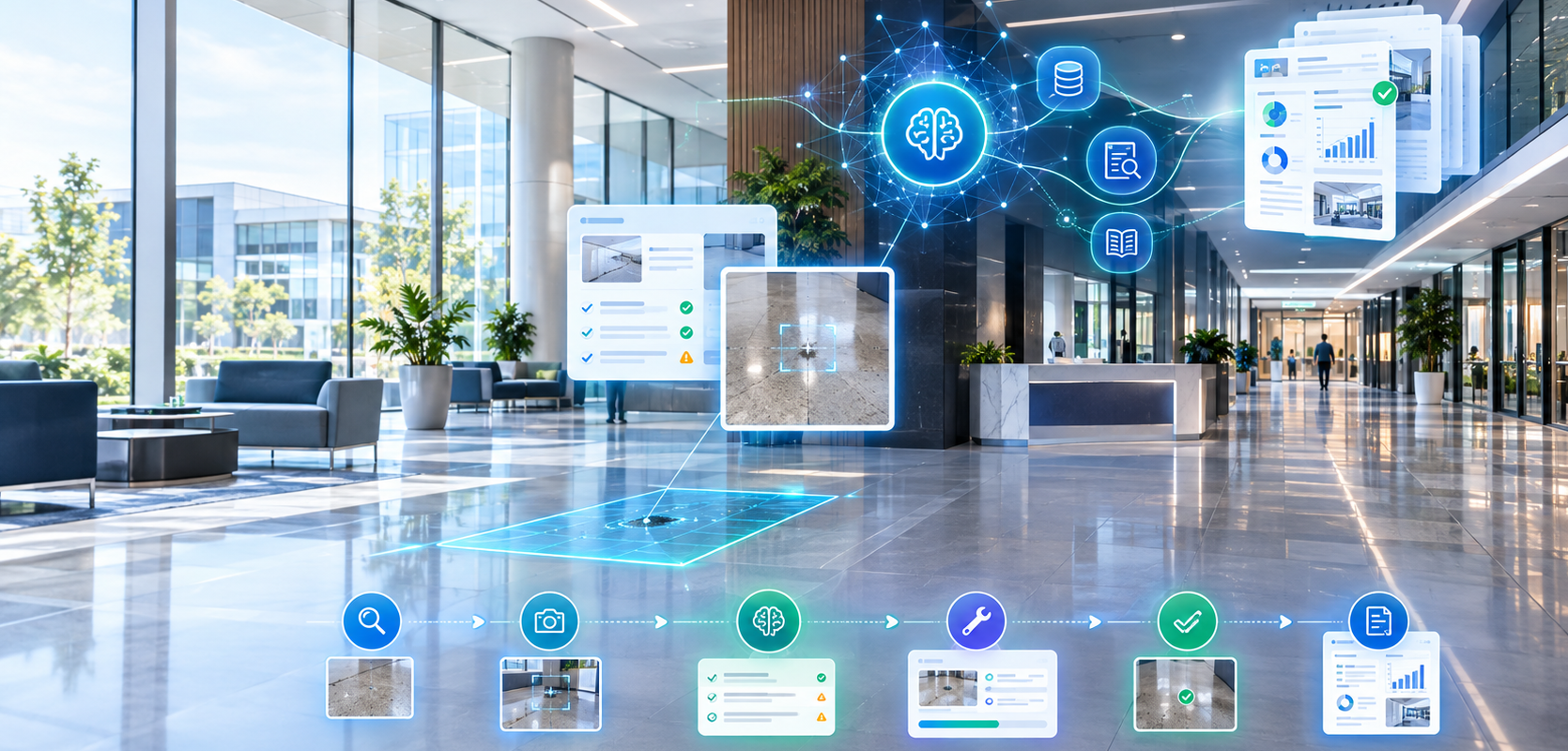
Our client is a North American leader in digital cleaning solutions, working across healthcare, education, hospitality and building services facility management. The company had a growing problem. Inspections were happening, but findings had no reliable route to resolution, cleanliness was still judged by eye, and manual reporting had become a serious administrative bottleneck.
The client partnered with Net Solutions to design and build a cleaning quality management platform. The first release paired a core inspection engine with the client’s proprietary imaging-based validation technology. Over a multi-year continuous partnership, that foundation grew in phases. AI was embedded directly into the platform’s workflows. A standalone RAG-based assistant launched for sales and field teams. A Corrective Action Plan (CAP) module followed, closing the loop between a finding and its resolution.
Every layer now pulls its weight. Imaging-based validation replaces visual guesswork with documented proof. CAP makes sure a flagged issue is tracked to closure instead of disappearing into an inbox. AI and automated workflows absorb the busywork on top, so assessment reports come together faster, the manual effort of writing summaries has dropped sharply, and knowledge that used to sit in scattered files is centralised and searchable. Across facilities, standardised inspection procedures are followed far more consistently than before.
The client backs all of this with ISSA GBAC STAR registration, SOC 2 Type II certification, HIPAA compliance in the US, and a multi-year deployment with a major national healthcare provider.
Assessments completed between 2024 and 2026
Individual assessment items recorded across key customers, 2024 to 2026
Service uptime maintained
Consecutive SOC 2 Type II audits completed with no exceptions
Cleaning has always been treated as a background function, noticed only when it fails. Our client set out to change that, which meant confronting problems the industry had lived with for years.
Stakeholders, especially in healthcare, stopped accepting assurances and started asking for proof. Cleaning had to move from subjective and reactive to objective, data-driven and fast.
Standards were judged through visual inspection or the occasional swab test. Visual checks depended entirely on individual judgement. Swab tests were too slow and too expensive to run at scale.
Cleaning accounted for a significant share of operational labour spend, yet leaders had almost no visibility into whether that investment produced measurable outcomes. Money went out. Proof did not come back.
Cleaning records lived in paper logs and spreadsheets. They were slow to complete, easy to misplace or falsify, and a liability the moment an auditor arrived. There was no defensible trail.
Cleaning protocols and product information were spread across emails, files and multiple systems. Consistent execution was difficult, and sales and field staff lost hours hunting for answers. Customers felt the same delay. Queries took longer to resolve, and slower responses cost trust.
Even after the platform digitised inspections, and before the AI workflow arrived, auditors were still reviewing 50 or more criteria per assessment by hand, writing summaries manually, interpreting photo evidence subjectively, and pulling several reports into one client-facing narrative, all while searching for the right SOP mid-inspection.
When inspectors caught real problems, such as missed restroom sanitisation, incorrect chemical dilution or recurring failures in high-risk zones, the trail went cold once the report went out. PDFs were downloaded, emails sent, calls made, and everyone hoped it got fixed. There was no accountability structure and no measurable closure.
Healthcare, education, hospitality and building services each carry different compliance expectations. A platform built for a hospital’s HIPAA-level scrutiny still had to work for a school district or a hotel chain, without splintering into separate products.
Inspectors work in basements, mechanical rooms and low-signal areas inside healthcare facilities where Wi-Fi is unreliable at best. Any tool built for this job had to run offline without losing data or interrupting the inspection.
The engagement began with joint ideation rather than a handover of requirements. Working alongside the client’s team, we pushed past the feature wish list to the question sitting underneath it: what would a facilities leader accept as proof that a space is clean, and what is the smallest version of that worth putting in front of the market. Those sessions set the shape of the first release. An inspection engine with configurable SOP checklists that worked with or without a connection, paired with imaging-based validation inside the same flow. Corrective action tracking and the AI layer were consciously left for later phases. That focus is why the MVP shipped in 40 days as a fully functional product rather than a prototype, and why the client had real market feedback to steer everything that came after it.
That first release proved the model, and the partnership kept building on it. AI was embedded into the platform’s own workflows, a standalone assistant launched for sales and field teams, and the CAP module closed the loop between findings and resolution. Each new capability was shaped by what field teams did with the last one, so features were added, adjusted or cut based on evidence from live inspections rather than assumptions made in planning.
Every major technical decision, from the choice of large language model to the underlying data architecture, was weighed against three requirements that were never compromised: enterprise-grade performance, data security, and real-world usability for people working in basements and mechanical rooms rather than in a conference room. That last requirement drove some of the hardest engineering calls on the project, including full offline operation and the decision to ground every AI output in the client’s own documentation instead of a general-purpose model.
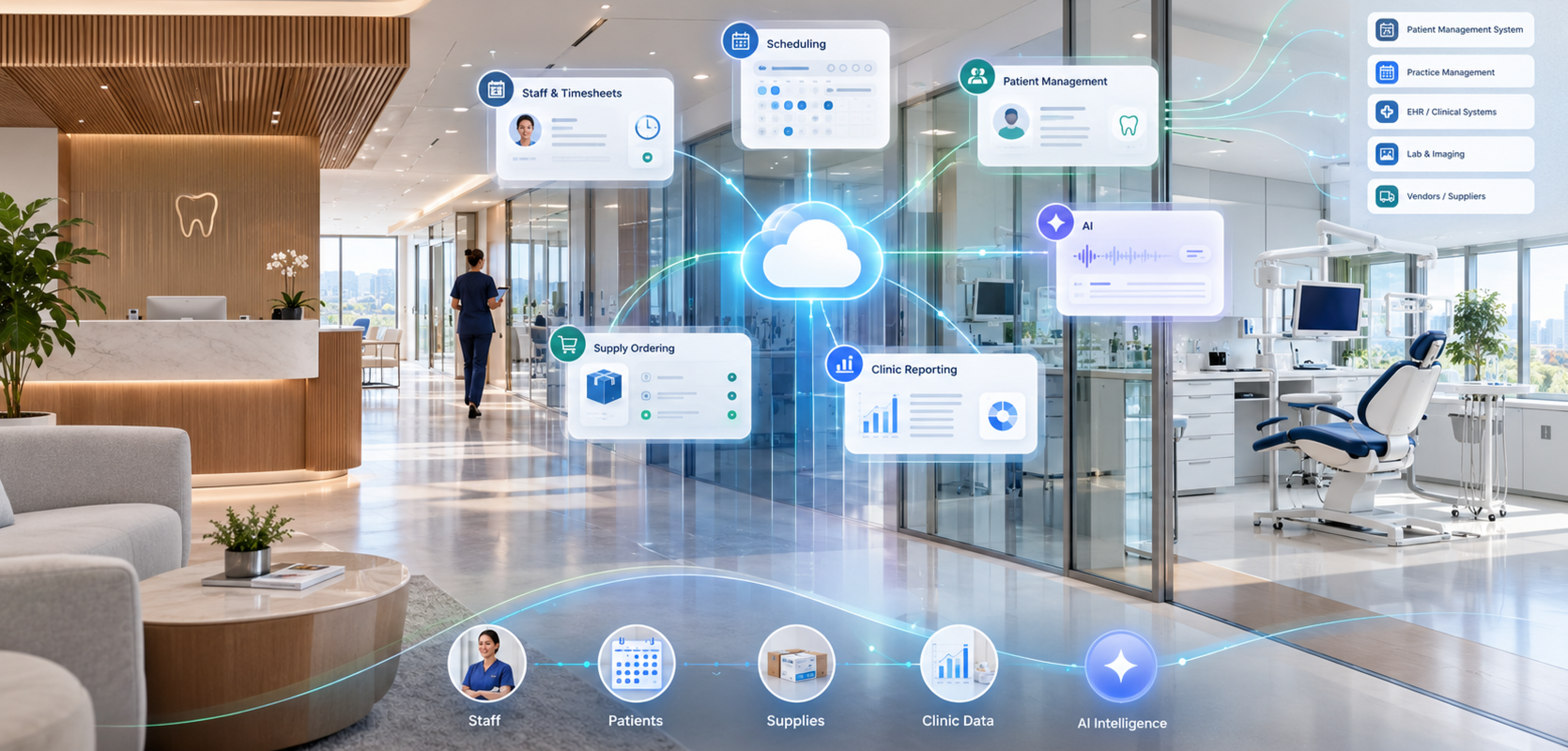
One Connected Ecosystem, Four Components: The platform is a unified system built around four integrated pillars: a core inspection engine, an imaging-based scientific validation layer, a Corrective Action Plan module, and an AI layer that runs across all of them alongside a standalone field assistant. These pillars arrived in phases across one continuous multi-year partnership. They now operate as a single connected system.
We engineered the central platform to digitise quality management end to end.
We integrated the client’s proprietary imaging technology through an SDK. It detects invisible surface contamination and renders before-and-after visual proof, with colour-coded scores and severity indicators that show teams exactly where to focus.
In high-stakes environments such as healthcare and food safety, assuming cleanliness without evidence is not a risk worth taking. Imaging-based validation removes the guesswork and helps prevent a costly pattern: over-cleaning areas that are already safe while under-cleaning the ones that matter. It also closes the loop between planning, execution and validation inside a single ecosystem.
Before CAP, the platform could identify a problem, but visibility ended there. There was no structured tracking and no measurable closure.
CAP converts inspection findings into structured, trackable, time-bound tasks across web (admins and inspectors), iPad (admins and inspectors) and a dedicated mobile app for custodians.
CAP turned the product from an inspection tool into a full-cycle quality management platform, where issues are resolved, measured and improved over time rather than simply identified.
AI was built directly into auditing and operational workflows as an intelligence layer mapped to the specific pain points slowing inspectors and custodians down every day.
Alongside the embedded AI, the client launched a standalone RAG-based application that acts as a centralised knowledge hub for sales teams and custodians. It gives instant access to cleaning protocols and product expertise, supports image-based assessments in the field, and brings consistency to sales conversations regardless of how experienced a representative is.
Every AI output across the platform is grounded in the client’s own approved SOPs and documentation through Retrieval-Augmented Generation, so answers are traceable to source material rather than generated from general knowledge.
Each location follows the same structured procedure, scored against configurable digital SOP checklists, which has lifted how consistently standardised inspection procedures are actually followed.
Centralised dashboards show compliance trends, recurring non-compliance patterns and exactly where training needs to focus.
Inspections run fully offline, so basements, mechanical rooms and low-signal zones no longer stall an audit or risk data loss.
Healthcare and food-safety clients get defensible imaging evidence in place of a visual judgement call.
Before-and-after colour-coded scores tell teams where to spend cleaning time and chemical use, cutting the cost of over-cleaning safe spaces while catching the high-risk zones that used to slip through.
CAP closes the loop that used to end with a PDF and a hope. Each finding now carries an owner, a deadline and a status.
Task completion ratio, overdue percentage, reopen rate and average time to close give the client a quantified view of how well problems get fixed.
Inspectors and custodians get immediate answers to real questions, such as which product to use on a specific surface or whether an observation meets the compliance bar for that location.
Assessment write-ups moved from manual drafting to a quick review-and-approve step.
New and temporary staff follow the same standard as the most experienced inspector, closing the experience gap between locations.
Our client has built something the cleaning industry has needed for a long time: one ecosystem where planning, execution, scientific validation, corrective action and AI-driven intelligence work together without friction. The core platform standardises the process. Imaging validation proves the result. CAP closes the loop. The AI layer removes the daily friction that used to slow operations down, turning cleaning from a cost centre into a strategic asset with a measurable return.
The outcome is more than efficiency. It is the confidence that comes from knowing cleanliness is proven, not assumed.
We did not simply build the features the client asked for. We understood why healthcare and education end customers needed proof instead of promises, and that understanding shaped decisions across the platform, from how the imaging technology integrates with the inspection engine to how AI summaries are structured for a compliance-first audience.
Working in healthcare meant SOC 2 Type II and HIPAA could not be an afterthought. We engineered the data architecture, AI layer and infrastructure around those standards from day one, which is a large part of why the client has completed three consecutive no-exception audits.
Rather than treating inspection, validation, corrective action and AI as separate features bolted together, we engineered them as one system that closes the loop from inspection to scientific validation to corrective action to measurable resolution.
Every AI output, from assessment summaries to field answers, is grounded in the client’s approved SOPs through Retrieval-Augmented Generation. That means fewer hallucinations and answers a team can rely on mid-inspection, not a chatbot bolted onto the side.
From a 40-day MVP to multi year engagement and a continually evolving AI layer, this has never been a one-off engagement. We are still building, refining and adding capability as the platform grows.
It is a cleaning quality and compliance management platform built by Net Solutions for a North American digital cleaning solutions provider. It spans web, iPad and mobile, and combines four components: a core inspection engine, an imaging-based scientific validation layer, a Corrective Action Plan module, and an AI layer that includes a standalone field and sales assistant.
Through imaging-based validation, integrated into the iPad app via an SDK. The technology detects invisible surface contamination and produces before-and-after visual proof with colour-coded scores and severity indicators, replacing the visual judgement calls and slow swab tests the industry relied on previously.
A CAP module converts an inspection finding into a structured, trackable, time-bound task with an owner, a priority and a deadline. Admins and inspectors create CAPs from assessments on web and iPad, and custodians receive, update and close them on a dedicated mobile app with notes and photo evidence. Without it, a flagged issue ends at a PDF with no confirmation that anyone fixed it.
Every AI output is grounded in the client’s own approved SOPs, manuals and policy documents using Retrieval-Augmented Generation. The model retrieves relevant source material before generating a response, so assessment summaries and field answers trace back to approved documentation rather than general training data.
Inspections run fully offline. Inspectors can complete audits, rate criteria, attach photo notes and track completion in basements, mechanical rooms and low-signal areas inside healthcare facilities, with data syncing once connectivity returns. No part of the inspection is interrupted or lost.
It is a RAG-based application that acts as a centralised knowledge hub for the client’s sales teams and custodians. It gives instant access to cleaning protocols and product expertise, supports image-based assessments in the field, and accepts text, voice-to-text and image input.
Healthcare, education, hospitality and building services facility management. It was designed to hold a hospital’s HIPAA-level scrutiny while remaining workable for a school district or a hotel chain, without splitting into separate products.
The client is SOC 2 Type II certified with three consecutive no-exception audits and is HIPAA compliant for US operations. The platform is also ISSA GBAC STAR registered and runs a multi-year deployment with a major national healthcare provider.
Net Solutions delivered a fully functional MVP in 40 days after a focused requirement gathering phase involving a business analyst, a UX analyst and a technical architect. The platform has since been developed over a multi-year continuous partnership through three-week Agile sprints.
More than 130,000 assessments were completed between 2024 and 2026, with over one million individual assessment items recorded across key customers in the same period. The platform has maintained 100% service uptime and supported three consecutive SOC 2 Type II audits with no exceptions.
Tell us where the gaps are in your current process. Whether that is inspections that never reach resolution, reporting that eats your team's week, or an AI pilot that needs grounding in your own documentation, we will come back with a practical view of what it takes to fix it.
Results matter. Discover how our customized solutions have delivered measurable business outcomes for clients across various industries. Each case study highlights the strategic impact of our work, turning challenges into opportunities for growth.
Ask Sol anything about digital products, AI, engineering, or growth, and get answers drawn from years of Net Solutions thinking and experience.