
Outsourcing software development can significantly reduce costs versus hiring and maintaining large in-house teams, give you access to a broader talent pool, and improve flexibility and scalability as project demands change. However, it can also introduce challenges such as communication barriers and timezone differences, quality and oversight risks, and security concerns if the partner isn’t carefully vetted. With strong partner selection, clear processes, and good governance, many of the drawbacks are manageable.
Are you thinking about outsourcing some or all software development? If so, you’re not alone. A recent study by Kearney reported that 90% of Fortune 500 companies rely on outsourcing companies for help with at least some aspect of their software development projects.
As a software development company ourselves, you might expect us to only focus on the positive side of IT outsourcing, but we’re going to give it to you straight. In this blog post, we’ll explore the pros and cons of working with an outsourcing company—along with tips to avoid the potential pitfalls we outline.
Outsourcing services can help you achieve your business goals, but only if you take a realistic look at both the potential risks and rewards associated with it.
Advantages of Outsourcing Software Development
Let’s dive into the benefits of outsourcing first, exploring the various ways that working with an outsourced team can offer you a competitive edge. You’re probably already familiar with some of the benefits of outsourcing, but we’re going to dig deeper and explore each one in a fair bit of detail.
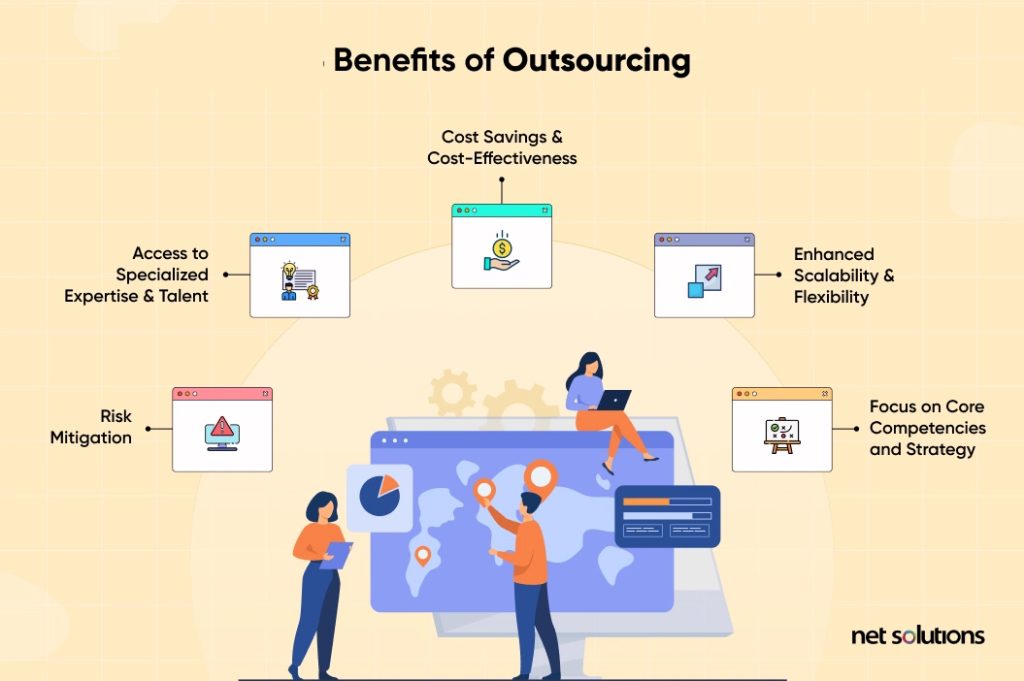
Lower Software Development Costs
One of the most obvious benefits of outsourcing is that
it’s usually more cost-effective than working with an in-house team alone.
A comprehensive study from the Harvard Business Review found
that companies that use outsourcing services reduce costs by 20-30% compared to
those that only rely on in-house software development.
That’s an impressive cost savings that will bolster your
bottom line, assuming you choose the right partner. Here are the various ways outsourcing can reduce costs.
- Lower labor costs: Working with an offshore software development firm in places like Asia,
Eastern Europe, or Latin America means lower labor costs. Since the cost of living is lower, the corresponding
hourly rate for tech talent is lower as well. - Hiring full-time employees is expensive: There are many hidden costs associated with hiring a
full-time employee. A study from Glassdoor found that the cost of hiring a new
employee averages $4,000 per employee, and that cost increases for high-level positions. This includes
costs associated with the recruitment process, onboarding, and more. - In-house teams come with hidden costs: Beyond hiring costs, you’ll need to cover each
employee’s benefits and, in places like the U.S., payroll taxes. You’ll also pay more for overhead costs, from
office space and equipment to electricity.
When you work with an outsourcing partner, they handle
all the hiring, firing, and payroll, along with equipment and overhead. All this makes offshore outsourcing good for
your bottom line.
Are you curious about outsourcing rates? Take a look at
our guide to outsourcing costs.
Access To A Wide Talent Pool
A survey from Deloitte found that half of executives at U.S. companies list talent acquisition as a top challenge they face, and this is
understandable in light of today’s tech
labor shortage.
Rather than searching in your own backyard for
developers, offshore outsourcing allows you to tap directly into a worldwide talent pool. Countries like India,
Poland, and the Czech Republic are home to a large number of full-stack developers who produce high-quality work at
an affordable price.
India in particular boasts a large number of young, ambitious
software engineers, a population that the Coursera Global Skills Report
identified as excelling in cloud computing and other prevalent technologies. Plus, with over 200 million English
speakers, you’re less likely to deal with communication issues.
Flexibility and Scalability
One of the greatest benefits that comes with outsourcing
is the flexibility and scalability it provides.
It simply doesn’t make sense to hire a new wave of
in-house team members each time a project’s requirements expand or business grows. Nor does it make sense to lay off
in-house employees when there’s a lull in work or profits.
Recruiting, hiring, and onboarding new employees is
expensive (see the previous section), and letting go of employees is something no leader wants to do unless it’s
absolutely necessary.
Outsourcing some or all of your tech needs to an outside
company solves that problem. Whether you’re using offshore, onshore, or nearshore outsourcing to support your development
process, you can easily add and remove staff as your needs change.
Benefitting From An Outside Perspective
One often-overlooked benefit of working with an
outsourcing partner is that outside teams offer a different perspective on your business and your products.
When you introduce a full-service design and development
firm to the mix, they’ll have their own points of view. As a strategic partner, they’ll introduce new ideas that
break up the tunnel vision and ingrained thinking that can happen in any organization.
An outsider’s perspective can be helpful because it
offers:
- A beginner’s mind: An expert who is looking at our product for the first time can see
opportunities for improvement that internal staff might miss. - New processes for idea generation and problem-solving: Just as two heads are better than one,
two or more teams are better than one—offering a fresh take that delivers new ideas. - A chance to break down communication siloes: Companies around the world face challenges with
departmental and team siloes forming. Working with an outside partner introduces new voices, shaking things up
and encouraging better inter-team and inter-departmental communication.
The benefits, of course, are only realized when you
partner with a team that is highly strategic and capable of seeing your big-picture goals, so vet potential partners
carefully!
Strength in Diversity
We live in a multicultural world. Whether your products
appeal to customers across the globe or in the city you’re headquartered, you’re bound to have people from a wide
range of cultures, nations, and linguistic groups using your products.
Working with nearshore and offshore outsourcing firms
brings an even wider perspective to your product development efforts. The new perspective we mentioned above, which
outside partners can provide, expands even further when your teams span national borders.
Of course, you still need to choose a partner who
understands your local culture and operating language, but if you’re dealing with a multilingual, cosmopolitan team
in another country, their collaboration with your in-house staff can produce powerful results.
Disadvantages of Outsourcing Software Development
Now that we’ve covered the positive side of engaging the development services of an outsourcing firm, let’s take a look at some of the risks and challenges that may come with it as well.
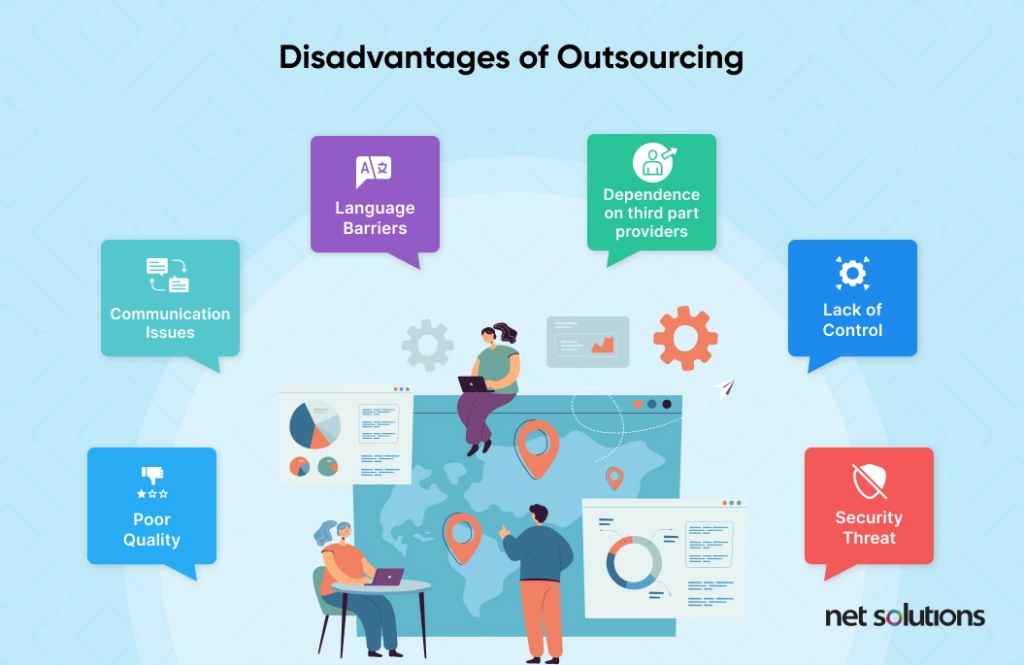
Keep in mind that these risks are easy to mitigate for
the most part, and surmounting them largely comes down to proper vetting. We’ll get into the specifics of overcoming
each challenge, but be aware that due diligence will get you most of the way there.
Communication Issues and Language Barriers
Let’s face it, communication among people who speak the
same native language and come from the same culture can be challenging at times.
Add distance, different time zones, and different native
languages to the mix, and both nearshoring and offshoring can present obvious challenges. Fortunately, avoiding
these outsourcing challenges is relatively simple, and it
starts with selection.
How to overcome this: Properly vetting
potential outsourcing partners will help you avoid communication problems, and it starts before you even hop on an
initial call with them.
Review the content on their website to see if they write
at a native (or near-native) level of fluency. You may be surprised to see that content produced by some offshoring
outsourcing firms is riddled with errors, even though it ranks highly in a Google search.
Even when the grammar is correct, much of it may sound
like it was written by someone who lacks a visceral understanding of the English language. It just doesn’t sound
right to a native speaker. Avoid working with those firms because if their writers lack a nuanced understanding of
the language, their project managers will likely struggle as well.
Once you’ve selected a potential provider whose content
is well written, set up calls with your prospective project managers as well as their sales team. Do they
communicate with ease and fluency? Do they have systems in place to ensure regular, clear communication? That’s the
kind of firm you want to hire.
Quality Assurance
A second potential challenge of outsourcing projects comes down to quality. It may be that your outsourcing partner,
whether they’re located across town or around the world, simply doesn’t have the same commitment to quality as your
internal staff.
How to overcome this: Once again, if
you thoroughly vet your outsourcing provider, you’ve got an excellent chance of mitigating quality control issues.
What can you do to ensure you’re working with a firm
that produces quality work?
- Work with outsourcing companies that have stood the test of time—those with at least 10 years of experience and
a proven track record of success. - Search for reviews of your potential partner on websites like Clutch.co to find unbiased assessments from
real customers. If they have a high rating and a decent sample size (more than 15 to 20 reviews from clients),
you can take the reviews seriously. - Review customer case studies that outline the work they’ve done in the past and include testimonials from
clients. A reputable firm should have quite a few of these. - Ask challenging questions about the firm’s processes and methodologies. Are they DevOps developers? Are they
prepared to employ Agile or other methodologies based on your needs?
Following these steps should help put to rest general
concerns about the firm’s skill set and dedication to producing quality software products.
Security Risks
Cybersecurity is an important topic among executives in
the U.S., with 81% of them listing it as a top concern in Deloitte’s
latest Global Outsourcing Survey.
This makes sense, considering the price companies pay
for avoidable security breaches—from a damaged reputation to a complete collapse of the business. In fact, in some
extreme cases, executives and business owners may be held legally liable for security breaches if they don’t handle
them properly or they’re found negligent.
When you work with an outsourcing partner, they have
access to vital data, so it’s important to work with a reputable firm.
How to overcome this: Only entertain
working with reputable, experienced firms, and even then you must be willing to ask tough questions about the
protocols they employ to keep your data and your systems safe from bad actors.
Failure to Integrate and Grasp Your Company’s Vision
Every company has its own unique corporate culture,
shaped by its unique vision and mission. Working with remote teams across time zone differences can cause a
disconnect, leaving outside service providers struggling to integrate and internalize that vision.
Your dedicated team may have all the core competencies
you require, and they may fully grasp the latest technologies used in app development, while still failing to
internalize your company’s DNA and integrate your core business needs into their outlook.
How to overcome this: Mitigating this
risk comes in two parts. First, just as with the other risks of outsourcing, you’ll want to vet your potential
vendors and review their case studies.
Do their customers come to see them as an integral part
of the team? Or do they just faithfully push out deliverables? Don’t be afraid to ask a potential vendor how they
work to understand their clients’ needs, cultures, and missions.
The second element of mitigating this risk is to develop
processes that connect remote teams with in-house staff—especially if you’re using a staff augmentation model.
Distributed workforces are common these days, and although it requires a little extra work to connect everyone, it
typically results in better software solutions.
Choose the Right Software Development Outsourcing Partner
Net Solutions is an award-winning software development outsourcing firm with 20 years of experience, helping startups as well as large organizations with everything from app development to digital transformation.
We take the time to get to know your company, its vision, and its products, and we’ve got countless customer case studies and success stories that testify to the quality we provide.
Talk to one of our experts today to learn how we can help you boost your bottom line and scale your business.
Frequently Asked Questions (FAQs)
1. When does outsourcing software development make the most sense?
Outsourcing is most effective when companies need to scale quickly, access specialized skills, or reduce operational overhead without committing to long-term internal hiring.
2. What are the biggest risks of outsourcing software development?
Common risks include misaligned expectations, communication challenges, quality inconsistencies, and data or intellectual property exposure if governance is weak.
3. Can outsourcing and in-house development work together?
Yes. Many companies use a hybrid model where outsourced teams complement internal staff, handling execution while core strategy and ownership remain in-house.
SHARE THIS POST
Table of Contents
Related Resources
- 10 Key Benefits of Outsourcing Software Development
- 10 Common Software Outsourcing Challenges [With Solutions]
- 19 Best Software Development Outsourcing Companies in 2026
- How Much Does It Cost to Outsource Software Development?
- Software Development Outsourcing: India's Top 11 Contenders
- Comparing Software Development Outsourcing Models: A Decision-Maker's Guide
- A Guide to Nearshore Software Development Outsourcing [2026]
- 15 Questions to Ask when Outsourcing Software Development
- Outsourcing Software Development for Startups [2026 Guide]
- 2026 Software Development Outsourcing Statistics: Trends, Insights & Predictions
- Software Development Outsourcing Trends