
Introduction: The Real Problem in Software Delivery Is Misalignment
Most software delivery problems do not begin with poor coding. They begin much earlier, when different people walk away with different interpretations of the same requirement.
A business stakeholder explains a need in business terms. A BA translates it into a story. A developer reads it as an implementation task. A tester interprets it as a set of validations. Everyone is competent. Everyone is acting in good faith. And yet the team can still end up building something that is technically correct but functionally off the mark.
That is why misalignment is one of the most expensive problems in software delivery. It creates rework, late surprises, unnecessary debate, and avoidable defects. It also damages confidence. By the time the issue becomes visible, code has already been written, test cases have already been prepared, and release plans may already be in motion.
Fred Brooks argued that many of software’s hardest problems are inherent to the nature of software itself, not just the tools we use to build it. One of those enduring problems is the difficulty of translating intent into working systems without losing meaning along the way. In modern delivery teams, that challenge still shows up every day.
This is where Behavior-Driven Development, or BDD, has been useful for us. We do not treat it as a fashionable testing technique or a documentation ritual. We use it as a practical way to create shared understanding before development moves too far ahead. It helps teams talk through behavior in concrete terms, expose assumptions earlier, and align around what “correct” actually means.
What Is Behavior-Driven Development (BDD)?
Behavior-Driven Development is a collaborative way to define how a system should behave before development begins in earnest. At its best, BDD is not about writing fancy test scripts. It is about getting business, product, QA, and engineering teams to agree on examples of expected behavior early enough that misunderstandings can still be corrected cheaply. That point matters because many teams hear the term BDD and think immediately of frameworks, feature files, or Gherkin syntax. Those things can be useful, but they are not the essence of the practice. The real value of BDD comes from the conversations it creates and the clarity it produces.
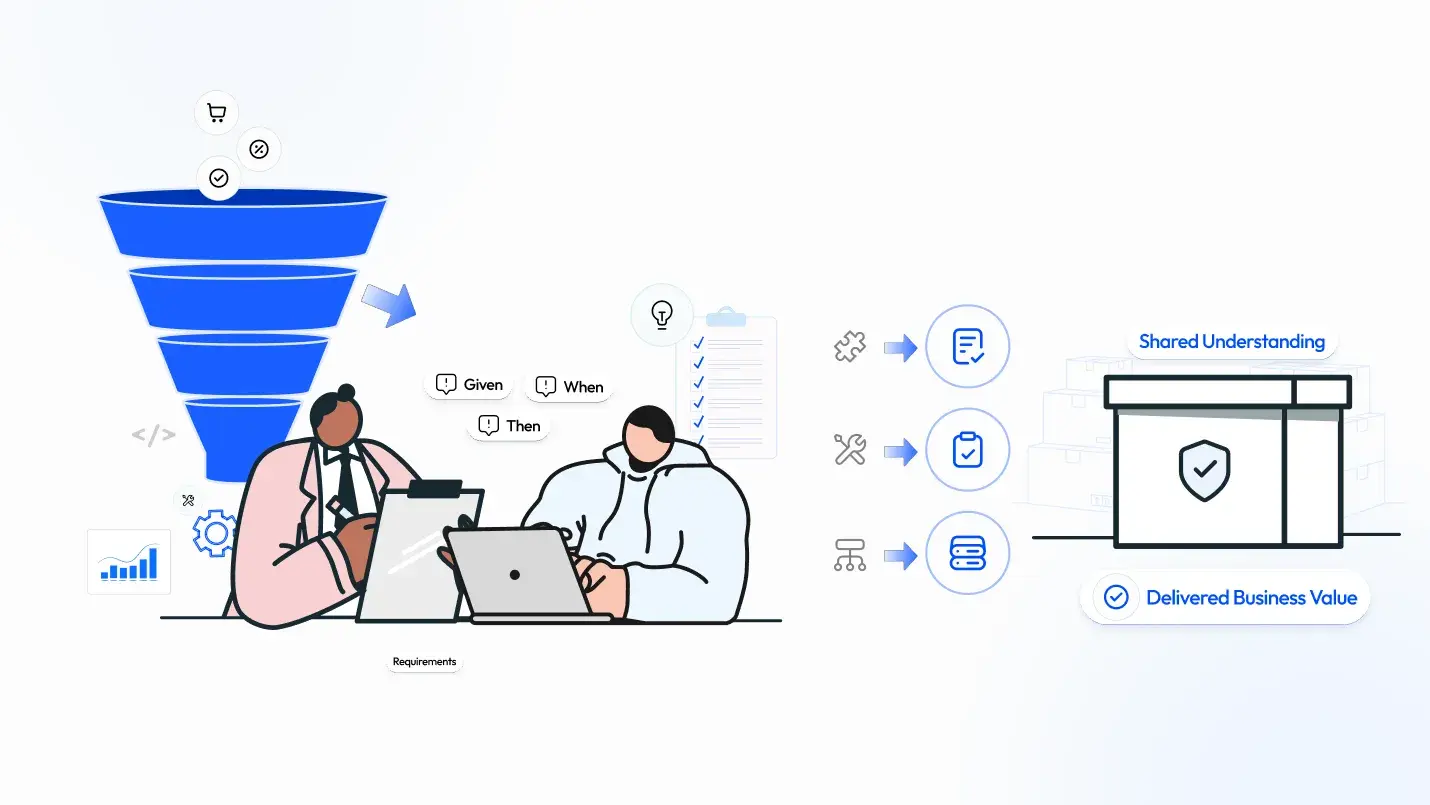
A simple way to think about BDD is this: instead of discussing requirements only in abstract terms, teams describe expected behavior through concrete examples. Those examples are often written in a structured format such as Given, When, Then.
- Given describes the starting context
- When describes the event or action
- Then describes the expected outcome
For example, instead of saying “premium users should not be rate limited in the same way,” a team can define exactly what that means in behavior terms. Or instead of saying “discounts should apply correctly,” a team can agree upfront how discounts behave when multiple rules, promotions, and exclusions interact.
That shift sounds simple, but it changes the quality of delivery conversations. It forces the team to move from vague intent to testable meaning. It exposes hidden assumptions. It sharpens acceptance criteria. It often reveals edge cases before anyone has invested too much effort in the wrong implementation.
So when we talk about BDD, we are really talking about a disciplined way of reducing ambiguity. The automation part matters, but it comes after the understanding.
Why Do Requirements Get Misunderstood?
Requirements rarely fail because no one thought about them. They fail because each person thinks about them from a different angle, and those differences stay hidden for too long.
A stakeholder may care about the business outcome. A BA may focus on the flow and the rules. A developer may focus on what needs to be implemented in code. A tester may focus on conditions, failure modes, and validation paths. None of these views are wrong. The problem is that they do not automatically converge.
This is why a user story that looks perfectly clear in a backlog grooming meeting can later trigger multiple rounds of clarification. Words like “should,” “valid,” “eligible,” “complete,” or “successful” often carry more ambiguity than teams realize. The team may feel aligned because everyone recognizes the words, but they may not agree on the behavior those words are supposed to represent.
A second problem is hidden assumptions. Every team member brings context from past projects, existing systems, domain knowledge, and personal habits of interpretation. Those assumptions often remain invisible until they collide. By then, the cost is higher. Development may already be underway, tests may already have been drafted, and timelines may already be under pressure.
A third problem is edge cases. In many teams, the happy path gets discussed first and most often. But software rarely lives on the happy path alone. Questions about exceptions, boundaries, thresholds, dependencies, and failure conditions tend to arrive later. That is exactly when they are most expensive.
This is also why traditional testing alone does not solve the issue. Testing can confirm whether a built system behaves according to whatever interpretation guided the implementation. But if the interpretation itself was flawed, teams can end up with very well-tested software that still misses the business intent.
That is the gap BDD helps close. It gives the team a structured way to discuss behavior before implementation choices harden into code.
How We Use BDD in Practice
We use BDD as a way to improve requirement clarity, not as an isolated QA activity. In practice, it works best when it begins with a business rule, workflow, or decision point where misunderstanding would be costly.
The first step is to identify the feature or rule that needs clarity. This is often a place where the outcome matters to the business, the logic has enough complexity to create confusion, or the cost of rework would be high. Pricing, eligibility, approvals, entitlements, calculation logic, workflow transitions, and policy-based behavior are all common examples.
The second step is to bring the right people into a focused discovery conversation. This does not need to become a long workshop. In many cases, a short but disciplined discussion is enough. The goal is to get the people who understand the business need, the implementation constraints, and the validation concerns into the same conversation early.
The third step is to work through examples. This is where the discussion becomes productive. Instead of debating abstract interpretations, the team asks practical questions. What happens if the customer qualifies for one rule but not another? What if the threshold is exceeded? What if a request arrives with missing or conflicting data? What should happen if the transaction is retried? What is the intended behavior when the exception occurs?
The fourth step is to write those examples in shared language. We often use structured scenarios because they force the team to be explicit about context, action, and outcome. The goal is not literary elegance. The goal is clarity. Everyone involved should be able to read the scenario and say, “Yes, that is what we mean.”
The fifth step is to align before development moves too far ahead. This is one of the most valuable points in the process. Once examples are written and discussed, misunderstandings tend to surface quickly. The team can correct them while the cost is still low.
The sixth step is automation, where appropriate. Not every scenario needs to become an automated end-to-end test. But where automation adds value, the scenarios can serve as executable acceptance criteria. That creates a strong link between business intent and technical verification.
The final step is to keep these scenarios useful over time. When maintained well, they become living documentation. They help new team members understand why the system behaves the way it does. They also make future change safer because the expected behavior is visible and testable.
This is the practical value of BDD for us. It gives teams a better way to think together before they build.
How BDD Helps BAs, Developers, Testers, and Stakeholders
One reason BDD works well is that it creates value for multiple roles at the same time.
For BAs and product people, it helps turn broad requirements into concrete examples. That sounds minor, but it changes the quality of requirement definition. It becomes easier to spot ambiguity, easier to write stronger acceptance criteria, and easier to identify where the business rule itself still needs refinement. Instead of handing over a requirement and hoping the implementation matches intent, the team starts with examples that are much harder to misread.
For developers, BDD improves the definition of done. It reduces the amount of guesswork involved in interpreting stories and acceptance criteria. It also lowers the risk of building something that passes technical review but later fails business review. When developers understand the behavior more clearly upfront, they can make better implementation choices and avoid rework driven by hidden assumptions.
For testers and QA professionals, BDD shifts quality left in a meaningful way. It allows validation thinking to enter earlier, before code is complete. Testers can challenge scenarios, surface missing conditions, and help make requirements testable from the start. That leads to fewer late surprises and more confidence that the delivered behavior matches the expected one.
For stakeholders, BDD improves visibility. It gives non-technical participants a clearer way to understand what the team intends to deliver. Instead of relying only on tickets, screenshots, or post-build demos, stakeholders can review behavior in a structured way while there is still time to influence it. That reduces the risk of hearing “this is what we thought you meant” at the wrong moment.
What makes this especially useful is that BDD does not require everyone to think in the same professional language. It creates a shared format that different roles can work with, each from their own perspective. That is a big part of why it improves alignment.

What Business Benefits Does BDD Create?
From a business perspective, the value of BDD is not that it adds another artifact to the process. The value is that it reduces avoidable waste.
The first and most obvious benefit is lower rework. When teams expose ambiguity earlier, they spend less time rebuilding logic that was technically correct but business-wise incomplete or inaccurate. That matters especially in workflows where changes become expensive once implementation, testing, and release planning are already underway.
The second benefit is stronger release confidence. When critical business behavior has been discussed clearly and validated against agreed examples, there is less uncertainty going into release. That does not eliminate risk, but it reduces one of the most common forms of delivery risk: the gap between what the business intended and what the system actually does.
The third benefit is better handling of rules-heavy domains. In areas such as pricing, eligibility, compliance, approvals, policy enforcement, or entitlements, misunderstanding the rule is often more costly than making a coding mistake. BDD helps teams make those rules visible and testable in a way that supports both clarity and traceability.
The fourth benefit is better knowledge retention. Teams change. People move. Context gets lost. When important system behavior exists only in tickets, tribal memory, or scattered conversations, future maintenance becomes harder and riskier. Well-maintained executable specifications help preserve that understanding in a form that remains useful over time.
The fifth benefit is safer modernization. Because BDD focuses on externally visible behavior rather than implementation detail, it gives teams a better safety net when refactoring systems, replacing components, or modernizing platforms. That is valuable for businesses that need to evolve without breaking the logic that supports revenue, compliance, or customer trust.
BDD does not magically make teams faster. In fact, it can slow the start of a feature slightly because it demands more discussion upfront. But in many cases, that effort pays back by reducing confusion, churn, and late-stage correction. It is less about speed in the first hour and more about waste across the full lifecycle.
When BDD Works Well, and When It Is Overkill
BDD is especially useful when the cost of misunderstanding is high.
It works well in business workflows with meaningful rules, multiple decision paths, or important exceptions. It is particularly effective in areas such as pricing engines, approval flows, order logic, financial rules, entitlement models, subscription behavior, compliance checks, and customer-facing workflows where edge cases matter.
It also works well in cross-functional teams where BAs, product people, testers, and developers all need to contribute to quality. In such environments, BDD gives the team a common structure for discussing intent without requiring everyone to speak in purely technical terms.
It is also valuable when systems are expected to evolve over time. If a business expects to refine rules, modernize platforms, or onboard new team members regularly, the living-documentation aspect of BDD becomes more useful.
That said, BDD is not the right answer for every piece of work. For very small internal tools, throwaway prototypes, or low-risk utility features, the overhead may not be worth it. Teams can also misuse BDD by writing scenarios that are too granular or too tied to UI interactions. When that happens, the scenarios become fragile and lose the benefit of behavior-level clarity.
In other words, BDD works best when teams stay focused on behavior that matters, not on turning every interaction into a scripted artifact.
What This Means in Practice
A few practical takeaways matter here.
First, alignment happens earlier. That is important because changes are always cheaper before implementation and test execution are deeply underway.
Second, specifications stay useful. When scenarios are maintained and automated appropriately, they can act as living documentation rather than static requirement text that becomes outdated.
Third, change becomes safer. Because BDD emphasizes behavior over implementation detail, teams can refactor or modernize with more confidence that critical logic is still protected.
Fourth, “done” becomes clearer. Instead of relying on broad interpretation, teams can point to agreed examples of expected behavior and validate against them.
Taken together, these are not small process improvements. They directly affect delivery quality, stakeholder confidence, and the long-term maintainability of the system.
Conclusion: Shared Understanding Is a Delivery Advantage
Behavior-Driven Development is not mainly about writing prettier tests. It is about reducing the distance between business intent and delivered software.
That matters because software projects rarely struggle only with implementation. They struggle with translation, interpretation, assumptions, and late discovery. BDD gives teams a practical way to deal with those issues before they become expensive.
For us, that is the real value of the practice. It helps BAs write better requirements, developers build with more clarity, testers validate earlier, and stakeholders gain more confidence in what is being delivered. It also helps preserve knowledge in a form that remains useful as systems and teams evolve.
In the end, shared understanding is not a soft benefit. It is a delivery advantage. And in complex software work, that advantage compounds over time.
Frequently Asked Questions About BDD
No. BDD is primarily a communication and clarity practice. Frameworks can help automate scenarios, but the deeper value comes from the discussions that shape those scenarios in the first place. If the team treats BDD only as a tooling choice, it misses most of the benefit.
TDD is typically focused on code design and correctness at the developer level. BDD is focused on shared understanding of expected system behavior across product, QA, and engineering. They are not enemies, and they do not need to compete for space. In many teams, they can complement each other well.
It can add upfront discussion, especially when teams are new to it. But that effort often pays for itself by reducing requirement ambiguity, late-stage clarification, and rework. The goal is not to add ceremony. The goal is to make costly misunderstandings visible earlier.