Executive Summary
Retail planogram compliance has long relied on manual shelf audits, a process that is slow, inconsistent, and reactive. This article explores how AI-powered computer vision is transforming retail shelf management by enabling real-time, automated detection of stockouts, misplacements, and compliance gaps across store networks.
Key Takeaways
- Computer vision automates planogram audits, replacing manual checks with continuous AI monitoring.
- Real-time alerts allow staff to act on stockouts and misplacements instantly, before sales are lost.
- The technology scales consistently across hundreds or thousands of store locations.
- It adapts to real-world shelf conditions, recognizing products by appearance rather than rigid layout rules.
- Future integration with predictive replenishment, demand forecasting, and vendor collaboration will make retail operations fully proactive.
For retailers evaluating AI adoption, computer vision for planogram compliance offers a clear, measurable ROI, combining operational efficiency gains with direct top-line impact.
Retail shelves are the frontline of sales. For shoppers, shelves determine whether they find what they came for or walk out empty-handed. For retailers, they are the battleground where sales are won or lost.
Yet, keeping those shelves properly stocked and aligned with planograms (the layouts that dictate where products should be placed) has always been a challenge.
In reality, stores are dynamic. Customers pick up items and put them back in the wrong place, staff shuffle products to make space, and popular products go out of stock faster than expected.
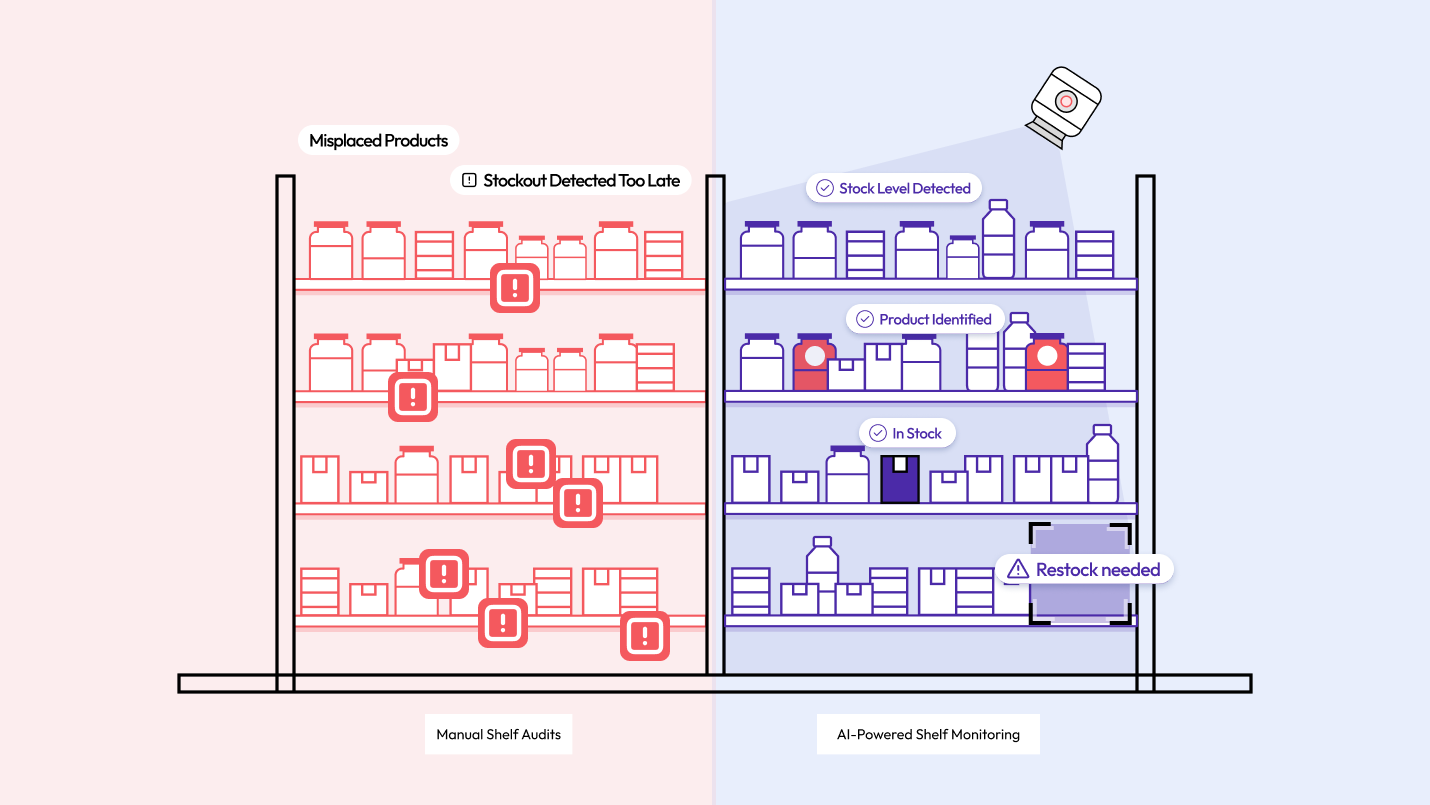
Traditional planogram audits, which require staff to manually check compliance, are slow, costly, and prone to errors. The result? Lost sales, brand dissatisfaction, and frustrated customers.
Enter Computer Vision: The Smarter Approach
Thanks to advances in AI-powered computer vision, retailers no longer have to depend solely on manual checks or rigid planogram rules. Using simple shelf images, AI can analyze, identify, and report issues in real time, transforming the way audits are performed.
Here’s how computer vision helps:
- Automatic product identification: AI recognizes products regardless of where they’re placed, even if customers return them to the wrong spot.
- Instant detection of gaps: Empty shelves or low stock levels are flagged immediately, reducing the risk of lost sales.
- Automated compliance checks: Instead of relying on staff to compare shelves against layouts, AI continuously monitors compliance.
- Real-time alerts for staff: Employees get notified of issues right away, ensuring fast resolution and better shelf execution.
Why This Matters for Retailers
- Boosted Sales and Revenue: Real-time alerts ensure products are replenished before customers walk away.
- Operational Efficiency: Manual audits consume hours of staff time. Automating the process frees employees to focus on higher-value tasks, such as customer service and upselling.
- Better Customer Experience: Well-stocked, organized shelves make shopping easier and build customer trust and loyalty.
- Scalable and Consistent Audits: Unlike human audits that vary by store and staff, computer vision provides consistent results across hundreds or even thousands of locations.
- Flexibility Beyond Rigid Planograms: Real-world conditions are never perfect. Computer vision adapts, recognizing products by their appearance rather than forcing strict adherence to layouts.

Real-World Applications
- Supermarkets: Soft drinks often move between aisles as customers pick them up and put them back. AI can identify misplaced bottles, flag empty rows, and ensure staff replenish before peak shopping hours.
- Pharmacies: Availability is not just about sales but also about safety. Computer vision ensures that essential medicines are present and easily accessible. It is critical during seasonal surges, such as flu season.
- Convenience Stores: With smaller teams, it’s hard to monitor every shelf. AI fills the gap by alerting staff to missing snacks, bottled water, or other fast-moving items.
- Electronics Retailers: Impulse buys, such as phone chargers or headphones, depend on proper display. AI verifies brand agreements and ensures shelves are never bare.
Applying AI to a physical store environment requires a blend of high-speed processing and high-accuracy detection. For a deeper look at the technical architecture behind these applications, see our detailed walkthrough on building smarter retail shelf monitoring systems.
From Reactive to Proactive Audits
The real power of computer vision lies in moving beyond simply “spotting mistakes.” Instead of discovering compliance issues after the fact, retailers can act proactively. Gaps, misplacements, and stockouts are flagged the moment they occur, preventing lost sales.
For business leaders, that means lower costs and higher profits. For operations teams, it creates smarter workflows and optimized staffing. And for customers, it guarantees they’ll always find what they’re looking for.
The Future of Retail Audits
Computer vision is just the beginning. When paired with other emerging technologies, it unlocks even greater potential:
1. Predictive Replenishment
Instead of waiting until a shelf is already empty, AI can predict when stock is likely to run out. It looks at past sales trends (for example, how quickly a product usually sells on weekends) and combines that with real-time shelf data to estimate when a product will need restocking.
Example: If a supermarket sells 20 bottles of orange juice every Saturday morning, and the system notices only 15 are left on the shelf by Friday night, it can alert staff to restock before Saturday shoppers arrive. This way, shelves never look empty, and sales are not lost.
2. AI-Driven Demand Forecasting
This means using AI to more accurately predict customer demand by analyzing shelf data. It combines real-time visibility (what’s selling fast right now) with historical sales data (what sold well in the past, during holidays, or specific seasons). This helps retailers stock the right products at the right time.
Example: During summer, AI may notice that cold drinks are selling 30% faster in a particular region. It can adjust the inventory plan so that more stock is delivered to those stores before demand peaks—reducing out-of-stock risks and wasted shelf space. For a deeper look at how this data shapes inventory, read our comprehensive guide on AI-powered retail demand forecasting.
3. Vendor Collaboration
Retailers don’t work alone—suppliers and brands play a big role in ensuring products are available and displayed correctly. By sharing real-time shelf data with vendors, retailers can hold them accountable and collaborate more effectively.
Example: A cosmetics brand has an agreement with a retailer to always keep a new lipstick collection displayed in a prominent spot. If computer vision detects that some stores aren’t complying, this data can be shared with the vendor. The brand can then send its own team to fix the display or support replenishment. This strengthens partnerships and ensures that both the retailer and the supplier benefit.
Conclusion
Computer vision is more than a tool. It’s a catalyst for intelligent retail operations. By automating planogram compliance and turning audits into real-time insights, retailers can reduce inefficiencies, capture more sales, and deliver the seamless shopping experience customers expect.
With predictive analytics and IoT on the horizon, the future of retail audits isn’t just automated; it’s intelligent, connected, and proactive.
Frequently Asked Questions
The future combines computer vision, demand forecasting, IoT sensors, and vendor collaboration platforms to create a fully proactive shelf-management ecosystem. Instead of responding to compliance failures, retailers will predict and prevent them — enabling smarter inventory allocation, stronger brand partnerships, and a consistently superior customer experience.
Traditional audits require staff to manually walk every aisle and compare shelves against printed or digital planograms — a process that is time-consuming, inconsistent, and typically done infrequently. AI-powered monitoring is continuous, automated, consistent across locations, and triggers instant alerts, making it far faster and more reliable.
Yes. Unlike rule-based systems that rely on location tags, AI-based computer vision identifies products by their visual appearance — packaging, shape, color, and labels. This means it can correctly identify a product even if a customer placed it in the wrong aisle or on the wrong shelf.