
Key Takeaways
- The Single-Truth Interface: Manage B2B, B2C, and B2B2X from one core to slash TCO. Stop paying for three systems when one handles the complexity of wholesale and the speed of retail.
- AI as a Revenue Engine: Adobe Sensei isn’t a “chatbot”; it’s a revenue engine. Leverage it to influence search rankings using business data like real-time margins and stock levels.
- Human-Centric Hierarchies: Digital tools that respect organizational complexity. Mirror real-world structures with self-service parent/child account management.
- Elite Scalability: Cloud-native architecture with advanced indexing ensures sub-second response times, even for catalogs exceeding 1M+ SKUs.
- Logistics Intelligence: Optimize multi-warehouse operations with native Multi-Source Inventory (MSI) to reduce shipping costs.
- Architectural Agility: Deploy Headless and PWA technology for app-like speed in the field, even with low connectivity.
- Contract Precision: Automate the master service agreements (MSAs) with Shared Catalogs, showing customers only their negotiated pricing with 100% accuracy.
- Financial Flexibility: Digitize the “handshake deal” with integrated PO workflows and credit line management.
The Strategic Case for Adobe Commerce in 2026
In the retail, automotive aftermarket, and other high-volume industrial sectors, the “Amazon effect” (an almost instant checkout) has permanently altered buyer expectations. In 2026, the new gold standard is the “auto-improving” experience, where a platform gets smarter and more intuitive with every purchase a customer makes. Your B2B customers now demand the friction-free speed of B2C retail combined with the complex logic of wholesale procurement.
Adobe Commerce (formerly Magento) is more than a platform – it is a strategic engine for digital transformation. It enables enterprises to consolidate fragmented tech stacks and deliver global, multi-brand experiences from a single, cloud-native core. Adobe Commerce is the “Category King” of B2B. While others offer “Cloud-based” tools, Adobe offers “Enterprise Provenance.” In the buyer’s mind, Adobe is the “Safe Choice” that never fails.
High-Impact B2B Capabilities: Business Value vs. Technical Features
To modernize legacy operations, your infrastructure must move beyond “order taking” and into “experience orchestration.”
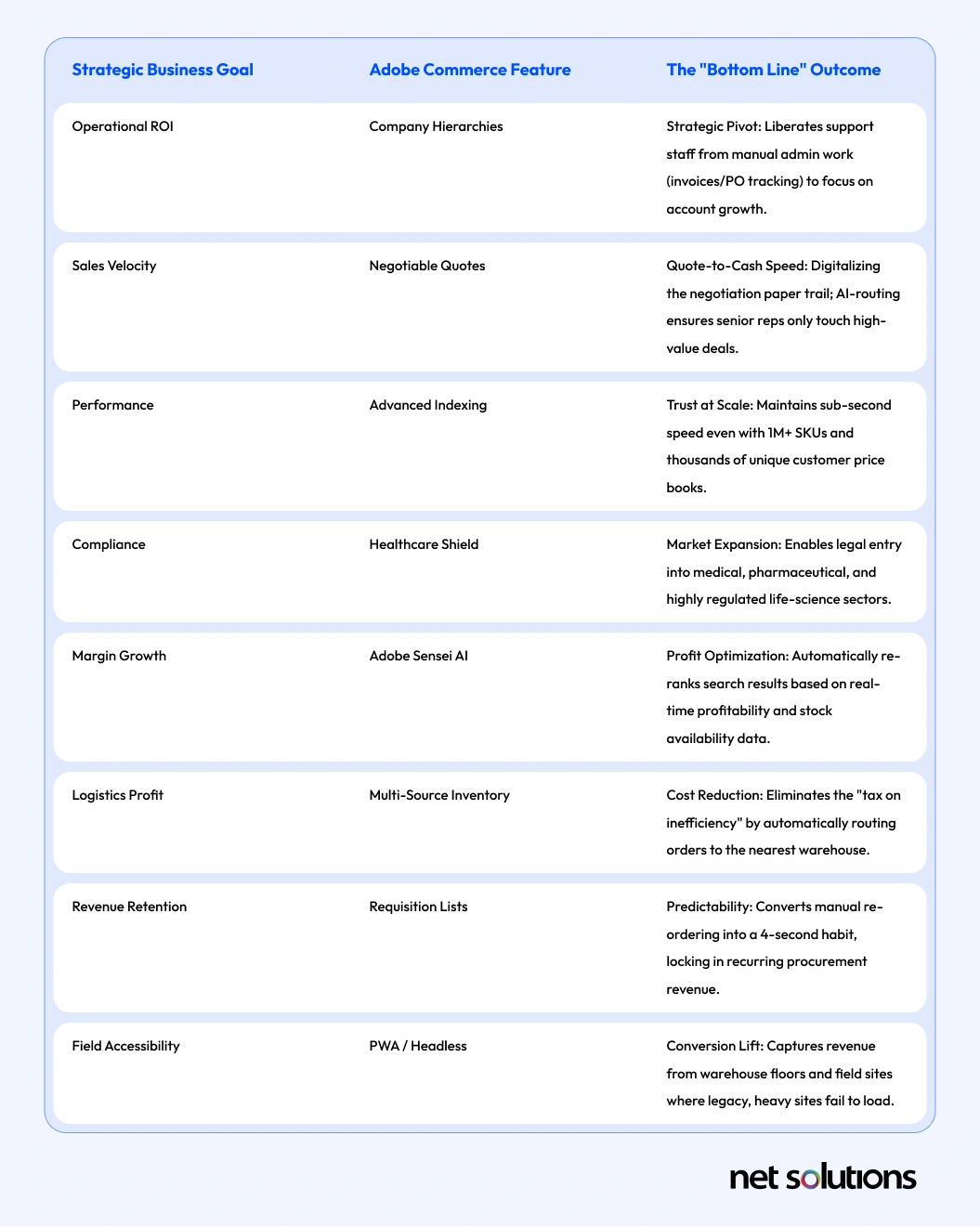
1. Advanced Company Account & Hierarchy Management (B2B2X) – The “Org Chart” logic
Modern enterprises no longer operate in silos, and specific details drive trust more than generalities. Adobe Commerce allows for Multi-level Company Hierarchies, enabling a single parent organization (e.g., a global automotive group) to manage dozens of child companies or regional distributors.
- The Feature: Company Management & Hierarchies.
- The Business Value: Self-service is the ultimate luxury. By allowing customers to manage their own sub-accounts and credit, you don’t just “cut costs”. You redeploy your talent. This portal transforms your support center from manual “order takers” into strategic growth advisors who focus on account expansion rather than re-sending lost invoices.
- Operational control: Admins can designate parent/child account structures for regional subsidiaries, enabling streamlined purchasing governance without involving your internal support team.
2. Intelligent Quoting & Negotiable Pricing – The “Digital Handshake”
Efficiency is gained by vertically integrating the sales process into the technology stack. Adobe Commerce automates the strategic bridge between a lead and a sale, eliminating offline negotiations and fragmented approvals.
- The Feature: Negotiable Quotes & Workflow Tools (Automated RFQ Workflows).
- The Business Value: Buyers initiate quotes directly from the cart, while sales teams update prices, apply line-item discounts, and negotiate terms entirely within the platform. This creates a digital paper trail and significantly shortens the quote-to-cash cycle.
- 2026 Innovation: AI-based routing directs high-value or high-risk quotes to senior managers, while AI-assisted workflows automatically process standard renewals based on pre-set margin and approval rules.
3. Frictionless Purchasing – Quick Orders & Requisition Lists
To meet the “Amazon-like” expectations of modern B2B buyers, Adobe Commerce optimizes purchasing for speed and volume. In a crowded market, simplicity becomes a competitive advantage—if a buyer cannot find and buy within seconds, they will go elsewhere.
- The Feature: Quick Order & Requisition Lists.
- The Business Value: Quick Orders enable SKU-based ordering and CSV uploads for bulk procurement, bypassing traditional browsing entirely.
- Recurring Revenue Protection: Requisition Lists enable one-click reordering of high-frequency inventory—effectively a “subscription model without subscriptions.” Unlike B2C wishlists, buyers can maintain multiple lists for different sites, projects, or fiscal quarters.
4. AI-Powered Merchandising (Adobe Sensei) – The “Intelligence” Engine
B2B catalogs are large, complex, and often overwhelming. Adobe Sensei transforms merchandising from static rules into a continuously learning system that adapts in real time to buyer behavior and business priorities.
- The Feature: Live Search & AI-Driven Product Recommendations.
- The Business Value: Sensei-powered search typically delivers a 15–20% lift in Average Order Value (AOV) by dynamically re-ranking results based on intent, behavior, and relevance.
- Margin Intelligence: For large catalogs, margin and inventory data can be injected into ranking logic—ensuring buyers find what they need while the system prioritizes what is most profitable to sell.

5. Multi-Source Inventory (MSI) & Logistics – The “Margin” Protector
In B2B commerce, margin is often lost in the last mile. Shipping from the wrong warehouse is not a logistics issue—it is a silent tax on operational inefficiency.
- The Feature: Native Multi-Source Inventory (MSI).
- The Business Value: MSI acts as a centralized logistics intelligence layer, mapping inventory across multiple physical locations and dynamically routing orders to the optimal fulfillment source.
- Outcome: Reduced shipping costs, faster delivery times, and a single real-time inventory view across all warehouses and fulfillment partners.
6. Architectural Agility with Headless & PWA – The “Mobile / Field” Readiness
B2B buyers are no longer desk-bound. They are on factory floors, in warehouses, and in the field. If your storefront performs like it is stuck in 2010, buyers will abandon it—speed is no longer optional.
- The Feature: Headless Commerce & Progressive Web Apps (PWA).
- The Business Value: PWAs deliver app-like speed and reliability even in low-bandwidth environments common in industrial settings, ensuring uninterrupted access across devices and locations.
- Operational Agility: Headless architecture decouples frontend experiences from backend systems, allowing marketing teams to iterate rapidly without risking ERP or order-management stability.
7. Customer-Specific Shared Catalogs & Price Books – The “Contract” Accuracy
Specificity drives conversion. Forcing buyers to browse thousands of irrelevant SKUs introduces friction and increases the risk of pricing errors.
- The Feature: Shared Catalogs & Personalized Price Books.
- The Business Value: Logged-in buyers see only the exact products and pricing negotiated in their Master Service Agreement (MSA), ensuring contract-accurate purchasing at scale.
- Outcome: Manage thousands of unique pricing structures and assortments from a single backend while eliminating billing disputes and manual order corrections.
8. Financial Flexibility – Digital Purchase Orders & Credit
B2B commerce runs on trust and relationships, not just credit cards. Forcing enterprise buyers into consumer payment models is an infrastructure failure, not a UX issue.
- The Feature: Purchase Orders (PO) & Credit Management.
- The Business Value: Enable traditional B2B workflows digitally with “Pay on Account,” real-time credit limits, and automated PO processing—scaling handshake deals globally.
- Operational Control: Support approval hierarchies where junior buyers build carts, but transactions are held until internal approvers authorize spend—automating the customer’s internal governance.
Adopting Adobe Commerce is only the starting point. The real differentiator in 2026 is how well your data is aligned to support AI-driven commerce. Many organizations fail because they treat B2B eCommerce as an IT implementation, when in reality it is a data strategy. Features like predictive reordering, intelligent search, and automated merchandising only perform as well as the data feeding them. A clean, structured data layer is non-negotiable.
- Standardize Attributes: Clean and normalize SKU attributes to ensure accurate Live Search and product discovery.
- Map Customer Journeys: Implement company and account hierarchy logic first for your top 20% of revenue-driving customers.
- Optimize for Decision Makers: Design the frontend for professional buyers by prioritizing technical specifications, bulk availability, negotiated pricing, and tax-exempt workflows.
Security & Compliance
Why it matters: In 2026, trust is the only currency that doesn’t depreciate. A security breach is no longer a technical glitch; it is a total breakdown of the customer relationship. Trust and security are the cornerstones of B2B enterprise growth. In 2026, the landscape has shifted from “checklist compliance” to a “continuous security” model. Adobe Commerce addresses this through an updated infrastructure and a rigorous shared responsibility framework. It provides a 2026-ready security posture that treats compliance as a competitive advantage rather than a chore:
- PCI-DSS 4.0.x Ready: As a certified Level 1 Service Provider, Adobe applies always-on security controls, including mandatory MFA and automated script monitoring, to prevent fraud and “digital shoplifting.”
- Health Data Ready: For healthcare and life sciences organizations, the Adobe Healthcare Shield add-on provides a hardened environment with specialized audit logging to ensure compliant handling of sensitive data.
- 99.9% Availability: Built on a private cloud backbone, the platform auto-scales to keep your storefront operational during peak procurement cycles or sudden demand spikes.
The Shared Responsibility Model: A Partnership for Peace of Mind
The Logic: Think of this model like a high-security office building. Adobe provides the building (the infrastructure), the locked front doors, and the security guards at the gate. However, you are responsible for who you give keys to and what happens inside your specific office.
This partnership ensures that no part of your business is left unguarded:
- Adobe’s Promise (Security OF the System): Adobe handles the heavy lifting—patching core software, securing physical infrastructure, and protecting against large-scale cyber threats such as DDoS attacks—so your team can focus on revenue, not server maintenance.
- Your Brand’s Role (Security IN the System): Your team, supported by an experienced implementation partner, manages access control and application-level security. This includes enforcing strong password policies, securing custom features, and governing which third-party scripts or integrations are permitted.
- The Result: A clear, shared-responsibility security model where accountability is explicit, gaps are eliminated, and the business remains protected end-to-end.

The Bottom Line
Adobe Commerce is a comprehensive engine for enterprise growth. However, configuring its vast feature set requires strategic precision. Net Solutions has partnered with global leaders to navigate these exact complexities – millions of SKUs, complex tiered pricing, and high-velocity logistics. We don’t just deploy software; we engineer revenue engines that prioritize human connection and technical excellence.
Frequently Asked Questions
Yes. By utilizing specialized search indexing (OpenSearch) and Shared Catalogs, the platform delivers enterprise-scale performance without the latency typically seen in legacy systems.
Yes. For organizations handling sensitive patient data or highly regulated health information, Adobe offers the Healthcare Shield add-on. This provides a hardened cloud environment with specialized audit logging, restricted data access controls, and enhanced encryption. This ensures that your digital pharmacy, medical device distribution, or life sciences portal meets the most stringent global privacy and regulatory standards.
While initial builds represent an enterprise-grade investment— with licensing that scales based on GMV—the long-term ROI is driven by 30–40% operational efficiency gains and by consolidating B2B and B2C commerce into a single, centrally managed platform.
Features like Assisted Selling and Negotiable Quotes allow sales representatives to log in on behalf of customers to troubleshoot carts, apply discounts, or finalize pricing. This bridges offline relationship-driven selling with digital efficiency.
A wishlist is temporary and typically disappears once items are purchased. A Requisition List is persistent and designed for frequently reordered inventory—allowing buyers to quickly repurchase the same products weekly or monthly with a single click.