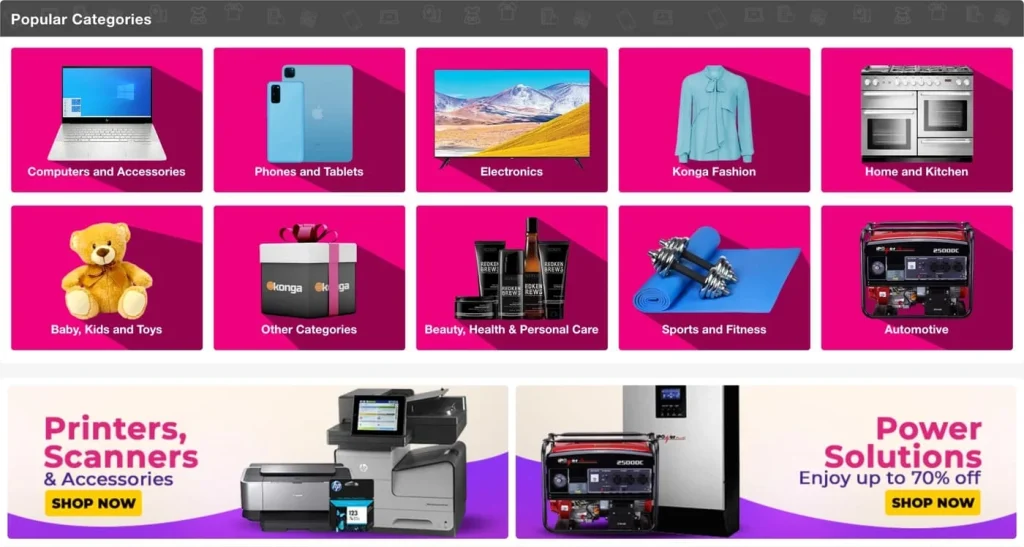
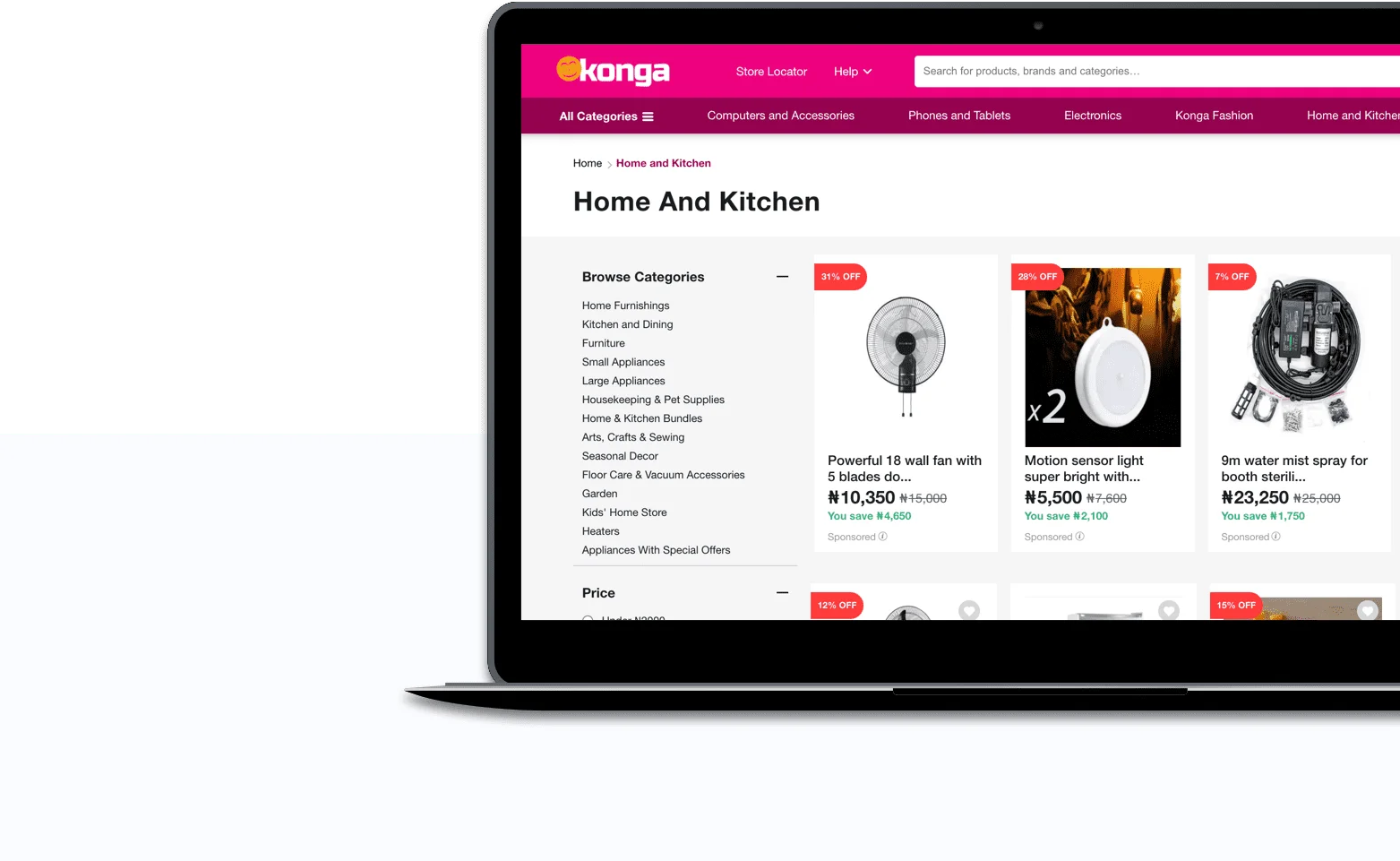
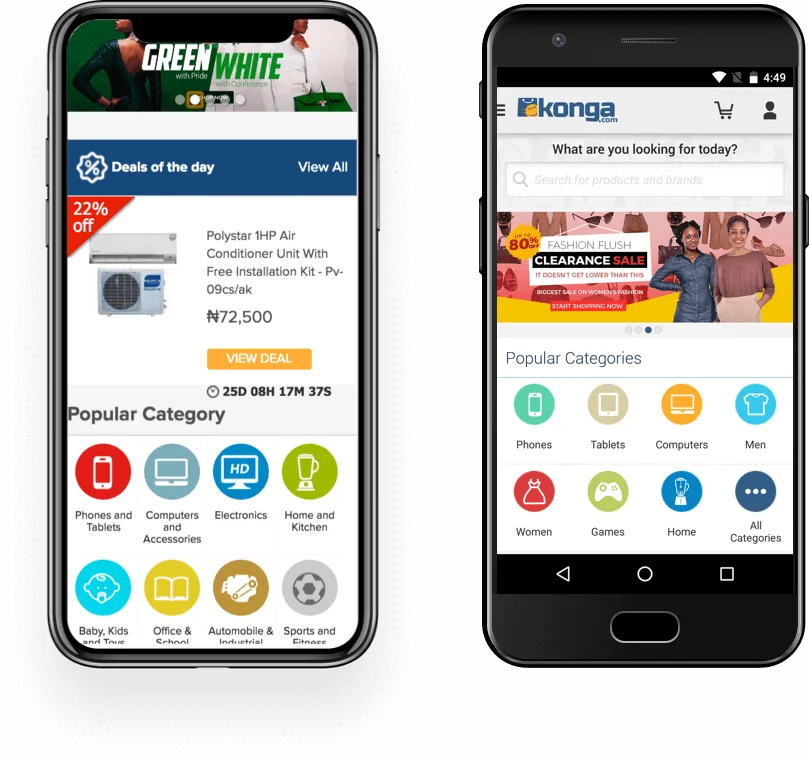
Konga is one of Nigeria’s leading e-commerce marketplaces, selling everything from electronics to groceries to millions of shoppers. Its web store worked. The problem was that a growing share of its market did not shop on the web at all. They shopped on a phone, often a low-cost Android phone, on a network that could not be relied on to stay up for the length of a checkout.
Getting Konga onto that phone was not a front-end exercise. Konga’s commerce logic lived in Magento, which at the time exposed no native mobile APIs, so there was nothing for an app to talk to. Net Solutions built that missing piece: a custom API layer over Magento that published the commerce functions an app actually needs, including authentication, catalogue, cart, checkout, payments and order status, while leaving Magento’s core untouched.
On top of that layer we shipped native Android and iOS applications built for the market as it really was, with heavy device fragmentation and unreliable bandwidth treated as design constraints rather than edge cases. Android launched first to capture the primary market, iOS followed, and the engagement went on to cover notifications, recommendations, cross-channel synchronisation, QA and knowledge transfer.
Most mobile commerce projects start with a design question. This one started with an integration problem and a market that punished any assumption of good conditions.
Konga’s customers were not shopping on flagship handsets with strong LTE. They were on a long tail of Android devices at every price point, on networks that dropped without warning. An app that loaded a heavy product page, stalled, and lost a cart would not just fail to convert. It would be uninstalled.
Magento had the commerce logic and no way to share it.
Konga’s core platform ran on Magento, which at the time shipped no native mobile application APIs. Every function the app needed already existed in the backend, but only in a form the web presentation layer could consume. Something had to sit in between and translate.
One app, hundreds of hardware and OS combinations.
The Android user base spanned wide variations in screen size, resolution, memory and operating system version. The shopping experience had to hold together across all of it, including on hardware with very little headroom to spare.
Bandwidth was not a performance metric, it was a conversion risk.
Frequent drops across regional mobile networks meant that heavy payloads and chatty API calls translated directly into timeouts, abandoned carts and lost revenue. Everything moving between the app and the server had to be as small as it could be.
Merchandising could not wait on an app store release.
Prices moved, stock moved, and campaigns ran on short notice. All of it had to reach the apps from Magento in real time, without shipping a new build and waiting for store approval and customer updates.
We treated Konga’s Magento investment as an asset to extend rather than a legacy system to replace. That single decision shaped everything else: the commerce engine stayed where it was, and a clean integration boundary was built around it.
Five pieces of work, sequenced so each one made the next one possible.
The middleware that made everything else buildable.
We developed a custom API gateway directly over Konga’s Magento backend, exposing customer authentication, product catalogue, cart state, checkout pipeline, payment processing and order status as services the apps could call. The apps consumed live commerce data while staying completely independent of Magento’s presentation layer, which meant the backend team and the mobile team could work without blocking each other.
A full shopping journey, built natively for each platform.
We engineered native applications covering product discovery, dynamic search, cart management, secure checkout, payment processing and real-time order tracking. Alongside the core journey we built the features that make a commerce app feel native rather than wrapped: social login, barcode product lookup, push notifications and digital wallet integration.
Designed for one bar of signal on a budget handset.
API payloads were trimmed to what each screen genuinely needed. Image assets were optimised and served to suit the device and connection. Caching and asynchronous fetching kept the interface responsive while data was still in flight, so a slow network degraded the experience gracefully instead of breaking the transaction.
Magento stayed the single source of truth.
Product variations, category changes, promotional pricing and stock levels propagated from Magento to the apps through the API layer as they changed. Merchandising teams kept working in one system, and customers saw current information without ever installing an update.
One customer, several devices, one continuous session.
We implemented real-time synchronisation of carts and wishlists between web and mobile, so a basket started on a desktop at work could be completed on a phone later. We integrated RichRecs APIs to power personalised discovery, including new arrivals, popular products, top sellers, recommended items and related products. Because Magento provided no mobile notification capability, we built that too, with API-triggered messages for deals and shipment activity.
What changed commercially, technically and operationally.
Konga moved from a web-only business to one with a direct presence on its customers’ home screens, opening a channel for acquisition, repeat purchase and re-engagement that the browser could not reach.
The Android application found its audience quickly after release and held a strong rating on the Google Play Store, which gave Konga the confidence to extend the ecosystem to iOS.
Platform performance contributed to Konga being named “Online Retailer of the Year” at the Marketing World Awards and to its inclusion on Fast Company’s World’s Most Innovative Companies list.
The API layer preserved Konga’s Magento architecture while letting the mobile applications scale, release and evolve on their own terms. Adding a second platform meant adding a client, not re-engineering the backend.
Lightweight payloads and optimised asset delivery kept browsing and checkout workable on inconsistent connections, which in this market is the difference between a completed order and a deleted app.
Five reasons this engagement worked, and none of them is the choice of platform.
The integration problem sat exactly between two disciplines. We brought both, so the API contract was designed by people who understood what Magento could give and what a native app actually needed to receive.
The custom API layer created a clean separation between commerce engine and client. Android proved it, iOS reused it, and later work built on it. That boundary is why the engagement could keep growing without a rewrite.
We designed for the phones and networks Konga’s customers really had. Optimising for conditions that do not exist is how mobile commerce projects quietly fail in emerging markets.
The work covered the full customer journey, from discovery and recommendations through payment, order tracking and post-purchase notification. Each stage was treated as part of one revenue path rather than a separate feature request.
An Android build turned into iOS development, Magento enhancements, notifications, synchronisation, QA and structured knowledge transfer to Konga’s own team. We were there for the evolution of the commerce ecosystem, not just its first release.
You build a custom API middleware layer between the two. The layer translates the app’s requests into Magento backend calls, so the mobile front end can handle login, catalogue browsing, cart management, checkout and order tracking without any modification to Magento’s core code. This is the approach Net Solutions used for Konga’s Android and iOS applications.

Four techniques do most of the work: keep API payloads to the minimum each screen requires, compress and size image assets dynamically for the device and connection, cache data locally on the handset, and fetch asynchronously so the interface stays usable while data loads. Together they let customers browse and complete checkout on unreliable connections.
It separates the customer experience from the commerce engine. New channels such as Android, iOS or a progressive web app can be launched against the same API contract without re-engineering inventory logic, database structures or payment workflows, which shortens time to market for every channel after the first.
Cart state is tied to a central customer account session on the server and accessed through APIs rather than stored on the device. When a shopper adds an item in the app, the API updates the shared session, so the item is already in the basket when they sign in on a desktop browser. Konga’s wishlists were synchronised the same way.
The Android application was engineered for a highly fragmented device landscape, covering wide variations in screen size, resolution, memory and OS version. Device capability and bandwidth constraints were considered together, since the same customers who had older hardware often had the weakest connections.
Through the custom API layer. Changes to products, categories, pricing, stock and other catalogue data were made once in Magento and reflected in the mobile applications, so no app store release was needed to update merchandising.
Yes. The solution included recommendation-driven discovery covering new products, popular products, top sellers, recommended items and related products, powered by RichRecs APIs within the defined project scope.
Net Solutions built custom notification functionality and triggered it through APIs, since the required capability did not exist in Magento. Customers received messages for deals and for order shipment activity.
Yes, provided the integration is built as a layer rather than a modification. At Konga, the API layer sat on top of Magento and left core code untouched, so the web store carried on trading normally while the mobile channel was developed and launched alongside it.
It depends on catalogue complexity, payment and logistics integrations, and whether an API layer already exists. A phased approach usually gets a business to market faster: ship one platform first, prove the API contract and the commerce flows in production, then extend to the second. That is the sequence Konga followed with Android before iOS.
Whether you are modernising a Magento platform, building native Android and iOS apps, or opening up your commerce engine through APIs, there is usually an engineering answer that does not involve starting over. Tell us where the bottleneck is and we will show you what the right architecture could do with the platform you already own.
Results matter. Discover how our customized solutions have delivered measurable business outcomes for clients across various industries. Each case study highlights the strategic impact of our work, turning challenges into opportunities for growth.
Ask Sol anything about digital products, AI, engineering, or growth, and get answers drawn from years of Net Solutions thinking and experience.