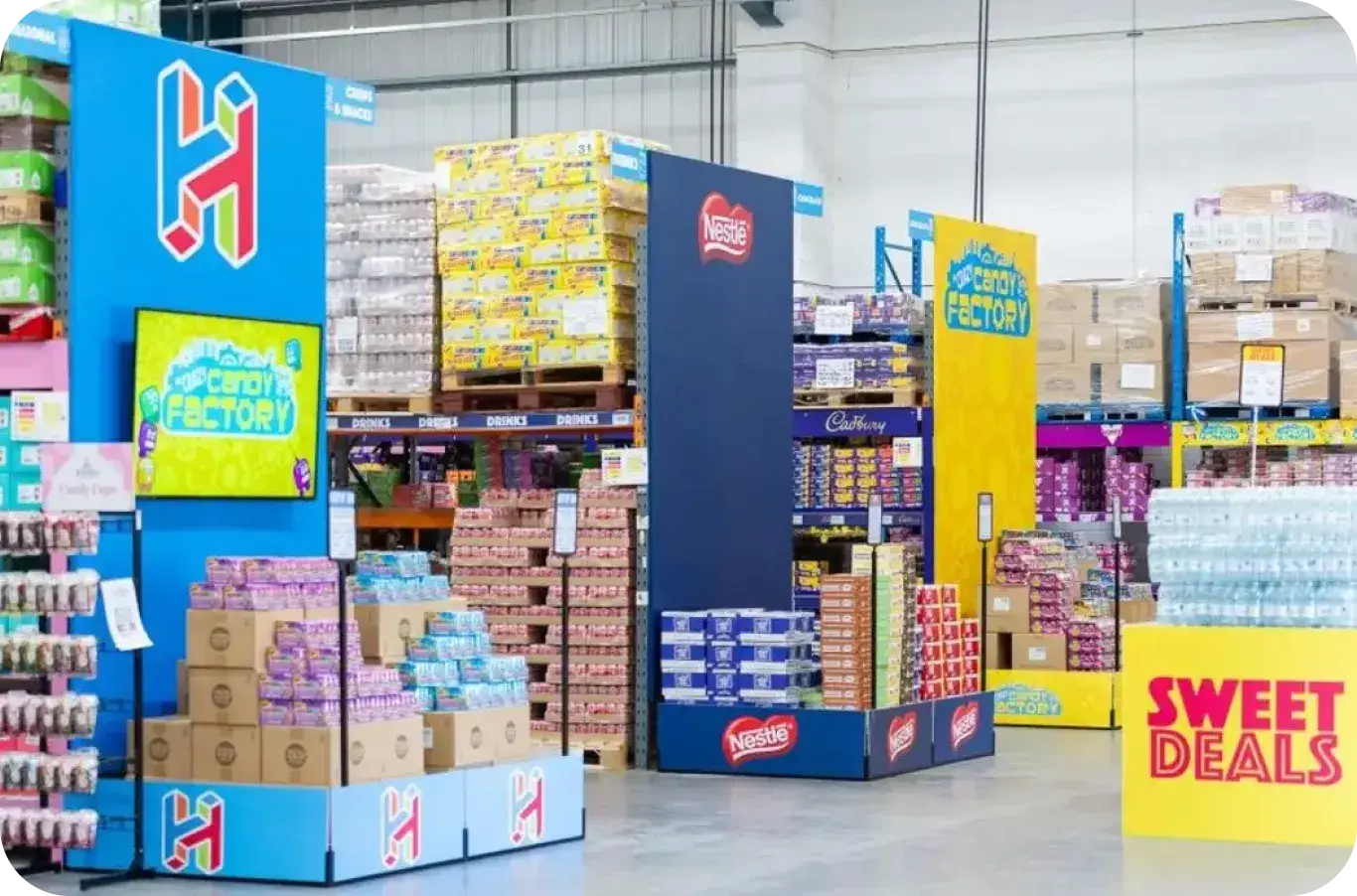
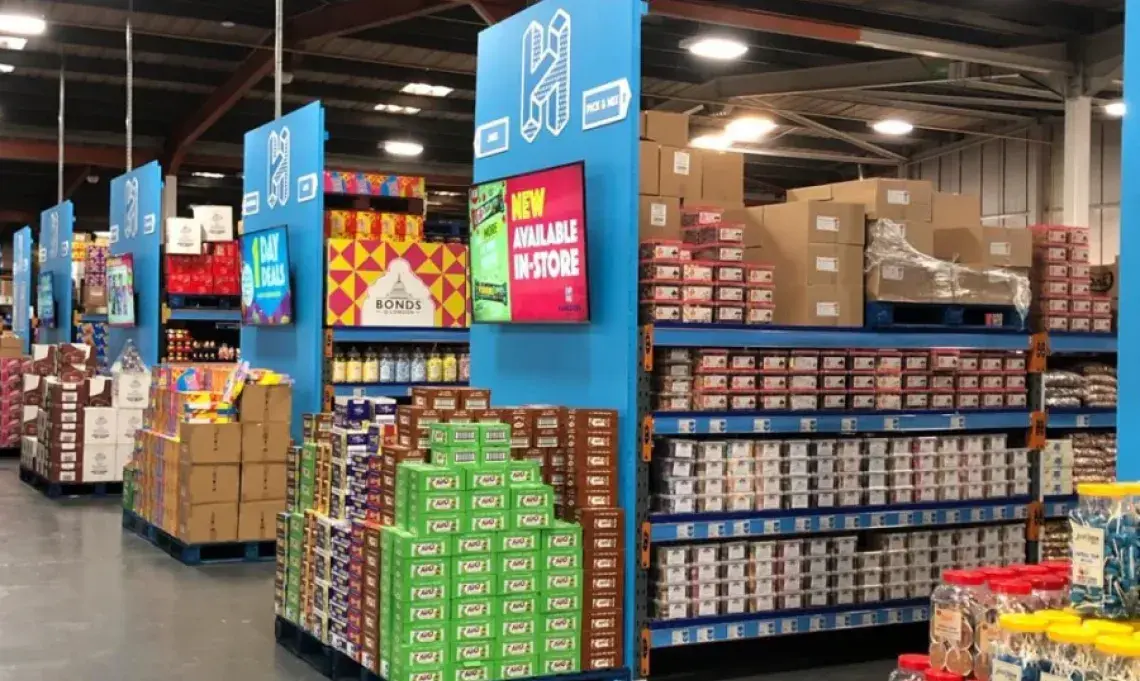
Hancocks sells sweets to the people who sell sweets. More than 3,000 SKUs, 13 wholesale stores, and thousands of independent retailers restocking on tight margins and tighter deadlines. After Net Solutions moved the business onto a composable, headless architecture, one gap remained. The storefront was fast, but it was not smart. Product recommendations ran on static rules that never learned. Search matched strings, not intent. Every promotional banner needed a developer.
We closed that gap by integrating Algonomy’s decisioning engine directly into the Next.js frontend, running recommendations, semantic search and campaign targeting as independent services rather than plugins bolted to the commerce core. Trade buyers now see recommendations shaped by their own order history, brand affinity and account entitlements. Merchandisers launch targeted campaigns without filing a ticket. Average order value rose 3.33%, user retention climbed 20%, and mobile engagement increased 11.4%.
Lift in average order value from AI-predicted cross-sell and bundling
Increase in user retention across the trade storefront
Growth in mobile user activity, alongside 9.9% on desktop
Developer tickets required to launch a targeted on-site campaign
Personalisation had been on the Hancocks roadmap for years. The problem was that every attempt at it had been built inside the commerce monolith, where it competed for the same database resources as order processing.
The result was personalisation that was technically present and commercially invisible.
The legacy engine ran on manually configured rules. Someone had decided, at some point, that a shopper viewing one product should see three others. Those pairings did not update as buying patterns shifted, did not account for a buyer’s own purchase history, and could not distinguish between a corner shop restocking penny sweets and a party supplier buying in bulk. The lift was close to nothing because the logic was closer to a static merchandising grid than a model.
Wholesale buyers search the way they talk in the warehouse. They type brand shorthand, half-remembered product names, case sizes and supplier part codes. The native search engine handled none of that. It ran exact-match queries against the product database, returned broad or empty result sets, and generated heavy lookups that contributed to deadlocks during peak ordering. Buyers who could not find a line simply did not order it.
Launching a banner, a seasonal offer or a pop-up meant writing and deploying custom scripts. For a category as seasonal as confectionery, where Halloween and Christmas ranges carry a large share of annual volume, a promotional window that opens and closes in days cannot depend on a release cycle. Merchandising ideas died in the backlog.
Trade buying is not consumer browsing. Accounts carry negotiated pricing tiers, restricted catalogue visibility and product entitlements. A recommendation engine that surfaces a product a buyer is not entitled to purchase, or shows a price that does not apply to their account, does more damage than showing nothing. Any personalisation layer had to respect those boundaries in real time, on every impression.
We treated personalisation as a product layer with its own boundaries, not as a feature of the commerce platform.
That distinction drove the whole engagement. Recommendations, search and campaign logic were pulled out of the backend entirely and run through Algonomy’s machine learning engine, connected directly to the frontend. The commerce platform kept doing what it is good at, which is holding the catalogue, pricing and orders. The decisioning layer took over everything that needed to think.
Three principles shaped the build:
Five components, built as independent services and connected to the storefront through Algonomy’s decisioning engine. Each one replaced something that had previously been either hard-coded, manual, or missing entirely. Together they gave Hancocks a storefront that learns from every session instead of waiting for someone to reconfigure it.
We deployed autonomous machine learning recommendation algorithms across product detail pages, product listing pages and the cart. The models weigh live browsing behaviour, individual buyer brand affinity, regional buying trends and historical wholesale order data to predict what a specific account is likely to need next.
Predictive basket analysis surfaces compatible product combinations at the point where a buyer is already committing. For a wholesaler, this is where personalisation converts into margin. A retailer ordering a chocolate range gets prompted with the display units, seasonal add-ons and complementary lines that similar accounts order alongside it, rather than a generic bestseller list.
Algonomy’s search layer applies natural language processing to interpret what a buyer means rather than what they typed. Behavioural ranking then re-orders results in the session itself, using real-time affinities and active interactions, so the list a buyer sees at their tenth search reflects what they have been doing for the previous nine.
Synonym and intent auto-learning bridges internal product naming and the everyday phrasing customers actually use. Precise SKU and part lookup handles the opposite case, where a buyer knows exactly which contract SKU or legacy catalogue code they want and needs it in one keystroke.
Search results respect account-specific pricing tiers, catalogue visibility rules and product entitlements in real time. Two buyers searching the same term see the catalogue they are actually authorised to buy from.
Inventory and pricing data synchronise instantly, so out-of-stock lines stop consuming prime result positions and buyers stop building baskets they cannot fulfil.
Engage gave the Hancocks team a Dynamic Experiences layer for building and launching banners, pop-ups and interactive on-site promotions without writing or deploying a line of code. Campaign turnaround moved from release cycles to minutes.
Rather than defining audiences by hand, the platform matches individual shopper behaviour and brand affinity into automated real-time targeting segments. Campaigns adapt in the moment based on visitor status, so a first-time visitor and a returning wholesale buyer with a five-year order history do not receive the same message.
Behavioural modelling triggers personalised experiences automatically, reducing the volume of manual A/B testing the team has to design, run and interpret.
Search journey performance is tracked end to end, exposing the exact points where buyers hit friction and abandon a search rather than leaving the team to infer it from conversion totals.
Visual, no-code controls let non-technical merchandisers adjust attribute weights and override AI ranking where commercial judgement should win. Category expertise stays in the loop.
Underneath all of it sits a real-time behavioural data ingestion pipeline that continuously trains the Find, Discover and Recommend models. This is the part that is invisible on the storefront and load-bearing for everything else.
The personalisation layer works because it is not sharing resources with order processing. Running on headless Adobe Commerce 2.4.5 with a React and Next.js frontend, Contentful for content and OpenSearch underneath, the decisioning services scale independently of the commerce core. The full modernisation story is covered in our Hancocks platform modernisation case study.
AI-predicted recommendations and smart bundling expanded basket sizes, delivering a 3.33% increase in average order value. For a wholesale operation running thousands of orders, a percentage point on AOV is a permanent structural gain rather than a campaign result.
User retention rose 20%. Engagement grew 11.4% on mobile and 9.9% on desktop, which matters disproportionately for trade buyers placing restock orders from a shop floor rather than a desk.
Marketing and sales teams now deploy dynamic offers, tune search behaviour and launch AI-segmented campaigns in minutes. Seasonal windows in confectionery are short, and the team can finally move inside them.
Moving discovery off the commerce database removed one of the heaviest sources of load during peak ordering, contributing to platform stability while making results materially more relevant.
Most personalisation projects fail for a reason that has nothing to do with the model. They get installed on top of a platform that cannot feed them clean, real-time behavioural data, and they get configured by people who need a developer for every change.
We build the decisioning layer and the architecture that carries it. That means setting clean component boundaries so personalisation scales independently of order processing, wiring event tracking that actually trains the models, and enforcing B2B realities like account pricing and entitlements inside the recommendation logic rather than patching them afterwards. We have done this across wholesale, automotive aftermarket and FMCG catalogues where the product data is messy and the buying rules are complicated.
If your personalisation programme is producing dashboards but not revenue, the problem is usually structural. Let’s look at it.
AI personalisation in B2B eCommerce uses machine learning to tailor product recommendations, search results and on-site campaigns to individual business accounts, based on live behaviour and historical order data. Unlike B2C personalisation, it has to respect account-level pricing tiers, catalogue entitlements and contract terms, so the buyer only ever sees products they are authorised to purchase at the price that applies to them.

Rule-based engines rely on pairings a merchandiser configured manually at a single point in time. They do not learn from live behaviour, do not adapt to seasonal demand shifts, and cannot distinguish between accounts with very different buying patterns. In a 3,000 SKU wholesale catalogue, the number of viable product relationships exceeds what any team can maintain by hand, so coverage stays thin and lift stays close to zero.
Algonomy provided the AI decisioning layer across three areas. Recommend delivered predictive cross-sell and up-sell on product pages, listing pages and the cart. Find and Discover powered semantic search with behavioural re-ranking and account-aware results. Engage gave merchandisers no-code control over banners, pop-ups and targeted campaigns. Net Solutions integrated all of it into a headless Next.js storefront and built the event tracking foundation that trains the models.
Average order value increased 3.33%, user retention rose 20%, mobile user activity grew 11.4% and desktop activity grew 9.9%. Campaign launch moved from a developer-dependent release cycle to a task merchandisers complete themselves in minutes.
B2B buyers search using trade shorthand, supplier part codes, case sizes and internal product jargon that rarely matches catalogue naming exactly. Exact-match keyword search fails on all of it and returns empty or irrelevant results. Semantic search interprets intent, learns synonyms automatically, and still handles precise SKU lookup when the buyer knows exactly what they want.
Sometimes, but rarely well. Personalisation depends on clean real-time behavioural event data and on running independently of the transactional database. On a tightly coupled monolith, the decisioning layer competes for the same resources as order processing and degrades performance under exactly the peak traffic conditions where personalisation matters most. Decoupling discovery and personalisation from the commerce core is usually the prerequisite.
The rules are applied inside the decisioning layer before a recommendation or search result is served, rather than filtering results after generation. Account pricing tiers, catalogue visibility and product entitlements are enforced on every impression, which prevents the common failure mode of surfacing products a buyer cannot actually order.
Models need traffic before they outperform rules, so meaningful lift typically appears within weeks rather than days as behavioural data accumulates. Search relevance and campaign agility improve immediately on launch, since those depend on configuration rather than training volume.
Tell us what your recommendation engine, search and campaign tooling look like today. We will tell you honestly whether the problem is the model, the data feeding it, or the architecture underneath it.
Adobe Commerce, Algonomy, Shopify, BigCommerce, AWS, Akeneo, Contentful and Klaviyo.
Results matter. Discover how our customized solutions have delivered measurable business outcomes for clients across various industries. Each case study highlights the strategic impact of our work, turning challenges into opportunities for growth.
Ask Sol anything about digital products, AI, engineering, or growth, and get answers drawn from years of Net Solutions thinking and experience.