Executive Summary
Foundation models have helped jump-start AI adoption for forecasting. Still, small pilot projects can make your team feel supported and less overwhelmed as they explore new technology.
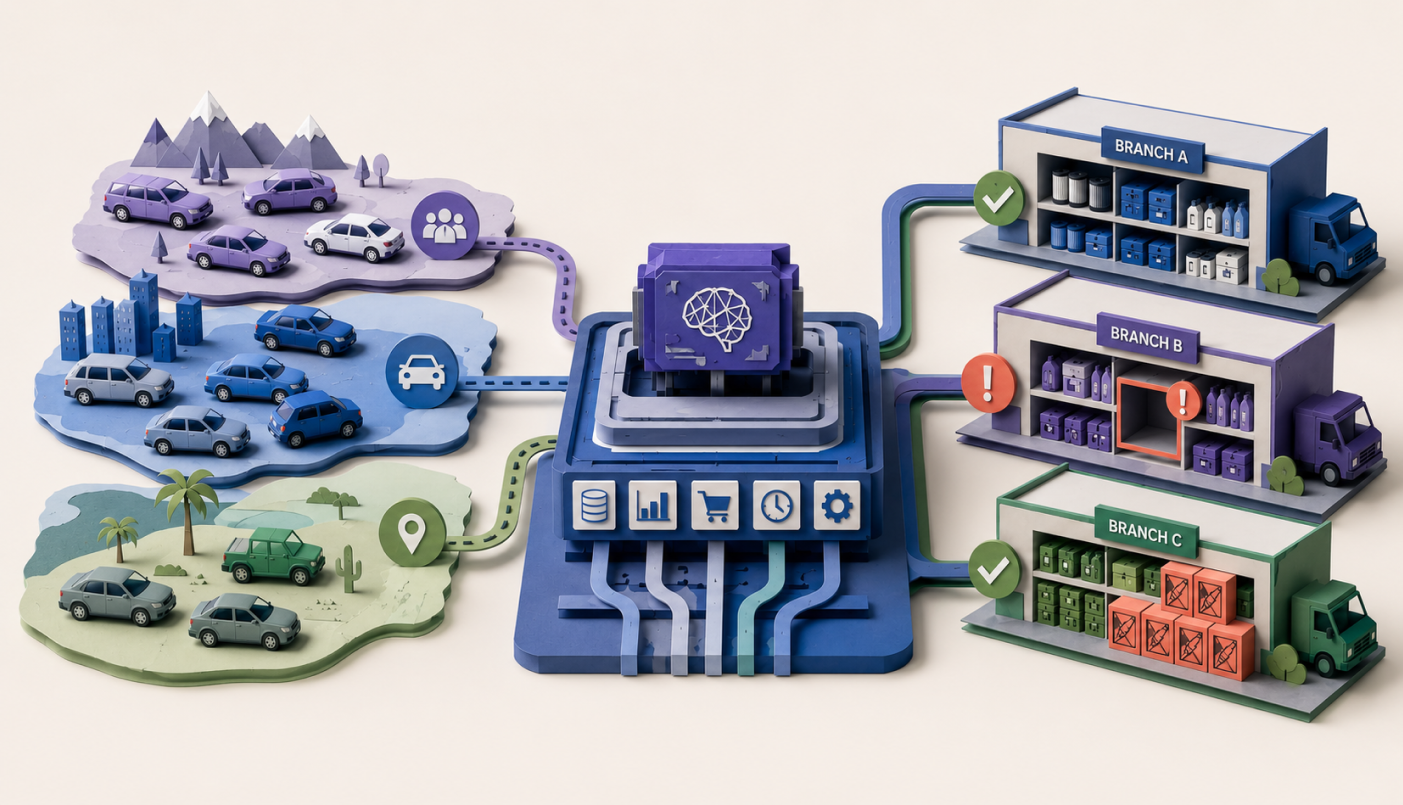
Time-series foundation models (machine learning models trained on vast stores of data), such as Chronos and TimesFM, let mid-market distributors start from a credible zero-shot baseline, with no up-front investment in building a model from scratch. What they do not supply is the rest of the system needed for effective AI forecasting: complete demand history, the signals that explain parts demand, the evaluation that earns trust, and the decision layer that turns a forecast into purchase orders and allocations.
- Overstock and stockouts are two symptoms of one planning problem. Better forecasting matters, but the forecast only creates value when purchasing and allocation policies act on it correctly.
- Foundation models change the economics. Pre-trained time-series models (e.g., Chronos and TimesFM) provide credible starting points on your own demand history, which then earn their place through backtests (historical data).
- The data and decision layers are critical to AI forecasting success. The model produces the forecast; the data and optimization layers make it usable.
- Parts demand is signal-rich, not uniformly predictable. Local vehicle populations, fitment, weather, and seasonality improve the forecast, but much of the SKU-location long tail remains intermittent.
- Backtests are the proof of effectiveness you need. To vet your forecasting accuracy, compare it against the planner, the current ERP method, and a seasonal baseline across history, then run it in shadow mode; the model earns influence by winning consistently.
Your Money Is Sitting On The Shelf
Ask your CFO where the margin went, and the answer is likely ‘on the shelves.’ Capital can be tied up in slow-moving SKUs at one branch while another branch loses sales to a stockout of the same part. Emergency transfers between locations can make the sale, but they erase the job’s margin. In many situations, purchase orders are sized on last year’s spreadsheet plus a planner’s instinct, all decisions made and orders placed before this season’s demand has even shown itself.
None of this is a technology problem; it is a prediction and planning problem: what will sell, in which region, in what quantity, and when—and what to buy and hold as a result. Demand forecasting is an established field that leverages statistical and machine-learning methods, with decades of results behind it and no hype required.
What has changed is who can afford to do it well. Previously an investment beyond most aftermarket retailers’ capabilities, AI demand forecasting models have now leveled the playing field.
What Changed: Forecasting Models Can Be Purchased
Until recently, building a bespoke machine-learning forecasting capability usually meant hiring or contracting data scientists to select, train, and maintain models: choosing algorithms, engineering features, and retraining the model as the business changed. The cost made demand forecasting out of reach for most mid-market distributors—not because the math was exotic, but because the team was expensive and the maintenance never ended.
Time-series foundation models have changed the economics of demand forecasting. Models such as Amazon’s Chronos and Google’s TimesFM are pre-trained on enormous volumes of time-series data, the way large language models (LLMs) are pre-trained on text. These models provide a credible zero-shot starting point (the technical term for fast setup, no pre-training required), giving you, day one, plain-instruction prompt access to begin working with your company’s demand history. While anyone can interact with the model, some forecasting expertise is still required to evaluate baselines and evaluation windows, handle intermittent and obsolete demand, manage uncertainty and drift, and decide when the system should defer to a planner. Foundation models reduce the need to design and train a bespoke model from scratch. We say this as a firm that built the custom models.
What We Learned Building Demand Forecasting The Hard Way
Before foundation models were a ‘thing,’ we worked with a leading UK specialty retailer to engineer a bespoke machine learning forecasting system. The retailer ran a large catalog across multiple warehouses, with demand that swung hard by season. Planning lived in spreadsheets fed by stale ERP exports; seasonal spikes were routinely caught only after purchase commitments had been placed, and every forecasting cycle consumed manual analyst effort. The familiar result: overstock in some locations, stockouts in others, and margin quietly lost to both.
What the bespoke build delivered. Custom machine-learning models generated SKU-level sales predictions, fed by live ERP integration across sales history, catalog, promotions, and demand signals. An optimization layer applied the forecasts to stock decisions across every warehouse location, with real-time dashboards and automated low-stock and trend alerts. Stockouts and overstocking both fell, and the system surfaced seasonal demand shifts earlier in the planning cycle.
Here is the honest lesson from that delivery, and the reason this article exists: the models were not where the effort went. The overwhelming share of the engineering sat in the layers around the model: ERP integration in place of stale exports, clean unified sales and stock data, and the optimization and workflow that turned a prediction into an actual replenishment and allocation decision. The model produced the forecast; the data and optimization layers made it usable.
Foundation models reduce the model-building burden. They do not build the data, constraints, optimization, and workflow around the forecast.
We rebuilt platforms exactly like this and wrote down what broke: Read the six failures and their fixes in our free 37-page Unreadable field report.
Read MoreWhat Today’s Parts Distributors Need For Accurate Demand Forecasting (To Support The AI Model)
Aftermarket distribution has unusually useful explanatory signals and unusually difficult demand patterns. Vehicle populations, fitment, weather, and seasonality can improve the forecast. Still, the long tail of SKU-location combinations remains sparse and intermittent, and an honest demand forecasting system is built with that in mind.
- Sales velocity by SKU and by branch is the base signal, reconciled across the commerce platform and ERP and refreshed at least as often as the purchasing decision requires.
- Sales history is not the same as demand history. A zero-sale day because no one wanted the part is different from a zero-sale day because the branch had none to sell. Stockout flags, backorders, substitutions, cancellations, and lost-sales estimates need to travel with the sales record. Otherwise, the model learns that products the distributor failed to keep available were products customers did not want.
- The installed vehicle population around each branch: the age, make, and engine mix of cars actually on the road will drive what fails and when, and each branch will have to stock for their local population. Take two branches: one sits in a rural area where most of the cars are diesels past their tenth birthday, so it sells a steady stream of EGR valves and glow plugs; the other is in a city full of small gasoline-powered cars a few years old, and those parts barely move there. When branch-level vehicle-population data is supplied, mapped to the relevant fitment records and aligned with sales history, the model can learn that relationship rather than relying on a planner to encode it manually.
- Fitment-driven catalog depth: a brake-pad category can contain dozens of near-identical SKUs, each linked to a different set of vehicle applications. Which of those versions actually sell at a branch depends on the cars people drive in that area. No national bestseller list can answer that question.
- Seasonality and weather: batteries, wipers, and cooling parts move on calendars a model learns quickly.
- Promotions and planned marketing, so the forecast prices in what marketing is about to do to demand.
The forecast estimates what each SKU-location combination is likely to require and how uncertain that estimate is. A decision layer then translates forecasting estimates into purchasing, allocation and rebalancing recommendations using the distributor’s service levels, supplier lead times and their variability, minimum order quantities, inventory position and operating costs. The stocking logic is familiar to experienced planners: hold depth on the fast-moving core and source the long tail on demand rather than warehousing it. The opportunity is to apply that logic consistently across every branch and recalculate it as demand changes.
When the forecast and decision layer improve, the intended outcomes are lower excess stock, fewer avoidable transfers, and more planner time spent on exceptions.
The Prerequisite: Decision-Grade Data
Most distribution stacks fail before any model runs: stock counts that lag the warehouse, sales data fragmented across channels, missing stockout and backorder flags, catalog records too inconsistent to aggregate. This is a massive topic on its own, with many steps, so we welcome you to learn more about what good foundations look like, and how to measure yours, in the four metrics that matter in aftermarket eCommerce.
How To Start Without Betting The Budget
Start with one category and one region, but begin with rolling historical backtests rather than waiting for a single season to finish. Compare the model against the planner’s forecast, the current ERP method, and a simple seasonal baseline across several historical periods. Measure forecast error and bias by demand type, then test the operational effect in shadow mode: availability, excess stock, emergency transfers, working capital and service level. Only after the model wins consistently should it influence human-approved purchase orders.
An important note: a failed pilot is still useful. How it fails tells you whether the constraint sits in the model, the underlying data, the inventory policy, or the planning workflow. Once fixed, you can begin again and keep learning from mistakes (the beauty of these models).
What this means for your business: if the capital sitting on your shelves is the number you would most like to shrink this year, the work starts in your demand data and the decisions built on it, not in a model selection exercise.
Frequently Asked Questions
You don’t need a dedicated team unless you’re looking to train a bespoke forecasting model from scratch. However, even for off-the-shelf models, you still need forecasting expertise to build appropriate baselines, test performance, handle intermittent demand, calibrate uncertainty and govern the system in production. Most of the engineering effort will sit in the data and decision pipeline rather than in inventing a new model.
Reorder-point planning triggers replenishment when projected inventory falls below a configured threshold. Modern ERP systems can calculate or vary those thresholds by item, location, service level, and season. A demand forecast adds a forward-looking, probabilistic view of expected demand. The decision layer then combines that forecast with current inventory, open orders, lead times, and operating constraints to recommend purchasing and network allocation decisions.
Sales velocity by SKU and branch, the vehicle population around each branch, the fitment structure of the catalog, seasonality, and promotions, with availability and lost-demand signals traveling alongside the sales record. Supplier lead times and inventory position feed the decision layer that acts on the forecast. Freshness should match the decision: a forecast refreshed less frequently than the purchasing decision will systematically lag the business.
Fix the foundations first, because a forecasting model pointed at bad data automates bad purchasing. Stock counts that lag the warehouse, sales fragmented across channels, missing stockout and backorder flags, and inconsistent catalog records all need addressing before any model earns trust. Measuring the current state of those foundations is the practical first step, and it is a data-engineering exercise, not a hiring one.
Discuss Demand Forecasting For Your Distribution Network
Talk to us about your sales history, inventory model, planning cadence, and operational constraints. We will help determine whether a forecasting pilot is worth running and what would need to be fixed first.