
Executive Summary
Enterprise retailers are sitting on vast troves of customer data and losing money because of it. Fragmented data systems don’t just create operational friction; they actively inflate acquisition costs, erode margins, and cause brands to behave like strangers to their most loyal customers. This piece diagnoses the root cause – the “Stranger Loop” – and maps the strategic and operational case for consolidating onto a unified data platform such as Adobe Experience Platform (AEP).
Key Takeaways
- Disconnected systems cause brands to behave like strangers to their own best customers. This phenomenon is called the Stranger Loop.
- The real cost of data silos is financial: wasted ad spend, margin erosion from blanket discounting, and missed retention opportunities.
- A standalone CDP solves storage, not activation. The gap between unified data and real-time action is where revenue is lost.
- AEP is composable: deploy the pillar that fixes your immediate bottleneck first, then scale. Full integration is a journey, not a prerequisite.
- The ROI case is measurable: 50% faster campaign builds, 20–30% retention uplift, and 242% return on CX investment.
- In 2026, the winning retailer is not the one with the biggest budget – it is the one with the best data architecture.

For many enterprise retailers, the digital storefront is booming, but the underlying data architecture is bleeding cash. A loyal customer buys a premium coat in a physical store, but because the Point-of-Sale (POS) system doesn’t talk to the advertising platform, the brand spends the next three weeks retargeting that exact customer with ads for the coat already hanging in their closet. In 2026, isolated data doesn’t just create a bad customer experience – it actively inflates your acquisition costs and erodes your margins.
Opening Scenario: The “Stranger” Loop
Imagine a multi-national retailer sitting on a mountain of customer data. They have purchase history in a legacy CRM, website behavior in an analytics tool, and email open rates in a separate marketing platform.
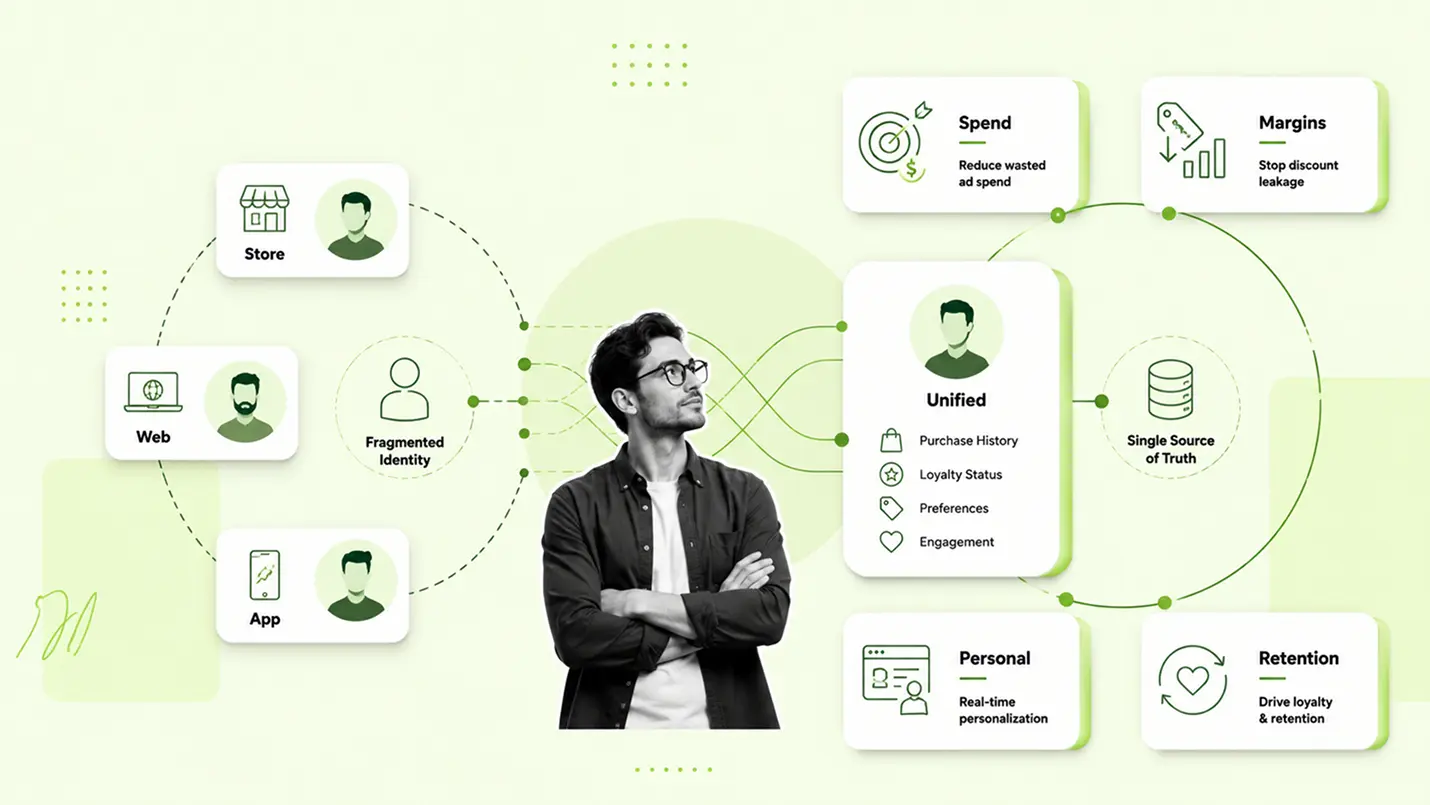
Despite this wealth of data, the marketing team is flying blind. When a high-lifetime-value (CLV) customer browses the website on their laptop without logging in, the system treats them as an “anonymous prospect.” It fires off a generic “New User! Take 10% Off” pop-up. Later, when that same user opens the brand’s mobile app, they are treated as a known VIP. The business suffers from Fragmented Identity. Because the systems cannot stitch together the anonymous web visitor with the known app user, the brand behaves like a stranger with short-term memory loss, reacting to disconnected events rather than a continuous human being.
The Hidden Problem: The Cost of Disconnected Data
The non-obvious challenge isn’t a lack of tools; it’s the Tax of Data Silos. When customer data lives in isolated platforms, marketing becomes inherently reactive.
Without a connected ecosystem, teams cannot respond to real-time intent. If a user abandons a cart, a disconnected system might wait for a nightly batch update to trigger an email—by which time the customer has already purchased from a competitor. The hidden consequences are severe:
- Wasted Spend: You are paying ad networks to acquire customers you already own.
- Inconsistent Personalization: Loyal customers receive acquisition offers, cheapening the brand perception.
- Margin Erosion: Offering blanket discounts because the system lacks the intelligence to identify who actually needs an incentive to convert.
Why Common Logic Fails
Standard industry advice suggests buying a standalone Customer Data Platform (CDP) to act as a storage bucket. The logic is: “Put all the data in one place, and the problem is solved.”
This logic fails because storing data is passive. A standalone CDP might give you a unified profile, but if it cannot instantly push that profile to an execution engine, the data is useless. Furthermore, bolting together different vendors for analytics, messaging, and data storage creates massive tech stack bloat. Developers spend their days maintaining fragile API connections instead of building features, and business users are forced to rely on IT to pull basic SQL queries just to understand campaign performance.
The Real Trade-Offs: Consolidating the Stack
To solve the fragmentation crisis, a business must decide to implement a centralized operational foundation like the Adobe Experience Platform (AEP).
- The Decision: Retiring disjointed point-solutions in favor of a unified ecosystem that handles ingestion, activation, and measurement under one roof.
- The Gain: Democratized data. Business teams can build dynamic audiences and trigger real-time campaigns without relying on IT or waiting for data engineers.
- The Risk: The transition requires a ruthless audit of existing legacy tools and a cultural shift toward centralized governance. You are trading the familiar comfort of isolated dashboards for the steep learning curve of a unified data schema.
Operational Reality: The Four Pillars of the AEP Engine
The operational reality of AEP is that it functions as a modular, self-optimizing ecosystem. Crucially, you do not need to integrate all four pillars at once. Because every business problem is unique, AEP is designed to be composable. A brand struggling with data fragmentation might deploy only the Real-Time CDP, while another struggling with campaign measurement might integrate only Customer Journey Analytics. You deploy exactly the pillar you need to fix your immediate bottleneck, and you can scale the rest of the architecture later.
For organizations that choose to connect the entire loop, it transforms scattered data into a “Single Source of Truth” through four distinct, synchronized modules:

What Smart Operators Do Differently: High-Impact Use Cases
Experienced teams use this connected architecture to move away from “batch-and-blast” emails and toward real-time, logic-driven interactions.
- Intelligent Cart Recovery: Instead of a generic reminder, AEP triggers a personalized message via SMS/Email with the exact items left behind, using predictive timing to ensure the message arrives exactly when the user is historically most likely to convert.
- Dynamic Homepages & Email Injection: When a returning visitor lands on the site, the CDP recognizes them instantly. If they previously viewed “running shoes,” the homepage banner updates immediately. Instead of static newsletters, the system injects real-time product recommendations into emails at the exact moment of open, showing live inventory.
- VIP Nurturing & Churn Prevention: Machine learning models identify early warning signals of churn (e.g., decreased visit frequency). Operators proactively trigger a “We miss you” offer before the customer leaves. Conversely, they identify high-CLV customers and suppress generic discounts, offering “VIP Early Access” instead to protect margins while driving advocacy.
Closing Insight: The Economics of Integration
In a mature digital economy, the platform isn’t just a marketing tool; it’s an operational lever for financial performance.
Companies that successfully unify their data see a profound impact on the bottom line: a 50% reduction in campaign build time, a 20–30% uplift in retention rates, and an astonishing 242% ROI on their Customer Experience Management investment. By consolidating multiple journey and campaign tools into AEP, businesses reduce tech stack bloat and eliminate the “Stranger Loop.” The competitive advantage no longer belongs to the brand with the biggest ad budget; it belongs to the brand that can recognize its customers instantly, measure interactions perfectly, and optimize the next step automatically.