
Executive Summary
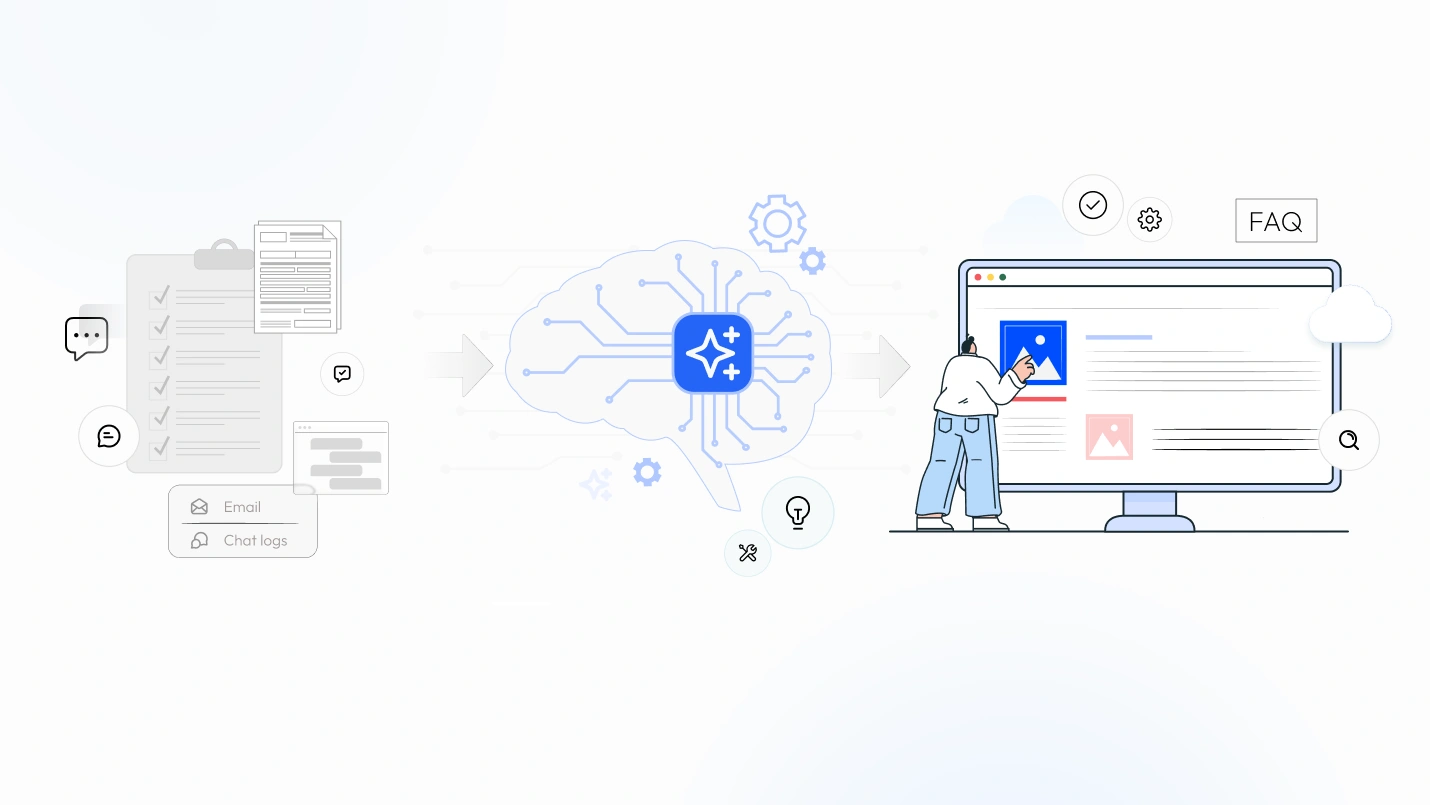
For growing enterprises, repetitive Level-1 (L1) support tickets represent a significant operational bottleneck, preventing teams from focusing on complex issues. While most organizations struggle with an understocked Knowledge Base, the solution is already sitting in their customer support ticket history. By applying AI-powered FAQ generation to historical data, companies can transform thousands of unstructured conversations into a structured, publishable Knowledge Base, deflecting 20–30% of support volume without increasing headcount or changing live infrastructure.
Key Takeaways
- Support Deflection: High-impact FAQs can reduce L1 ticket volume by a projected 20–30%.
- Rapid Time-to-Value: AI can analyze thousands of archived conversations in days, a task that would take months manually.
- Risk-Free Implementation: Secure, “air-gapped” offline processing ensures zero impact on live customer support operations and zero performance risk.
- Data Privacy: Strict programmatic redaction of Personal Identifiable Information (PII) ensures compliance before any AI processing begins.
- Operational Insights: Beyond content, AI clustering identifies product friction points, terminology gaps, and process failures.
If your support team spends a significant chunk of their day answering the same questions – “How do I reset my password?”, “Why did my payment fail?”, “How do I export my data?” – You are not alone. For companies running customer support via any tool (Freshdesk, Zoho Desk, LiveAgent, Buffer, or any other), repetitive Level-1 (L1) tickets are among the most predictable, solvable, and costly operational inefficiencies.
The good news: your ticket history already holds the answer. The challenge is extracting it. Manual analysis of thousands of archived conversations would take months. AI can do it in days. Read on to understand the business case for AI-powered FAQ generation, walk through how a modern implementation works end-to-end, and see what results look like in practice.
What is The Hidden Cost of an Understocked Knowledge Base?
Most support leaders know their knowledge base is incomplete. Few have quantified the cost. Here is a hypothetical framework for thinking about it:
- The average cost of handling a support ticket manually is $15.56, with agent time at $1.60 per minute, across all ticket types, including complex issues that genuinely need human attention.
- By contrast, a self-service interaction costs as little as $0.10 on average, roughly 1% of the cost of a live agent handling the same query.
- Despite this, 81% of customers say they try to resolve issues themselves before contacting support, meaning the demand for self-service already exists. The gap is on the supply side: most knowledge bases simply do not cover enough ground.
- And the cost compounds: without documentation, the same questions resurface month after month, and every undocumented issue becomes a recurring line item on your support budget.
The core problem is not effort. It is discovery. Support teams know the high-frequency questions exist; they feel them every day. But identifying the precise clusters, writing the articles, and keeping them current requires a level of continuous investment that most teams cannot sustain manually.

How Does AI-Powered FAQ Generation Actually Work?
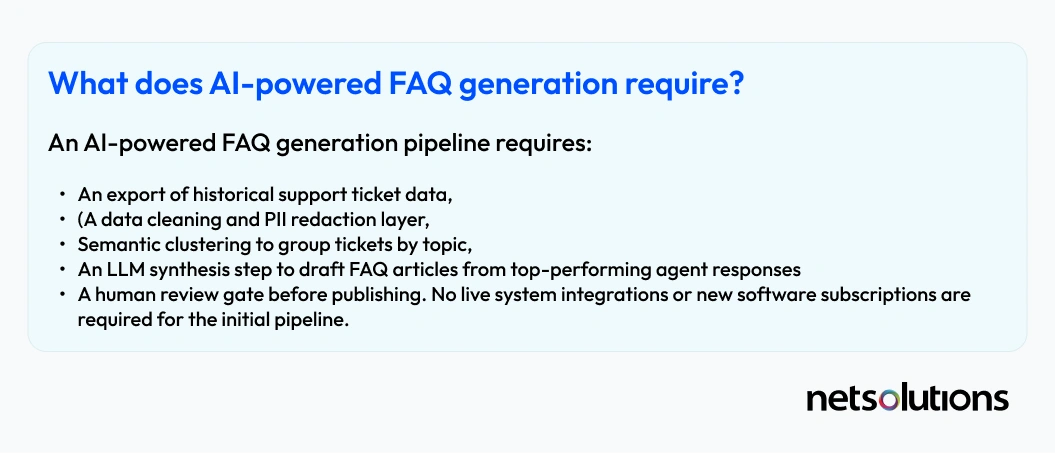
AI-powered FAQ generation is not about asking ChatGPT to write help articles. It is not a generic content tool; it is a structured pipeline that mines your actual support history to surface what customers are truly asking and synthesizes your team’s best answers.
Here is what a well-designed implementation looks like, stage by stage:

The key distinction from generic AI content tools is this: every FAQ produced is grounded in real customer questions from your own customer support data. AI is not inventing scenarios; it is organizing and clarifying conversations that already happened.
These are the three business problems this solves immediately:
- Support Deflection at Scale: Strategic FAQs directly address frequent ticket themes, allowing a meaningful share of customers to find answers independently.
- Capturing Institutional Knowledge: AI encodes the resolution logic from your highest-performing agents into durable documentation, protecting the business from the risks of agent turnover.
- Surfacing “Hidden” Product Friction: The analysis often reveals features with high ticket volumes but zero documentation — a clear signal of UI/UX issues or process bottlenecks, such as onboarding emails landing in spam.
What to Look for in an Implementation Partner?
Not all AI knowledge base projects are built equally. If you are evaluating vendors or implementation partners, here are the questions that separate serious implementations from proof-of-concept demos:
- How is PII handled before data is sent to any AI model? Redaction should happen programmatically, before any LLM sees the data.
- Does the pipeline respect departmental context? Processing all tickets as a single dataset produces generic, low-accuracy output. Group-based segmentation is a quality signal.
- Is there a human review gate before any content is published? Human-in-the-loop is not optional for brand-safe content.
- What is the ongoing cost model? One-time analysis pipelines are dramatically more cost-effective than perpetual AI subscriptions for this use case.
- Does the output map to your knowledge base structure, or does it require significant reformatting to publish?
How We Helped a Services Company Modernize Its Freshdesk Knowledge Base

Project Details
We completed a comprehensive data analysis initiative to modernize the Client’s Freshdesk support operations. By applying AI to historical support data, we have transformed thousands of unstructured conversations into a structured Knowledge Base. This project has delivered ready-to-publish FAQs that directly address the most frequent customer pain points, without requiring new software infrastructure.
Problem Statement
- Operational Bottleneck: Support teams are overwhelmed by repetitive Level-1 queries (e.g., “How do I reset my password?”), preventing them from focusing on complex issues.
- Content Gap: The existing Knowledge Base is missing critical articles for common problems, forcing users to rely on human support for basic answers.
- Manual Dependency: Identifying these content gaps would require months of manual analysis of ticket logs.
Key Achievements & Project Deliverables
This initiative moved beyond theoretical analysis to provide tangible assets that the client can use immediately.
High-Impact Deliverables
- Automated Knowledge Extraction: Successfully analyzed historical tickets to identify the most recurring support themes.
- Content Generation: Delivered high-quality, step-by-step FAQ articles. These are drafted, formatted, and ready for final review.
- Gap Analysis: Identified distinct topic clusters (e.g., Login Issues, Payment Failures) where no documentation previously existed.
Efficiency Wins
- Zero-Integration Deployment: Results were achieved through offline analysis, meaning no changes were required in the client’s live Freshdesk, and no downtime occurred.
- Cost-Effective Execution: A one-time processing pipeline delivered high value without recurring AI subscription costs.
Technical Execution
From Raw Data to Insights
We employed a secure, multi-stage AI pipeline to transform raw, noisy data into valuable knowledge.
Step 0: Secure Data Acquisition (Offline Handover)
- The Action: The client exported historical ticket archives from Freshdesk platform and hosted them on a secure Box drive. The data was downloaded offline while preserving the original folder structure, without connecting to the live database or API.
- The Value: This “air-gapped” method ensured zero risk to live operations and no performance impact on the active support platform.
Step 1: Data Hygiene & Privacy (Sanitization)
- The Action: Technical noise such as HTML code and email headers was programmatically removed, and Personal Identifiable Information (PII) was redacted.
- The Value: The AI learns only from the problem context rather than personal details, ensuring compliance and cleaner insights.
Step 2: Intelligent Segmentation (Group-Based Processing)
- The Action: Tickets were segmented according to existing support groups such as Applications, Insurance, and Technical Support instead of being processed as one dataset.
- The Value: This preserved departmental context and produced more accurate and specialized FAQs for each support team.
Step 3: Semantic Pattern Recognition (Topic Clustering)
- The Action: AI embeddings converted text into mathematical vectors, followed by unsupervised clustering to group tickets by meaning rather than simple keyword matching.
- The Value: This approach captured related issues that manual review or keyword searches would likely miss.
Step 4: Generative Synthesis (Drafting)
- The Action: Large Language Models synthesized the best historical answers from top-performing agents into standardized FAQ drafts.
- The Value: The output mirrors the tone and expertise of experienced support staff while requiring minimal editing.
Step 5: Cost-Optimized Processing
- The Action: Batch processing and dimensionality reduction techniques were used to process large datasets efficiently.
- The Value: Thousands of tickets were analyzed at a fraction of the cost of traditional real-time AI queries.
Technology Stack
- Language: Python 3.x
- AI & ML: OpenAI (Embeddings + LLMs), scikit-learn
- Clustering: MiniBatch K-Means, UMAP
- Data Processing: pandas, NumPy, JSONL
- Visualization: matplotlib, Jupyter
- Security: PII redaction, offline processing
Strategic Business Impact

Insight Spotlight
What We Discovered
Beyond generating text, the AI analysis revealed critical patterns regarding why users contact support. These insights offer immediate opportunities for product improvement:
- The “Hidden” Pain Points: High volumes of tickets were related to specific features with no documentation, indicating a potential UI usability issue.
- Terminology Mismatch: Users search using everyday language, while documentation often uses technical terminology, causing search failures. The newly generated FAQs bridge this gap.
- Process Bottlenecks: A major cluster of tickets related to account activation suggests automated emails frequently land in spam, highlighting an upstream process issue that can now be corrected.
Risk Management & Compliance
- Data Privacy: All Personal Identifiable Information (PII) was programmatically redacted before any analysis was conducted.
- Human-in-the-Loop: A strict “Review First” policy ensures that no AI-generated content goes live without human approval, guaranteeing accuracy and brand alignment.
Future Roadmap & Innovation Opportunities
Aligned with the client’s vision to explore further enhancements, we have identified three strategic pillars for the next phase:
Automation & Integration
- Direct Publishing: Build a connector to push approved FAQs directly to Freshdesk platform via API.
- Multi-Language Support: Automatically translate FAQs into Spanish and French to support global markets.
Intelligent Operations (The “Next Level”)
- Smart Ticket Routing: Use the identified “Cluster IDs” to automatically route incoming support emails to the correct departments.
- Sentiment-Based Prioritization: Analyze the tone of incoming tickets to flag frustrated customers for faster response by senior agents.
- Product Feedback Loop: Aggregate recurring problem clusters monthly and share them with the Product Team to address root causes.
From Reactive to Proactive CX
This project proves that scaling support does not always require hiring more agents. Instead, organizations can unlock significant value by utilizing the data they already have.
By converting dormant ticket archives into active self-service knowledge assets, companies can reduce operational costs while simultaneously improving the overall customer experience.

Ready to See What’s Inside Your Ticket Data?
We offer a no-commitment discovery session to assess your Freshdesk data volume, identify the highest-impact FAQ clusters for your organization, and outline a pilot scope.
If the numbers make sense, we move fast. If they don’t, we’ll tell you what to do.
Contact us to schedule your discovery session.
Frequently Asked Questions
No. The cleanest implementation model uses an offline export of your historical ticket data. You export the archive, share it via a secure file transfer, and we process it without ever connecting to your live environment. This eliminates both security risk and operational disruption.
For a typical mid-market ticket dataset (10,000–50,000 historical tickets), the processing pipeline runs in days rather than weeks. The rate-limiting step is usually your internal review and approval of the generated FAQs before publication.
All Personal Identifiable Information (PII) is programmatically redacted before any AI model processes the data. The AI learns from the shape of the problem (the issue description, the resolution path), not from individual customer details. Data handling protocols are documented and available for compliance review.
Yes. Data hygiene is the first stage of the pipeline. HTML markup, email threading artifacts, and formatting noise are stripped before clustering. Semantic embedding handles variability in how agents or customers phrase the same issue, which is precisely why this approach outperforms keyword-based analysis.
Deflection benefits begin accruing the moment your first FAQ articles go live in the customer support tool. For organizations with clearly documented L1 ticket costs, the payback period for a pilot engagement is typically measured in weeks rather than quarters. We can work with your support operations data to model projected savings before engagement.