
Executive Summary
The core message from our London executive breakfast event is that AI success hinges on strategic alignment rather than just tool adoption. While most organizations have gathered vast amounts of data, the real competitive advantage now lies in connecting these disconnected silos to move from retrospective insights to real-time action. By unifying data and execution, businesses can transform AI into a performance engine that enhances customer experiences and operational efficiency. Ultimately, the “AI Divide” will separate those who layer technology over fragmentation from those who build a disciplined, governed, and connected enterprise.
Key Takeaways
- Shift from Insight to Action: AI has evolved from a retrospective reporting tool (“What happened?”) into an execution engine (“What should we do next, and can the system do it?”).
- The “Alignment” Prerequisite: AI tools are widely available, but they increase complexity rather than performance if the underlying data remains siloed. Success requires bringing together data, strategy, and execution.
- Friction is a Revenue Killer: Modern customers expect a seamless experience. When data isn’t shared across departments (Marketing, Ops, Finance), it creates inconsistent messaging and delayed responses that drive customers away.
- Governance is the “Brake” that Allows Speed: To scale AI without losing control, organizations must build in clear boundaries, visibility/auditability, and strict operational guardrails from day one.
- Strategic Prioritization: AI readiness is a disciplined four-step journey: Assess (identify siloes), Standardize (govern data), Connect (link systems), and Prioritize (focus on high-ROI use cases like personalization or forecasting).
At the recent Net Solutions “Competing in the Era of AI” executive breakfast in London, one message was clear: AI is everywhere, but most organizations still lack a practical roadmap for using it effectively.
The problem isn’t access to AI tools. Those are widely available.
The real challenge is alignment — bringing together data, strategy, and execution in a way that drives measurable business results. The companies that will lead in the AI era won’t just experiment with new technologies. They will transform disconnected data into a strategic asset and use AI to create seamless customer experiences and more efficient operations.
This is where strategy and execution must converge.
A New Turning Point
For years, digital transformation has focused on building systems — CRM platforms, analytics tools, cloud infrastructure, and eCommerce engines.
Those investments improved efficiency and scalability.
But today, we’ve reached a new turning point. It’s no longer enough to collect and store data. The advantage now comes from connecting it — and using AI to act on it in real time.
The key question for leadership teams is simple: Are we structured to operate as an intelligent, connected enterprise?
AI Is Moving From Insight to Action
In the past, AI mostly helped analyze information.
Now it can drive action.
Modern AI systems can:
- Understand customer intent based on behavior and language
- Recommend the next best action
- Automate processes across multiple systems
- Learn from results and continuously improve
This shifts AI from a reporting tool to an execution engine.
Instead of asking, “What happened last quarter?” businesses can ask, “What should we do next — and can the system execute it?”
But this only works when the underlying data is unified and well-governed.
If systems are disconnected, AI increases complexity.
If systems are aligned, AI increases performance.
Why This Moment Matters
Two major forces are converging.
1. The Technology Is Ready
Cloud platforms are stable. Data systems are more interoperable. AI models are enterprise-grade.
The limiting factor is no longer capability. It’s coordination.
Organizations that align their systems will unlock compounding value. Those who don’t will struggle with fragmented results.
2. Market Expectations Are Rising
Customers expect fast, personalized experiences across channels. They don’t think in terms of departments or platforms.
If data isn’t shared across systems, customers experience friction — inconsistent messaging, delayed responses, and irrelevant recommendations.
In a competitive market, friction costs revenue.
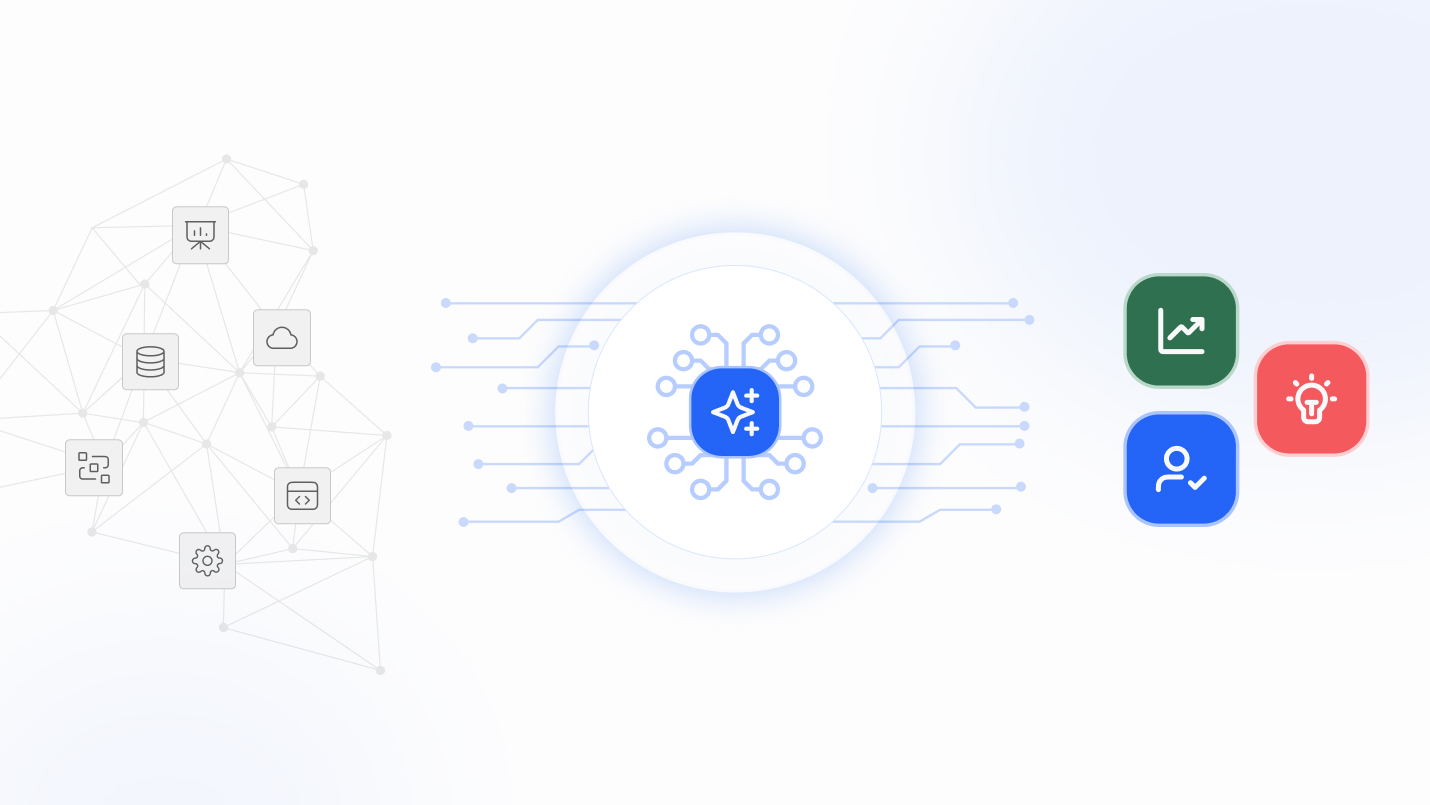
From Disconnected Systems to Connected Intelligence
Many enterprises still operate with siloed systems:
- Marketing performance data in one platform
- Customer profiles in another
- Operational systems disconnected from experience data
- Financial insights separated from real-time demand
Each system may work well individually. Together, they create gaps.
AI does not automatically fix those gaps. It requires orchestration.
The next phase of transformation isn’t about adding more tools.
It’s about connecting what already exists — and ensuring it works together.
Three Ways AI Creates Real Business Impact
When data is aligned and accessible, AI can deliver value in three powerful ways.
1. Better Customer Experiences
AI can personalize recommendations in real time, anticipate needs, and adapt messaging dynamically. Instead of reactive marketing, businesses can deliver proactive engagement.
The result: smoother journeys, higher satisfaction, stronger loyalty.
2. More Efficient Operations
AI can automate repetitive processes, improve forecasting accuracy, optimize supply chains, and reduce manual errors. This reduces operational costs while improving speed and reliability.
Efficiency becomes embedded — not incremental.
3. Smarter Decision-Making
AI supports leadership decisions in pricing, promotions, inventory, and resource allocation. Rather than relying solely on historical data, organizations can make predictive, forward-looking decisions.
AI becomes a collaborator — not just a tool.
Innovation Without Losing Control
A common concern is clear: If AI begins executing decisions, do we lose control?
The answer is no — if governance is built in from the start.
Three principles matter:
- Clear Boundaries: AI systems should operate within defined capabilities and business rules.
- Visibility and Auditability: Every AI-driven action should be trackable and measurable.
- Guardrails: Compliance, brand standards, and operational constraints must remain intact.
When AI operates within structured oversight, it strengthens control rather than weakening it.
A Practical Path to AI Readiness
Becoming AI-ready doesn’t require an overnight complete overhaul.
It requires a disciplined approach.
Step 1: Assess Your Data Landscape
Identify where data is siloed and where integration gaps exist.
Step 2: Standardize and Govern
Create shared data definitions and governance frameworks.
Step 3: Enable System Connectivity
Ensure systems can securely communicate and share information.
Step 4: Prioritize High-Impact Use Cases
Start with areas like personalization, forecasting, or automation that deliver measurable ROI.
Step 5: Measure Outcomes — Not Experiments
Track improvements in efficiency, revenue growth, and customer satisfaction.
AI success is measured by business impact, not the number of pilots launched.
Questions Leaders Must Ask Now
AI transformation is not a technical initiative. It’s a strategic one.
Leadership teams should ask:
- Where can AI create measurable value first?
- Are our systems flexible and connected enough to support it?
- Do we have clear governance and accountability?
- Are we building sustainable capability — or chasing trends?
These questions separate disciplined transformation from scattered experimentation.
The Emerging Divide
The divide in the market is not between companies that use AI and those that don’t. It’s between companies that align their data and strategy — and those that layer AI on top of fragmentation.
Some organizations will deploy tools without integration and see limited returns. Others will connect their data, align teams, and embed AI into core processes — unlocking sustainable competitive advantage.
The difference is alignment.
Conclusion: From Experimentation to Advantage
The companies that succeed in the AI era will not be those with the most AI pilots.
They will be those that:
- Turn disconnected data into a strategic asset
- Align data, strategy, and execution
- Use AI to improve both customer experience and operational efficiency
The shift is not about complexity.
It’s about clarity and connection.
Net Solutions’ Data & AI services are designed to support this transition — helping organizations unify fragmented data ecosystems, implement governed AI capabilities, and unlock scalable growth across both customer experience and operations.
A great place to start — and to understand where your organization stands and which actions to prioritize — is Net Solutions’ AI Readiness Diagnostic, which provides a structured assessment of your current capabilities and the steps required to move forward:
https://www.netsolutions.com/ai-readiness-assessment/
Because the future won’t be defined by how much data you collect.
It will be defined by how intelligently you use it.
Frequently Asked Questions
No. The next phase of transformation isn’t about replacing your existing tools (CRM, eCommerce engines, Cloud infra). It is about orchestration —connecting the systems you already have so they can communicate and share data in real time.
Control is maintained through structured oversight. By setting clear business rules and “guardrails” (compliance and brand standards), and ensuring every AI action is trackable and auditable, leadership strengthens oversight rather than weakening it.
Success should be measured by business outcomes, not the number of pilot programs or “experiments” launched. Key metrics include measurable improvements in operational efficiency, revenue growth, and customer satisfaction scores.